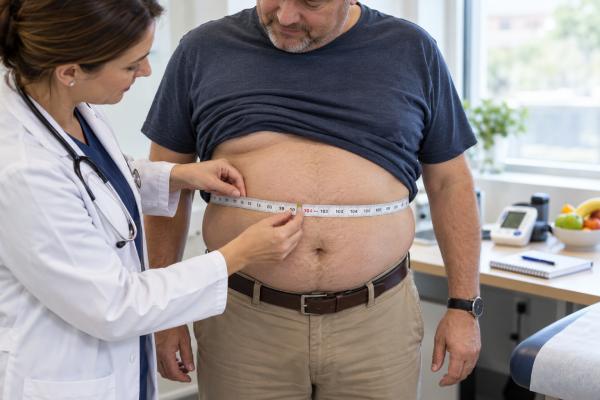
Waist circumference is a simple way to estimate central abdominal fat, and it can reveal cardiovascular risk that body weight or BMI alone may miss. A larger waist is associated with insulin resistance, high blood pressure, abnormal triglycerides, type 2 diabetes, fatty liver disease, and cardiovascular disease. In U.S. clinical practice, waist measurements above about 40 inches (102 cm) in men and 35 inches (88 cm) in women are commonly used as higher-risk thresholds, although risk can rise below those values and lower cutoffs are appropriate for some ethnic groups. Waist-to-height ratio adds another practical check: keeping your waist below half your height is a useful general target for many adults. The measurement is not a diagnosis, and one reading should not be viewed in isolation. The most useful approach is to measure consistently, combine the result with blood pressure and metabolic labs, and focus on sustainable habits that reduce abdominal fat while improving fitness and overall heart health.
Table of Contents
- Why Waist Size Matters for Heart Health
- How to Measure Your Waist Correctly
- What Your Waist Number Means
- Waist vs BMI and Waist-to-Height Ratio
- How to Reduce Waist Circumference
- Mistakes That Make Waist Measurements Misleading
- When to Talk With a Healthcare Professional
Why Waist Size Matters for Heart Health
Waist circumference is useful because abdominal fat is not metabolically identical to fat stored elsewhere. A larger waist often reflects more visceral fat, the fat stored deep inside the abdomen around internal organs. Visceral fat is associated with inflammation, insulin resistance, higher triglycerides, fatty liver, and other changes that increase cardiometabolic risk.
That does not mean every inch of waist size is visceral fat. The measurement includes skin, muscle, subcutaneous fat, abdominal contents, and body structure. It is best viewed as a practical screening marker rather than a direct scan of internal fat.
The cardiovascular connection is strong enough that professional groups recommend considering abdominal obesity alongside BMI. Research has repeatedly found that central obesity predicts cardiovascular events and mortality even after accounting for total body size.
A larger waist tends to travel with several risk factors:
- Higher blood pressure.
- Higher fasting glucose and A1C.
- Higher triglycerides.
- Lower HDL cholesterol.
- Fatty liver disease.
- Sleep apnea.
- Reduced insulin sensitivity.
These findings often cluster as metabolic syndrome. The value of measuring your waist is that it can identify this pattern earlier, including in people whose BMI does not look especially high.
A normal BMI does not guarantee a low-risk waist
BMI is calculated from height and weight. It cannot tell where fat is stored. Two people with the same BMI can have very different amounts of abdominal fat, muscle, and lower-body fat.
This matters because “normal-weight central obesity” is possible. A person can fall in a normal BMI category while carrying a disproportionately large amount of fat around the waist. In that situation, blood pressure, glucose, lipids, and waist measurement may reveal risk that BMI misses.
How to Measure Your Waist Correctly
Consistency matters more than squeezing the tape to get the smallest possible number. Use a flexible, non-stretch tape measure and measure directly over the skin or a thin layer of clothing.
A commonly recommended method is:
- Stand upright with feet about hip-width apart and weight evenly distributed.
- Find the bottom of your lowest ribs and the top of your hip bones.
- Place the tape around the abdomen midway between those landmarks.
- Keep the tape level and parallel with the floor.
- Let the tape rest against the skin without compressing it.
- Breathe out normally and take the measurement at the end of the exhale.
- Record the value to the nearest 0.1 inch or 0.5 cm.
Some U.S. protocols measure at the top of the iliac crest instead. Different methods can produce slightly different results, so use the same method each time if you are tracking change.
When to measure
For personal tracking, measure under similar conditions. Morning before breakfast is convenient because abdominal fullness is relatively consistent, but the exact time is less important than repeatability.
Do not worry about tiny day-to-day shifts. Hydration, constipation, a large meal, bloating, menstrual-cycle changes, and tape placement can move the reading. Measuring every two to four weeks is usually more useful than measuring every day.
If you are comparing a home measurement with one taken in a clinic, ask which anatomical site was used before assuming a difference represents real fat gain or loss.
What Your Waist Number Means
For many U.S. adults, widely used higher-risk waist thresholds are:
| Group | Waist circumference associated with higher cardiometabolic risk |
|---|---|
| Men | More than about 40 in (102 cm) |
| Women | More than about 35 in (88 cm) |
These are screening thresholds, not cliffs. Risk does not suddenly appear at 40 or 35 inches, and a measurement just below the cutoff is not automatically “safe.” Cardiometabolic risk generally rises across a continuum as central adiposity increases.
The cutoffs also do not fit every population equally. People of South Asian, East Asian, and some other ethnic backgrounds may develop diabetes and cardiovascular risk at lower levels of BMI and waist circumference. Clinical guidelines therefore use lower thresholds in some groups.
Age and sex hormones also influence fat distribution. After menopause, for example, fat storage often shifts toward the abdomen. A person may notice an increasing waist despite relatively stable weight.
Look at the trend, not just the cutoff
If your waist increases from 33 to 37 inches over several years, that trend can be meaningful even if you have not crossed a sex-specific threshold. Likewise, reducing waist circumference by several centimeters can be a useful sign of improved body composition even if you remain above a population cutoff.
Pair the measurement with objective health data. Blood pressure, fasting glucose, A1C, triglycerides, HDL, LDL, and sometimes ApoB help show whether central adiposity is affecting cardiovascular risk.
Ethnicity changes how absolute cutoffs are used
A single waist threshold cannot capture risk equally in every population. South Asian, Chinese, Japanese, and some other Asian populations tend to develop type 2 diabetes and cardiometabolic complications at lower BMI and waist values than many White populations. Some international criteria therefore use thresholds around 90 cm for men and 80 cm for women in several Asian groups, although exact recommendations vary by organization and ancestry.
The practical lesson is not to memorize every cutoff. If you belong to a group known to develop metabolic disease at lower body sizes, or you have a strong family history of diabetes or early heart disease, take a rising waist seriously even when it is below the commonly quoted U.S. 40- and 35-inch thresholds. Waist-to-height ratio can help because the same under-0.5 target is easier to apply across sexes and ethnic groups.
Changes in waist can matter even when weight barely moves
Exercise can reduce visceral fat while preserving or increasing lean tissue. In that situation, the scale may move slowly while waist size decreases. This is one reason measuring both weight and waist can provide a better view of progress.
The reverse can also happen. If body weight stays stable but waist circumference steadily rises, fat may be shifting toward the abdomen while muscle mass falls. That pattern becomes more common with aging, inactivity, and hormonal change. It is worth responding with resistance training, adequate protein, aerobic activity, and a review of total calorie intake rather than assuming stable weight means stable risk.
Waist vs BMI and Waist-to-Height Ratio
Waist circumference, BMI, and waist-to-height ratio answer slightly different questions.
BMI estimates body size relative to height. It is useful for population risk classification but cannot distinguish fat from muscle or show fat distribution.
Waist circumference focuses on central body size. It provides information about abdominal fat that BMI misses.
Waist-to-height ratio adjusts waist size for height. It is calculated by dividing waist circumference by height using the same units.
For example, a waist of 36 inches and a height of 72 inches gives a ratio of 0.50.
Current NICE guidance classifies adult waist-to-height ratio roughly as:
- 0.40 to 0.49: healthy central adiposity range.
- 0.50 to 0.59: increased central adiposity and health risk.
- 0.60 or higher: further increased risk.
The easy message is keep your waist to less than half your height. This works across sexes and ethnic groups better than a single absolute waist cutoff, although no anthropometric measurement perfectly predicts individual risk.
Which number should you use?
For most adults with a BMI below 35 kg/m², using both BMI and a measure of central adiposity gives a more complete picture. Waist-to-height ratio is especially useful for people who are very short or tall because it puts waist size in context.
For adults with high muscle mass, BMI can overestimate body fat, so waist measurement can be particularly helpful. At very high BMI levels, waist-to-height ratio may add less information because central adiposity is already likely to be elevated.
If you want to understand what the tape measure is indirectly capturing, read about visceral fat and heart disease risk.
How to Reduce Waist Circumference
You cannot selectively burn fat from the waist. Sit-ups and abdominal exercises strengthen the core but do not force the body to use nearby fat stores. Waist reduction comes from lowering overall and visceral fat while maintaining or building lean tissue.
Create a sustainable energy deficit when fat loss is needed
If you have excess body fat, a moderate calorie deficit can gradually reduce waist size. Extreme diets are unnecessary. The most effective eating plan is one you can maintain while getting enough protein, fiber, vitamins, and minerals.
Build meals around:
- Vegetables and fruit.
- Beans and lentils.
- Whole grains such as oats, barley, and brown rice.
- Fish and other minimally processed protein sources.
- Nuts and seeds.
- Olive oil and other unsaturated fats.
This closely resembles a Mediterranean diet for heart health.
Reduce foods that make calorie control difficult without adding much fullness, such as sugary drinks, frequent alcohol, pastries, candy, chips, and large portions of ultra-processed foods. You do not need to ban them completely; frequency and portion size matter.
Walk and perform other aerobic exercise regularly
Aerobic activity can reduce visceral fat even when weight loss is modest. Aim toward at least 150 minutes per week of moderate-intensity aerobic activity, or an equivalent combination of moderate and vigorous exercise.
Brisk walking is a practical option because it requires little equipment. If you currently do very little activity, begin with 10 to 15 minutes at a comfortable pace and build gradually.
More weekly movement can produce additional benefit. Short walks after meals, taking stairs, cycling for transportation, and structured cardio sessions all contribute.
Add strength training
Strength training helps preserve muscle during weight loss and improves insulin sensitivity and physical function. Two or more sessions per week can complement aerobic exercise.
Use major movement patterns such as squats or sit-to-stands, rows, presses, hip hinges, step-ups, and carries. Start with loads you can control and increase gradually.
Sleep enough and address sleep apnea
Chronic short sleep can increase hunger, worsen glucose regulation, and make consistent training harder. Most adults do best with roughly 7 to 9 hours of sleep opportunity.
Loud snoring, witnessed pauses in breathing, morning headaches, or excessive daytime sleepiness can signal sleep apnea. Untreated sleep apnea is strongly linked with hypertension and cardiometabolic risk.
Limit alcohol when abdominal fat and triglycerides are rising
Alcohol adds calories, can increase appetite, and may raise triglycerides. Some people notice a meaningful waist reduction when they cut back on frequent drinking, especially when alcohol was contributing several hundred calories per day.
Set a realistic rate of change
A smaller waist over several months is more meaningful than a dramatic one-week shift caused by dehydration. Track waist, body weight, activity, and strength together.
If weight falls but strength and energy collapse, the calorie deficit may be too aggressive. If waist shrinks while scale weight changes slowly, you may still be improving body composition.
For people with overweight or obesity and related health problems, even modest weight loss can improve blood pressure, triglycerides, glucose, and liver fat. The amount of waist reduction varies from person to person, so there is no universal number of inches that must disappear before health improves. Instead, look for a downward trend in waist together with better laboratory values, easier movement, and improved fitness.
If lifestyle changes are consistent but abdominal obesity remains severe, that does not mean the effort has failed. Genetics, medications, menopause, sleep disorders, and other medical factors can make weight regulation harder. Evidence-based obesity medications and metabolic surgery can produce substantial reductions in body weight and waist size in appropriate patients and may improve cardiovascular risk factors. Those treatments require medical assessment rather than self-prescribing.
Mistakes That Make Waist Measurements Misleading
Waist measurements are simple, but technique errors can create false trends.
Pulling the tape too tight. The tape should touch the skin without digging in.
Changing the measurement site. Measuring at the narrowest point one week and at the navel the next can shift the result by several centimeters.
Holding your breath or sucking in. Breathe normally and measure at the end of a relaxed exhale.
Measuring after a large meal one time and fasted the next. Abdominal fullness changes the number.
Reacting to tiny changes. A 0.25-inch difference may be measurement noise. Look for a sustained trend.
Using waist size as the only health marker. A smaller waist is helpful, but cardiovascular risk also depends on age, blood pressure, lipids, glucose, smoking, fitness, family history, and medical conditions.
Assuming a waist trainer reduces fat. Compression garments can temporarily change shape while worn, but they do not remove visceral fat or improve cardiovascular risk.
When to Talk With a Healthcare Professional
Consider a medical review if your waist is above a higher-risk threshold, has been rising steadily, or is accompanied by high blood pressure, abnormal glucose, high triglycerides, fatty liver disease, or symptoms of sleep apnea.
A clinician may recommend checking:
- Blood pressure, including home readings.
- A fasting lipid panel and possibly ApoB.
- Fasting glucose and A1C.
- Liver tests when fatty liver is suspected.
- Sleep apnea risk.
- Overall cardiovascular risk based on age, smoking, family history, and other factors.
If excess weight is significantly affecting health, evidence-based treatment can include dietitian support, structured behavioral programs, prescription anti-obesity medication, or bariatric surgery in appropriate candidates. The goal is not cosmetic perfection; it is reducing disease risk and improving function.
Waist circumference works best as a warning signal and progress marker. Measure it consistently, interpret it alongside other risk factors, and focus on habits that improve your whole cardiovascular profile. A few centimeters of sustained reduction can be more meaningful than chasing an arbitrary “ideal” body shape. Recheck under the same conditions every few weeks, and judge success by the overall direction of your health rather than one isolated tape-measure reading or a comparison with somebody else’s body shape.
A smaller waist is most meaningful when it accompanies better blood pressure, glucose control, fitness, sleep, and lipid levels over time.
References
- Identifying and assessing overweight, obesity and central adiposity 2025 (Guideline)
- Waist to height ratio as a simple tool for predicting mortality: a systematic review and meta-analysis 2023 (Systematic Review)
- Associations of obesity indices change with cardiovascular outcomes: a dose-response meta-analysis 2024 (Systematic Review)
- Diagnostic Accuracy of Waist-to-Height Ratio, Waist Circumference, and Body Mass Index in Identifying Metabolic Syndrome and Its Components in Older Adults: A Systematic Review and Meta-Analysis 2024 (Systematic Review)
- The association between the visceral to subcutaneous abdominal fat ratio and the risk of cardiovascular diseases: a systematic review 2024 (Systematic Review)
- Obesity and Cardiovascular Disease: A Scientific Statement From the American Heart Association 2021 (Position Statement)
Disclaimer
This article is for general education and does not provide a diagnosis or personalized weight-management plan. Waist thresholds vary by sex, ethnicity, age, body composition, and clinical context, so interpret your measurement with other cardiovascular risk factors. Seek professional guidance if central weight gain is accompanied by abnormal blood pressure, glucose, lipids, or other health concerns.