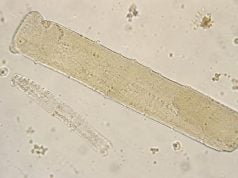
Bacteria seen on urine microscopy can support a urinary tract infection, but the finding does not prove that an infection is present. Bacteria may come from the bladder or kidneys, from normal organisms around the urethra or genital skin during collection, or from growth in a sample that was not processed promptly. The result becomes more meaningful when urinary symptoms, white blood cells, leukocyte esterase, nitrite, and a properly collected urine culture point in the same direction. Culture is especially important when symptoms are severe, infection is recurrent or complicated, pregnancy is involved, or antibiotic resistance is a concern. Colony count also needs context: the traditional threshold of 100,000 colony-forming units per milliliter is not the only count that can represent infection, particularly in symptomatic patients. Interpreting microscopy well means separating bacteriuria from contamination and avoiding treatment of bacteria that are present without evidence of symptomatic infection.
- Bacteria on microscopy do not automatically mean UTI: symptoms, pyuria, specimen quality, and culture results determine significance.
- White blood cells strengthen the case for infection: bacteriuria without inflammation is more likely to represent contamination or asymptomatic bacteriuria.
- Colony counts are context-dependent: symptomatic infection can occur below 100,000 CFU/mL, especially with a well-collected specimen and a typical uropathogen.
- Mixed growth often suggests contamination: multiple organisms, especially with many squamous epithelial cells, commonly trigger repeat collection.
- Culture follow-up matters in higher-risk cases: fever, flank pain, pregnancy, recurrent UTI, urinary obstruction, or treatment failure usually warrants more careful evaluation.
Table of Contents
- What Bacteria on Urine Microscopy Mean
- UTI vs Contamination vs Asymptomatic Bacteriuria
- How Colony Count and Culture Change the Interpretation
- How Other Urinalysis Findings Fit With Bacteria
- Collection and Laboratory Factors That Affect Results
- Follow-Up After Bacteria Are Found
- When Bacteriuria Needs Prompt Medical Care
What Bacteria on Urine Microscopy Mean
Urine microscopy examines formed elements in a urine specimen after collection. Bacteria may appear as small rods or cocci, sometimes moving by Brownian motion. Modern laboratories may detect them with automated particle analyzers, digital imaging, flow cytometry, or manual microscopy. The report may use categories such as few, moderate, or many rather than a precise bacterial count.
That microscopic description is different from a urine culture. Microscopy can show that bacterial-sized particles are present, but it usually cannot identify the organism or determine antibiotic susceptibility. Culture grows organisms from the sample, estimates the amount of growth, identifies likely pathogens, and can guide antibiotic selection when susceptibility testing is performed.
Bacteriuria becomes most persuasive for UTI when the patient also has compatible symptoms. Common lower-tract symptoms include burning with urination, urgency, frequency, and suprapubic discomfort. Fever, chills, flank pain, nausea, or systemic illness raises concern for upper-tract infection such as pyelonephritis. A urinalysis for UTI combines bacterial findings with inflammation markers rather than treating microscopy as a stand-alone diagnosis.
The amount of bacteria reported microscopically is not interchangeable with a culture colony count. “Many bacteria” under the microscope does not mean “more than 100,000 CFU/mL,” and “few bacteria” does not rule out infection. Different methods, urine concentration, and collection quality can make those two measurements diverge.
Microscopy is also less specific than culture for telling organisms apart. Rod-shaped particles may suggest bacilli and round particles may suggest cocci, but shape alone cannot reliably identify a species. Yeast, crystals, debris, and very small particles can occasionally be misclassified, especially by automated systems. When organism identity will change management, culture or another validated microbiologic test is required. This is why a microscope report is best viewed as a rapid clue that can be available before culture, not a replacement for culture in cases where microbiologic confirmation matters.
The timing of symptoms adds another layer. Bacteria detected during classic new-onset dysuria and frequency has a different pretest probability than the same result in a person tested because of fatigue alone. Diagnostic stewardship tries to prevent low-value urine testing in people without urinary symptoms because once bacteria are found, clinicians may feel pressure to treat even when the result represents colonization. Limiting unnecessary testing can therefore prevent unnecessary antibiotics as effectively as interpreting a positive result correctly.
UTI vs Contamination vs Asymptomatic Bacteriuria
The central question is whether bacteria represent infection of the urinary tract, contamination of the specimen, or asymptomatic bacteriuria.
Symptomatic UTI means bacteria are causing an inflammatory infection that fits the patient’s symptoms and testing. Pyuria, usually reflected by white blood cells in the urine or a positive leukocyte esterase test, supports inflammation. A culture growing a plausible uropathogen strengthens the diagnosis, particularly when the specimen was collected correctly.
Contamination occurs when organisms from skin, the vulva, vagina, distal urethra, collection container, or handling enter the sample. Contaminated specimens often contain mixed organisms and may have many squamous epithelial cells. These clues are useful but not absolute. A true polymicrobial infection can occur in selected patients, especially those with catheters, structural urinary abnormalities, or complex healthcare exposure.
A contaminated urine culture commonly leads to repeat collection rather than automatic antibiotic treatment. Repeating the sample is particularly useful when the original result conflicts with symptoms or when culture reports mixed flora without a dominant pathogen.
Asymptomatic bacteriuria means significant bacteria are present in urine without symptoms attributable to UTI. It becomes more common with age, diabetes, urinary catheters, and some urinary tract abnormalities. Most nonpregnant adults do not benefit from antibiotics for asymptomatic bacteriuria, and unnecessary treatment can cause adverse effects and promote resistance. Important exceptions include pregnancy and selected patients before invasive endourologic procedures that are expected to cause mucosal trauma.
These three categories explain why a result that simply says “bacteria present” cannot answer whether antibiotics are needed. The same microscopic appearance can lead to very different management depending on symptoms, collection method, pregnancy status, catheter use, and culture findings.
How Colony Count and Culture Change the Interpretation
Urine culture reports bacterial quantity in colony-forming units per milliliter, or CFU/mL. Historically, at least 100,000 CFU/mL of a single organism in a clean-catch specimen became a familiar benchmark for significant bacteriuria. That threshold is useful in some settings, but it should not be treated as a universal rule.
Symptomatic patients can have genuine infection at lower colony counts, especially when the culture grows a typical urinary pathogen and pyuria is present. Collection method also changes interpretation. A catheterized specimen has less opportunity for distal contamination than a midstream voided sample, so lower growth may be meaningful. Laboratory reporting conventions differ, and some laboratories group low counts into ranges rather than reporting an exact number.
A urine colony count is therefore best interpreted with four questions:
- Was the specimen collected in a way that limits contamination?
- Is there one predominant organism or mixed growth?
- Are there urinary symptoms and evidence of inflammation?
- Does the colony count fit the collection method and clinical setting?
Culture can also identify the organism. Escherichia coli is the most common community uropathogen, but other Enterobacterales, Enterococcus, Staphylococcus saprophyticus, Pseudomonas, and additional organisms can be important in the right context. The species matters because some bacteria are more likely to reflect contamination in certain specimens, while others are recognized urinary pathogens.
When susceptibility testing is reported, clinicians can narrow therapy to an antibiotic that is active against the organism and appropriate for the infection site. This is one reason a urine culture and sensitivity test is important for complicated infection, pyelonephritis, recurrent UTI, treatment failure, and resistant-organism risk.
A culture can also be negative despite urinary symptoms. Prior antibiotics, low bacterial burden, fastidious organisms, poor collection, nonbacterial causes of dysuria, or test limitations can contribute. A negative culture should therefore trigger reassessment rather than an assumption that every symptom is noninfectious.
Likewise, a positive culture is not automatically proof that the urinary tract is the source of a patient’s fever or illness. In hospitalized patients, bacteriuria can coexist with pneumonia, skin infection, medication reactions, or other diagnoses. The more nonspecific the symptoms, the more important it is to avoid anchoring on the urine result. A coherent diagnosis should connect urinary symptoms or systemic signs, pyuria, culture findings, and the absence of a better explanation. Reviewing prior culture organisms and resistance patterns can also improve interpretation when the patient has recurrent or complicated infection.
How Other Urinalysis Findings Fit With Bacteria
Bacteria are more useful when interpreted as part of a urinalysis pattern. White blood cells, leukocyte esterase, nitrite, red blood cells, epithelial cells, and casts each add information.
| Finding | How it affects interpretation |
|---|---|
| White blood cells or pyuria | Supports urinary inflammation but is not specific for bacterial UTI |
| Positive leukocyte esterase | Supports the presence of white blood cells |
| Positive nitrite | Supports nitrate-reducing bacteria but has limited sensitivity |
| Many squamous epithelial cells | Raises concern for a contaminated voided specimen |
| White blood cell casts | Suggest inflammation within the kidney and can occur with pyelonephritis |
| Blood | Can occur with cystitis, stones, tumors, or kidney disease and is not UTI-specific |
Nitrite deserves a common clarification. Some urinary bacteria convert nitrate to nitrite, but not all organisms do, and urine needs enough bladder dwell time for the reaction. Frequent urination, low dietary nitrate, dilute urine, and certain organisms can produce a false-negative nitrite result. A negative urine nitrite test therefore cannot rule out UTI.
Pyuria also has limits. White blood cells can appear with stones, sexually transmitted infections, interstitial nephritis, tuberculosis, and other inflammatory conditions. Conversely, bacteriuria without pyuria is less supportive of symptomatic bacterial UTI, especially in an otherwise stable adult. The most reliable interpretation comes from matching the laboratory pattern to the symptoms and the quality of the sample.
Collection and Laboratory Factors That Affect Results
A clean specimen is essential because bacteria multiply rapidly and contamination is common. For a midstream clean-catch sample, the patient begins urinating, then collects the middle portion into a sterile container without touching the inside of the cup or lid. Instructions differ slightly by sex and laboratory, but the goal is to reduce contact with surrounding skin and genital flora.
The clean-catch urine culture method is not perfect. Even carefully collected samples can be contaminated. If repeated voided cultures remain uninterpretable and an accurate result is clinically important, a catheterized specimen may be considered.
Timing after collection matters. Bacteria can multiply in urine left at room temperature, increasing apparent bacteriuria and potentially changing pH. Cells can also degrade. Laboratories therefore aim for prompt analysis or appropriate refrigeration/preservation according to validated procedures. An old specimen with heavy bacterial growth but little inflammatory evidence may be misleading.
Antibiotics taken before collection can suppress growth and cause a false-negative culture. Whenever practical and medically safe, culture should be obtained before starting antibiotics in patients who need microbiologic confirmation. This is particularly useful in severe or complicated infection, where a later susceptibility result can guide definitive treatment.
Menstruation, vaginal discharge, recent sexual activity, and poor collection technique can add cells and bacteria to a sample. Catheters create another special setting: long-term catheterization commonly leads to bacteriuria and biofilm, so a positive culture alone is not enough to diagnose catheter-associated UTI.
Automated microscopy can efficiently screen large numbers of specimens, but microscopy is still only one stage of the diagnostic pathway. Laboratories may use reflex algorithms in which culture is performed only when urinalysis meets specified criteria. These systems can reduce unnecessary cultures, but clinical exceptions remain important, particularly in high-risk patients.
Follow-Up After Bacteria Are Found
Follow-up depends first on symptoms. A healthy nonpregnant adult with no urinary symptoms and incidental bacteria may need no treatment and sometimes no culture at all. Treating a number rather than a syndrome can expose patients to diarrhea, allergic reactions, drug interactions, and antimicrobial resistance without improving outcomes.
A symptomatic patient may need culture depending on the clinical situation. Culture is commonly recommended when infection is recurrent, complicated, associated with fever or flank pain, occurs in pregnancy, involves a catheter or urinary abnormality, affects a patient with substantial comorbidity, or fails initial therapy. The exact approach differs by age, sex, pregnancy status, and local practice.
When culture confirms infection, treatment can be adjusted to the organism and susceptibility profile. For complicated UTI, current guidance emphasizes narrowing to targeted therapy once culture and susceptibility results are available rather than continuing unnecessarily broad empiric treatment.
Persistent symptoms despite therapy deserve reassessment. Possibilities include resistant bacteria, an obstructing stone, kidney infection, abscess, prostatitis, an incorrect diagnosis, or a noninfectious cause of urinary symptoms. Repeating a culture may be useful when treatment failure is suspected, but routine “test-of-cure” cultures are not required after every uncomplicated UTI once symptoms resolve.
Recurrent episodes deserve a structured approach rather than repeated empiric antibiotics. A recurrent UTI evaluation may look for culture-confirmed patterns, resistance, stone disease, incomplete bladder emptying, anatomic risk factors, or other contributors.
Certain groups need different interpretation. During pregnancy, screening for asymptomatic bacteriuria is recommended because untreated bacteriuria can increase the risk of pyelonephritis and adverse pregnancy outcomes. In people with long-term urinary catheters, bacteriuria becomes very common and treatment is generally reserved for compatible infection rather than culture positivity alone. Older adults also frequently have asymptomatic bacteriuria; nonspecific symptoms such as confusion should prompt a search for multiple possible causes instead of assuming that bacteria in urine proves UTI.
Children are another special case because urine collection method strongly affects reliability. A bagged specimen may be useful for screening in infants but has a high contamination rate for culture, so a more controlled collection method is often needed to confirm UTI. In men with recurrent bacteriuria or persistent symptoms, clinicians may consider prostate involvement, urinary retention, or structural disease. These examples show why a laboratory result cannot be interpreted independently of age, anatomy, and how the specimen was obtained.
One additional reason to culture selectively is that asymptomatic bacteriuria is not treated in most nonpregnant adults. Bacteria may be present without causing a symptomatic infection, and unnecessary antibiotics can produce adverse effects and resistance. Pregnancy and certain invasive urologic procedures are important exceptions, so symptoms, pregnancy status, and planned procedures must be part of the interpretation rather than assuming that any bacterial finding requires antibiotics.
When Bacteriuria Needs Prompt Medical Care
Seek prompt medical assessment when urinary symptoms occur with fever, chills, flank or back pain, vomiting, confusion, marked weakness, low blood pressure, or rapidly worsening illness. These features can indicate pyelonephritis or sepsis. Pregnancy, significant immune suppression, a single functioning kidney, urinary obstruction, recent urinary surgery, or advanced kidney disease also lowers the threshold for timely evaluation.
Visible blood in the urine, inability to urinate, severe colicky pain, or symptoms that worsen despite antibiotics also warrant medical review because infection may not be the only problem. An obstructing stone with infection can be particularly dangerous and may require urgent drainage in addition to antibiotics.
For stable patients with mild lower-urinary symptoms, the important step is accurate diagnosis rather than reacting to the word “bacteria” on a report. A well-collected sample, assessment of pyuria and symptoms, and culture when indicated can separate a treatable UTI from contamination or asymptomatic bacteriuria and reduce unnecessary antibiotic use.
References
- The EFLM European Urinalysis Guideline 2023 2024 (Guideline)
- Diagnostic value of different urine tests for urinary tract infection: a systematic review and meta-analysis 2022 (Systematic Review)
- Diagnostic Stewardship for Urine Cultures 2024 (Review)
- IDSA 2025 Guideline Update on Complicated Urinary Tract Infections 2025 (Guideline)
- Polymicrobial urine cultures: reconciling contamination with the urobiome while recognizing the pathogens 2025 (Review)
Disclaimer
Bacteria on urine microscopy cannot by itself diagnose a UTI or determine whether antibiotics are needed. Anyone with severe urinary symptoms, fever, flank pain, pregnancy, recurrent infection, or worsening illness should seek clinical evaluation and follow instructions for culture and treatment based on their individual risk.