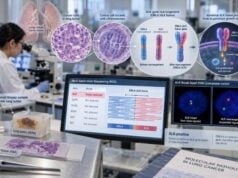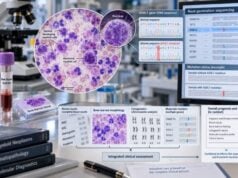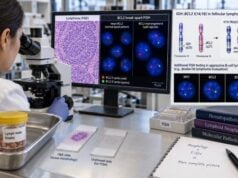
A BRAF mutation test checks a tumor for changes in the BRAF gene, most importantly the activating BRAF V600E variant. BRAF encodes a protein kinase in the RAS-RAF-MEK-ERK signaling pathway, which helps control cell growth. The V600E mutation keeps this pathway abnormally active and can act as a major cancer driver. BRAF mutations occur across many tumor types, but the meaning of a positive result is strongly cancer-specific. In melanoma, BRAF V600 status can identify patients eligible for combined BRAF and MEK inhibition. In colorectal cancer, V600E carries prognostic and treatment implications and can also help interpret mismatch-repair testing. In thyroid cancer, it is common in papillary thyroid carcinoma and can be targetable in advanced BRAF V600E-positive disease. In non-small cell lung cancer, V600E is an established actionable driver. Therefore, the test result should always be interpreted with the tumor type, stage, other biomarkers, assay method, and current treatment guidelines.
- BRAF V600E is an activating mutation that causes persistent MAPK pathway signaling and can drive tumor growth.
- The same BRAF V600E result has different prognostic and treatment meaning in melanoma, colorectal, thyroid, and lung cancers.
- Testing may use PCR, next-generation sequencing, mutation-specific immunohistochemistry, or circulating tumor DNA, depending on the cancer and clinical question.
- A negative result means the tested assay did not detect a qualifying BRAF alteration; it does not rule out cancer or all possible driver mutations.
- BRAF-targeted treatment usually uses pathway combinations rather than a BRAF inhibitor alone, and the preferred combination depends on tumor type.
Table of Contents
- What BRAF V600E Means
- How BRAF Mutation Testing Is Done
- BRAF V600E in Melanoma
- BRAF V600E in Colorectal Cancer
- BRAF V600E in Thyroid Cancer
- BRAF V600E in Lung Cancer
- How to Interpret Positive, Negative, and Other BRAF Results
What BRAF V600E Means
BRAF V600E is a single amino-acid substitution that changes valine to glutamic acid at position 600 of the BRAF protein and activates the MAPK growth pathway without normal upstream control. It is written as p.V600E at the protein level and commonly as c.1799T>A at the DNA level.
BRAF sits downstream of RAS and upstream of MEK and ERK. Normally, this signaling cascade turns on and off in response to growth signals. V600E changes the BRAF kinase into a strongly active form, allowing sustained pathway signaling and promoting cell proliferation and survival.
V600E is not the only BRAF alteration. Tumors can have V600K, V600D, V600R, K601E, non-V600 activating mutations, kinase-impaired mutations, insertions, deletions, amplifications, or BRAF fusions. These abnormalities can belong to different biological classes and do not all respond to the same drugs.
This distinction matters when reading a report. “BRAF positive” is incomplete unless the exact variant is stated. Most regulatory approvals and treatment evidence refer to a specific mutation class, often BRAF V600E or broader BRAF V600 disease.
BRAF mutations detected in cancer tissue are usually somatic, meaning they arose in the tumor and were not inherited. A typical tumor BRAF V600E finding does not by itself indicate a hereditary cancer syndrome. Rare germline BRAF variants can occur in developmental RAS/MAPK syndromes, but that is a different clinical setting from routine tumor biomarker testing.
Across solid tumors, BRAF mutations occur in roughly 7% of cancers overall, although frequency varies widely. They are especially common in melanoma and papillary thyroid carcinoma and occur in smaller subsets of colorectal and lung cancers. The biological context of the organ matters as much as the mutation itself.
How BRAF Mutation Testing Is Done
BRAF testing can be performed with targeted PCR, next-generation sequencing (NGS), mutation-specific immunohistochemistry, or liquid biopsy, with method selection based on speed, tissue availability, and how broadly the tumor needs to be profiled.
Targeted PCR assays are fast and sensitive for predefined hotspots such as V600E. They are useful when the clinical question is narrow, but they may miss uncommon non-V600 variants outside the assay design.
NGS evaluates BRAF together with many other cancer genes. This is especially useful when a tumor can have several actionable drivers, as in lung cancer or advanced solid tumors. A solid-tumor NGS panel can identify the exact BRAF variant and other alterations that influence classification or therapy.
Mutation-specific immunohistochemistry with the VE1 antibody can detect BRAF V600E protein in selected tumor types. It is rapid and preserves tissue architecture, but performance depends on tumor type, staining quality, and laboratory validation. Molecular confirmation may be needed for equivocal staining or when treatment depends on a precise genotype.
Circulating tumor DNA from plasma can also detect BRAF mutations in advanced cancers. Liquid biopsy is useful when tissue is difficult to obtain or when rapid profiling is needed. However, a negative plasma result can occur when the tumor sheds little DNA. In settings such as metastatic lung cancer, a negative plasma BRAF result may need follow-up tissue testing.
The pathology report should identify the sample, method, exact variant, allele fraction when relevant, and whether the test met quality standards. Low tumor content, DNA damage, decalcification, or assay coverage limitations can produce false-negative or indeterminate results.
BRAF V600E in Melanoma
BRAF mutation testing is a core predictive biomarker in advanced melanoma because BRAF V600-positive tumors can be treated with combined BRAF and MEK inhibitors. Approximately 40%–50% of cutaneous melanomas harbor a BRAF mutation, and most of those involve codon 600. V600E is the dominant variant, with V600K and other V600 substitutions less common.
BRAF status is especially important in unresectable stage III or metastatic melanoma and can also influence adjuvant treatment decisions after resection of high-risk BRAF-mutant disease. Common BRAF/MEK combinations include dabrafenib plus trametinib, encorafenib plus binimetinib, and vemurafenib plus cobimetinib in indications where they are approved and appropriate.
Using a BRAF inhibitor alone is generally avoided when a validated BRAF/MEK combination is available because combined pathway blockade improves disease control and reduces some resistance mechanisms and paradoxical MAPK effects.
BRAF positivity does not automatically mean targeted therapy should be given first. Immune checkpoint therapy is also highly effective in advanced melanoma, and sequencing depends on disease tempo, symptoms, tumor burden, brain metastases, prior adjuvant therapy, comorbidities, and patient goals. Current melanoma guidance often favors immunotherapy first for many clinically stable patients, while BRAF/MEK inhibition remains important when a rapid response is needed or after immunotherapy resistance.
The BRAF result is not a melanoma diagnostic marker by itself. Melanoma diagnosis still depends on pathology and melanocytic markers. A BRAF-mutant result supports a molecular subtype and therapeutic option rather than proving that a lesion is melanoma.
Non-V600 BRAF mutations require separate interpretation. Some signal as class 2 or class 3 alterations and may have different sensitivity to RAF, MEK, or emerging pathway inhibitors. The treatment evidence for classic V600-directed combinations should not be automatically applied to every BRAF variant.
BRAF V600E in Colorectal Cancer
In colorectal cancer, BRAF V600E defines a distinct molecular subgroup with important prognostic, therapeutic, and hereditary-cancer-screening implications. The mutation occurs in roughly 8%–10% of colorectal cancers, with variation by stage and population. It is associated with right-sided primary tumors, older age, certain histologic patterns, and historically poorer outcomes in metastatic disease.
A BRAF V600E test for colon cancer is often interpreted alongside RAS, microsatellite instability (MSI), mismatch-repair (MMR), and other biomarkers. A broader colorectal cancer biomarker panel helps determine both targeted-therapy eligibility and immune-therapy context.
BRAF V600E colorectal cancer behaves differently from BRAF-mutant melanoma. Blocking BRAF alone has limited activity because colorectal tumor cells can reactivate MAPK signaling through EGFR. Effective targeted treatment therefore combines BRAF inhibition with EGFR blockade, with chemotherapy now integrated into first-line treatment in appropriate metastatic disease.
In the United States, encorafenib plus cetuximab and fluorouracil-based chemotherapy received traditional FDA approval in February 2026 for adults with metastatic BRAF V600E-positive colorectal cancer. The BREAKWATER program showed a substantial improvement in response rate and later confirmed clinical benefit compared with standard chemotherapy approaches. Treatment selection still depends on performance status, prior therapy, MSI status, disease burden, and other factors.
BRAF V600E also has a role in Lynch syndrome workup. When a colorectal tumor shows loss of MLH1 and PMS2 or is MSI-high because of MLH1 loss, finding BRAF V600E strongly favors a sporadic pathway involving somatic MLH1 promoter methylation rather than classic Lynch syndrome. However, it is not an absolute exclusion test. Rare hereditary or constitutional scenarios exist, so young age, striking family history, and other findings can still justify genetics evaluation.
The related MSI test for colon cancer answers a different question and should not be replaced by BRAF testing.
BRAF V600E in Thyroid Cancer
BRAF V600E is the most common oncogenic driver in papillary thyroid carcinoma and is also a major therapeutic biomarker in BRAF V600E-positive anaplastic thyroid cancer. In papillary thyroid carcinoma, prevalence is commonly around 40%–50% overall, although it varies by histologic subtype and population.
The mutation supports a BRAF-like MAPK molecular profile and can be associated with features such as extrathyroidal extension, lymph-node metastasis, reduced expression of iodine-handling genes, and recurrence. However, its independent prognostic value is not absolute. Tumor size, age, stage, histologic subtype, TERT promoter status, extent of invasion, nodal disease, and treatment response can matter more than BRAF alone.
For this reason, a positive BRAF V600E result should not automatically trigger more extensive thyroid surgery in every low-risk papillary thyroid carcinoma. Molecular information can refine risk in selected cases, but surgical decisions still depend on ultrasound, cytology, tumor extent, patient preference, and established risk-stratification systems.
BRAF testing can also help characterize indeterminate thyroid nodules when included in a broader molecular classifier. A highly specific oncogenic mutation may increase the probability of malignancy, but the performance of a panel depends on the pretest risk and the other genes it measures.
In advanced thyroid cancer, the mutation can directly affect treatment. Dabrafenib plus trametinib has established activity in BRAF V600E-positive anaplastic thyroid carcinoma and can produce dramatic responses in some patients. BRAF/MEK inhibition may also be used in selected advanced differentiated thyroid cancers, including strategies intended to restore radioiodine uptake in refractory disease, although indications depend on the exact clinical setting and current approvals.
A BRAF V600E finding therefore ranges from a common molecular feature in otherwise indolent papillary cancer to a critical treatment target in aggressive anaplastic disease. The pathology label and stage determine which meaning applies.
BRAF V600E in Lung Cancer
BRAF V600E is an actionable driver in a small subset of non-small cell lung cancers, so comprehensive molecular testing is recommended in appropriate patients with advanced nonsquamous NSCLC. BRAF mutations occur in roughly 2%–4% of NSCLC, and V600E accounts for a substantial fraction of them.
BRAF testing is typically part of a lung cancer biomarker panel that also evaluates EGFR, ALK, ROS1, MET, RET, NTRK, KRAS, HER2, and other targets as appropriate. Broad NGS is efficient because these drivers are relatively uncommon and often require different treatments.
For metastatic NSCLC with BRAF V600E, combined BRAF/MEK inhibition is an established treatment strategy. Dabrafenib plus trametinib has long-standing activity, and the FDA approved encorafenib plus binimetinib in October 2023 for adults with metastatic BRAF V600E-positive NSCLC.
The companion diagnostic evidence for encorafenib/binimetinib includes both tissue and plasma assays. If plasma is positive for BRAF V600E, the result can be actionable in the appropriate clinical setting. If plasma is negative, tissue should be tested when feasible because a negative liquid biopsy can reflect low circulating tumor DNA rather than true absence of the mutation.
As with other oncogene-driven lung cancers, treatment planning also considers PD-L1, disease distribution, brain metastases, prior therapy, and the full genomic profile. A BRAF V600E result is clinically meaningful even if PD-L1 is high because targeted and immune approaches have different evidence and toxicity profiles.
Treatment resistance is another reason the exact context matters. BRAF-driven cancers can reactivate MAPK signaling through upstream receptors, RAS changes, MEK alterations, BRAF amplification, splice variants, or parallel growth pathways. The dominant mechanism differs by tumor type and by therapy. A cancer that progresses after one BRAF-directed regimen should therefore be reassessed using disease-specific guidance rather than assuming that the original mutation disappeared or that every BRAF/MEK combination will work equally well.
When tissue is scarce, the order of tests matters. A broad NGS panel can preserve material by evaluating BRAF and other drivers at once, whereas repeated single-gene assays may exhaust a small biopsy. In cancers with several mutually exclusive actionable alterations, such as advanced lung adenocarcinoma, comprehensive profiling is often more informative than sequential hotspot testing.
How to Interpret Positive, Negative, and Other BRAF Results
The correct interpretation begins with the exact variant and tumor type, not simply whether the report says “BRAF detected.”
| Result | General interpretation | Next question |
|---|---|---|
| BRAF V600E detected | Strong activating MAPK driver identified | What does V600E mean in this specific cancer and stage? |
| Other BRAF V600 variant | Activating codon-600 alteration, with therapy evidence varying by variant and tumor | Is the specific variant covered by the intended therapy indication? |
| Non-V600 BRAF alteration | Biology may differ from V600E | What functional class and treatment evidence apply? |
| BRAF not detected | No qualifying alteration found by that assay | Was testing broad enough and was the specimen adequate? |
| Indeterminate / insufficient | The test could not reliably determine status | Can another specimen or method be used? |
The variant allele fraction, if reported, is the proportion of sequencing reads carrying the alteration. It is influenced by tumor purity, copy number, clonality, and sample quality. A 30% allele fraction does not mean the cancer is “30% BRAF-positive” and does not by itself measure response.
A negative hotspot assay can still miss uncommon BRAF mutations or fusions. If the cancer type has multiple actionable drivers, broad NGS may be more informative than repeating a narrow V600E-only assay.
A positive tumor result also should not automatically lead to germline testing. BRAF V600E is overwhelmingly a somatic cancer-driver event. The more important next step is to determine whether the finding changes diagnosis, prognosis, targeted therapy, or—specifically in MLH1-deficient colorectal cancer—the probability of Lynch syndrome.
The central lesson is that BRAF is a context-dependent biomarker. V600E is the same molecular substitution in every organ, but melanoma, colorectal cancer, thyroid cancer, and lung cancer respond differently because their signaling networks and treatment evidence differ. The most useful report is therefore one that names the exact alteration and is interpreted within the correct tumor-specific guideline.
The timing of testing should match the point when a result can change care. In newly diagnosed advanced disease, early testing can prevent starting a less appropriate therapy before the driver status is known. At recurrence, retesting may be useful when the original assay was narrow, tissue was limited, or acquired resistance is suspected. The goal is not to repeat BRAF testing automatically, but to make sure the molecular information is current and broad enough for the treatment decision at hand.
References
- Mutations in the Serine/Threonine Kinase BRAF: Oncogenic Drivers in Solid Tumors 2024 (Review)
- BRAF V600E-mutant metastatic NSCLC: disease overview and treatment landscape 2024 (Review)
- Braf-Mutant Melanomas: Biology and Therapy 2024 (Review)
- Encorafenib, cetuximab and chemotherapy in BRAF-mutant colorectal cancer: a randomized phase 3 trial 2025 (RCT)
- BRAF V600E in thyroid cancer: navigating prognostic uncertainty and therapeutic opportunity 2025 (Review)
- FDA grants traditional approval to encorafenib for metastatic colorectal cancer with a BRAF V600E mutation 2026 (Official Page)
Disclaimer
This article is for general educational information and does not replace personalized oncology, pathology, or genetic counseling. BRAF treatment indications and biomarker algorithms are tumor-specific and can change as new evidence and regulatory approvals emerge, so an individual result should be reviewed with the treating cancer team.