CYFRA 21-1 is a blood tumor marker that measures soluble fragments of cytokeratin 19, a structural protein found in many epithelial cells. It is used most often as an adjunct marker in non-small cell lung cancer (NSCLC), particularly squamous-cell carcinoma, where higher levels can be associated with greater disease burden and a less favorable prognosis. CYFRA 21-1 is not specific enough to diagnose lung cancer or to screen healthy people. Kidney impairment, benign lung disease, inflammation, and other epithelial injuries can raise the marker, and different laboratory assays can produce substantially different results. That means the laboratory’s own reference limit matters more than an internet cutoff. In a patient with known lung cancer whose CYFRA 21-1 is elevated before treatment, serial measurements may help track response: a sustained decline can support treatment effectiveness, while a confirmed rise may prompt further evaluation. Imaging, pathology, molecular testing, symptoms, and clinical examination remain more important than the marker alone.
- Many assays use an upper reference limit near 3–3.5 ng/mL, but CYFRA 21-1 cutoffs vary by laboratory and method.
- High CYFRA 21-1 is associated most strongly with NSCLC, especially squamous-cell disease, but it is not cancer-specific.
- Kidney dysfunction and benign pulmonary inflammation can cause false elevations and should be reviewed before interpreting a high result.
- Serial CYFRA 21-1 is more useful than a single value when the marker was elevated before cancer treatment.
- CYFRA 21-1 should not replace CT scans, biopsy, or molecular testing and is not an established population lung-cancer screening test.
Table of Contents
- What CYFRA 21-1 Measures
- CYFRA 21-1 Normal Range and High Levels
- CYFRA 21-1 in Lung Cancer
- Non-Cancer Causes of High CYFRA 21-1
- Treatment Monitoring and Prognosis
- Testing, Assay Differences, and Result Trends
- Why CYFRA 21-1 Is Better for Monitoring Than Screening
- Limitations and What to Do With an Abnormal Result
What CYFRA 21-1 Measures
CYFRA 21-1 is not a whole protein made only by tumors. It is a circulating fragment of cytokeratin 19 (CK19), an intermediate-filament protein that helps epithelial cells maintain their structure. When epithelial cells turn over, become injured, or die, fragments of CK19 can enter the bloodstream. Malignant epithelial tumors may release larger amounts because of high cell turnover and tissue destruction.
Laboratories detect CYFRA 21-1 with antibodies directed against specific CK19 fragments. The result is usually reported in nanograms per milliliter (ng/mL). Because commercial assays use different antibody combinations, calibrations, and analytical platforms, their numerical results are not always interchangeable.
That assay dependence is unusually important for CYFRA 21-1. Recent comparative research has shown large differences between methods even when the same patient samples are tested. For serial cancer monitoring, using the same laboratory and method whenever possible makes the trend more trustworthy.
CYFRA 21-1 is best understood as a cell-turnover marker with oncologic applications. It can rise when a lung cancer is shedding CK19 fragments, but it can also rise when non-cancer epithelial tissue is injured. The marker therefore adds information but cannot establish why the tissue damage is occurring.
In lung cancer, CYFRA 21-1 is often considered alongside other serum markers. Neuron-specific enolase and ProGRP are more closely associated with small-cell neuroendocrine disease, while CYFRA 21-1 is more strongly linked to NSCLC, particularly squamous histology.
CYFRA 21-1 Normal Range and High Levels
A commonly quoted decision limit for CYFRA 21-1 is around 3.3 ng/mL, but there is no universal normal range. Some laboratories use values near 3.0, 3.3, or 3.5 ng/mL; others establish method-specific limits. The reference interval printed on the report is the correct starting point.
A single mildly high result should not be read as “lung cancer positive.” The probability that an elevation reflects malignancy depends on the patient’s symptoms, smoking history, imaging findings, kidney function, inflammatory disease, and whether a cancer is already known.
| Pattern | Possible meaning | What usually matters next |
|---|---|---|
| Within the assay reference range | Does not exclude lung cancer | Imaging and pathology remain decisive |
| Mild elevation | May reflect renal impairment, inflammation, benign lung disease, or cancer | Review confounders and clinical context |
| Marked elevation | More concerning in a patient with known or suspected epithelial cancer | Correlate with stage, imaging, and tissue diagnosis |
| Falling during treatment | May support treatment response | Confirm with imaging and clinical improvement |
| Persistent serial rise | May indicate progression or recurrence | Exclude assay/renal changes and consider restaging |
CYFRA 21-1 is not a staging test. Higher levels are more common in advanced NSCLC and often correlate with tumor burden, but no serum concentration can assign a TNM stage or prove metastasis. Stage comes from imaging, pathology, and anatomic assessment.
The number also does not determine histology. Squamous-cell NSCLC tends to produce higher CYFRA 21-1 more often than adenocarcinoma, but either subtype can have an elevated or normal result. Tissue pathology remains necessary for classification.
CYFRA 21-1 in Lung Cancer
CYFRA 21-1 has been studied most extensively in non-small cell lung cancer, which includes adenocarcinoma, squamous-cell carcinoma, and other less common histologies. Its strongest traditional association is with squamous-cell carcinoma because those tumors often express and release CK19 fragments.
Not a stand-alone diagnostic test
A high CYFRA 21-1 can increase suspicion when a patient already has a lung mass or other concerning findings, but it cannot confirm lung cancer. Diagnosis requires tissue or cytologic evidence in most cases. A normal result cannot rule cancer out because sensitivity is incomplete, especially in earlier-stage disease.
Current lung-cancer diagnosis also goes far beyond serum proteins. Once NSCLC is confirmed, molecular profiling can identify driver alterations such as EGFR, ALK, ROS1, BRAF, MET, RET, KRAS, and NTRK, while PD-L1 helps guide immunotherapy decisions. A lung cancer biomarker panel answers treatment-selection questions that CYFRA 21-1 cannot.
Prognostic information
Across many studies, a higher pretreatment CYFRA 21-1 is associated with worse progression-free or overall survival in NSCLC. The relationship has been observed in patients receiving chemotherapy, targeted therapy, and immunotherapy.
This is a group-level association. It does not mean a particular CYFRA 21-1 number can predict how long an individual patient will live. Stage, molecular subtype, performance status, metastatic sites, treatment options, and treatment response carry major prognostic weight.
Small-cell lung cancer
CYFRA 21-1 can sometimes be elevated in small-cell lung cancer, but it is not the preferred serum marker for that histology. ProGRP and NSE have a stronger neuroendocrine association. Marker patterns can occasionally support a clinical impression, but pathology—not a blood panel—determines whether a tumor is small-cell or non-small-cell.
Non-Cancer Causes of High CYFRA 21-1
False-positive CYFRA 21-1 results occur because CK19 is present in normal epithelial tissues. Injury and inflammation can release fragments without malignancy.
Important non-cancer causes include:
- Kidney impairment. Reduced renal clearance is one of the most important confounders and can produce persistent elevation.
- Benign pulmonary disease. Pneumonia, chronic obstructive pulmonary disease, interstitial lung disease, and other inflammatory or destructive lung conditions may raise the marker.
- Systemic inflammation or epithelial injury. Severe inflammatory states can increase circulating CK19 fragments.
- Liver disease and other organ dysfunction. These conditions may alter marker metabolism or reflect tissue injury.
- Recent major illness. Acute tissue damage can make a one-time result difficult to interpret.
Kidney function deserves special attention because it can change over the course of cancer therapy. Dehydration, chemotherapy, contrast exposure, urinary obstruction, or chronic kidney disease may raise creatinine and alter CYFRA 21-1 at the same time. A rising tumor marker accompanied by worsening kidney function does not necessarily mean the tumor has progressed.
Benign lung disease creates another challenge in people with heavy smoking histories. COPD or infection may coexist with a suspicious pulmonary nodule. In that setting, CYFRA 21-1 cannot reliably distinguish inflammation from cancer. CT imaging and, when needed, biopsy provide far stronger diagnostic evidence.
Other epithelial cancers—including bladder, head and neck, cervical, and some gastrointestinal malignancies—may also elevate CYFRA 21-1. Therefore, an unexplained high result does not identify the lung as the source.
Treatment Monitoring and Prognosis
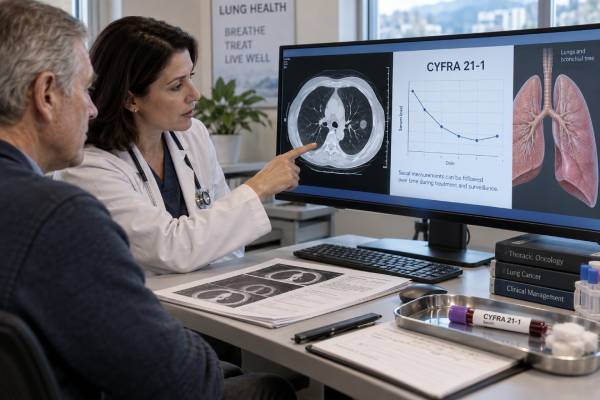
Longitudinal monitoring is one of the most consistent clinical uses proposed for CYFRA 21-1. The marker is most helpful when it is clearly elevated before treatment and then measured under similar conditions over time in follow-up.
A patient with advanced NSCLC might begin therapy with CYFRA 21-1 at 14 ng/mL and then fall to 7, 4, and 2.8 ng/mL as imaging shows tumor shrinkage. That coordinated decline strengthens the interpretation that treatment is working.
The reverse pattern can also be informative. If a previously low post-treatment value rises steadily over several measurements, clinicians may consider earlier imaging or closer assessment for progression. The important word is steadily: a single increase can result from biological variation, assay change, inflammation, or renal dysfunction.
Recent prospective work has found that CYFRA 21-1 measured around the time of initial radiologic staging during chemotherapy can correlate with treatment response and survival. Other reviews have consistently identified high pretreatment levels and insufficient declines as unfavorable prognostic features.
However, serum markers should not override direct evidence. A patient whose CT scan clearly shows response should not have effective treatment stopped because of one discrepant CYFRA value without investigation. Likewise, a normal marker does not make progressive disease on imaging disappear.
In lung cancer, CEA monitoring may be more informative in some adenocarcinomas, while SCC antigen can be another squamous-associated serum marker. The best marker is the one that reliably tracks the individual patient’s known disease.
Testing, Assay Differences, and Result Trends
CYFRA 21-1 requires a routine blood draw. Fasting is usually not necessary unless other tests ordered at the same time require it. The key preparation is not dietary—it is analytical consistency.
Whenever possible, serial samples should be run on the same platform. Recent studies demonstrate that CYFRA 21-1 assays can disagree substantially because they may recognize different CK19 fragments or use different calibrations. A patient switching hospitals may therefore show an apparent jump or fall that is partly methodological.
Before interpreting a change, clinicians may review:
- The laboratory and assay used for each result
- Kidney function at each time point
- Recent infection or inflammatory lung disease
- Timing relative to chemotherapy, radiation, surgery, or immunotherapy
- Imaging findings and symptoms
- Other serum markers, if they were useful at baseline
Small fluctuations near the reference limit are less meaningful than a persistent multi-sample trend. Percent change can be helpful, but there is no universally accepted percentage that automatically defines response or progression in every lung-cancer setting.
A practical principle is to compare “like with like”: same assay, similar clinical timing, stable organ function, and repeated values. That reduces the chance that a technical difference will be mistaken for a biological one.
Timing around treatment can also matter. Cell death from effective therapy may transiently release intracellular material, while hydration and kidney function may change during chemotherapy. For that reason, an unexpected early marker movement is usually interpreted cautiously and compared with the next planned sample rather than treated as an immediate verdict on response. This is especially important when scans and symptoms are otherwise clinically stable or clearly improving over time.
Why CYFRA 21-1 Is Better for Monitoring Than Screening
A biomarker can be useful after a cancer diagnosis even when it performs poorly as a screening test. CYFRA 21-1 is a good example. In a patient with known NSCLC and a clearly elevated baseline, the clinician already knows the disease being tracked. The question is whether the marker moves in the same direction as tumor burden. That is a much narrower task than asking whether an apparently healthy person has lung cancer.
Screening requires very high performance because most people being tested do not have the disease. Even a modest false-positive rate can lead to large numbers of unnecessary CT scans, procedures, biopsies, and anxiety. CYFRA 21-1 rises in benign lung and kidney conditions, while some early lung cancers do not raise it at all. Those two problems—false positives and false negatives—make it unsuitable as a population screening test.
Diagnosis has a similar limitation. Imagine a smoker with pneumonia, chronic kidney disease, and a lung nodule. A high CYFRA 21-1 cannot tell whether the marker comes from infection, reduced clearance, or a malignancy. The answer comes from the radiologic appearance of the nodule and, when necessary, tissue sampling.
Monitoring is different because the patient serves as their own reference. If CYFRA 21-1 was 18 ng/mL when metastatic NSCLC was active, then fell to 3 ng/mL with radiologic response, a later confirmed rise to 8 and 14 ng/mL may be meaningful even before symptoms change. The absolute cutoff matters less than the reproducible personal trajectory.
This distinction also explains why combining several serum tumor markers does not automatically create a reliable screening panel. Adding CEA, SCC antigen, NSE, or ProGRP can increase the number of abnormal results, but it can also increase false positives. Modern lung-cancer care prioritizes low-dose CT for evidence-based screening, tissue for diagnosis, molecular testing for treatment selection, and serum markers only where they add validated complementary information.
Limitations and What to Do With an Abnormal Result
CYFRA 21-1 has three major limitations: incomplete sensitivity, incomplete specificity, and poor harmonization across assays. Those limitations prevent it from serving as a stand-alone screening or diagnostic test.
For lung-cancer screening, low-dose CT—not serum CYFRA 21-1—is the evidence-based method used in appropriately selected high-risk adults. A normal CYFRA result should never reassure a person with concerning symptoms or a suspicious CT finding that lung cancer is excluded.
If you do not have a cancer diagnosis and the result is high, the next step is to understand why the test was ordered. A clinician may review kidney function, respiratory illness, smoking-related lung disease, and imaging. Mild isolated elevation may justify repeat testing after a reversible problem resolves rather than immediate invasive testing.
If you have known NSCLC, a rising result should be discussed with the oncology team. They may repeat the test, check renal function, review symptoms, or advance planned imaging. The meaning depends on whether CYFRA 21-1 previously tracked the cancer well.
Seek prompt medical evaluation for coughing up blood, new severe shortness of breath, chest pain, rapidly worsening weakness, neurologic symptoms, or other significant changes. These symptoms require clinical assessment regardless of the tumor-marker result.
The most useful way to interpret CYFRA 21-1 is as a supporting trend marker. It can strengthen evidence of response, progression, or higher-risk disease when the rest of the clinical picture agrees, but it should never substitute for the tests that directly show what the cancer is and where it is.
References
- CYFRA 21-1 as a circulating biomarker in non-small cell lung cancer 2026 (Review)
- A deeper evaluation of cytokeratin fragment 21-1 as a lung cancer tumor marker and comparison of different assays 2025
- Biomarkers Suitable for Early Detection of Intrathoracic Cancers in Primary Care: A Systematic Review 2024 (Systematic Review)
- Relevance of tumor markers for prognosis and predicting therapy response in non-small cell lung cancer patients: A CEPAC-TDM biomarker substudy 2024 (Clinical Trial)
- Prognostic value of blood-based protein biomarkers in non-small cell lung cancer: A critical review and 2008-2022 update 2023 (Review)
Disclaimer
This article is for general education and does not diagnose lung cancer or interpret an individual CYFRA 21-1 result. Assays and reference limits vary, and kidney function, lung inflammation, and other conditions can alter the marker. Discuss abnormal or changing results with the clinician managing your evaluation or cancer treatment.