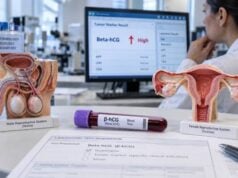
The HE4 blood test measures human epididymis protein 4, a protein that can be elevated in many epithelial ovarian cancers. Doctors may use HE4 as part of the evaluation of an ovarian or adnexal mass, often together with CA-125 and menopausal status in the ROMA score, or as a serial marker in some people already diagnosed with epithelial ovarian cancer. A high HE4 level does not diagnose ovarian cancer. Kidney dysfunction is one of the most important non-cancer causes of elevation, and age, smoking, assay method, and other medical conditions can also affect the result. HE4 is not elevated in every ovarian cancer subtype, so a normal value cannot rule cancer out. The most useful interpretation combines the actual HE4 value and trend with the laboratory’s reference range, kidney function, menopause status, ultrasound or other imaging, symptoms, CA-125, and the clinical reason the test was ordered.
- HE4 is a blood tumor marker used mainly in epithelial ovarian cancer risk assessment and monitoring, not as a stand-alone cancer test.
- Results are usually reported in pmol/L; common assay cutoffs include about 70 pmol/L before menopause and 140 pmol/L after menopause, but laboratory ranges vary.
- Kidney impairment can raise HE4 substantially and is a major cause of false-positive results.
- ROMA combines HE4, CA-125, and menopausal status to help classify malignancy risk in selected women with an adnexal mass.
- HE4 and ROMA are not recommended as general ovarian cancer screening tests for people without an adnexal mass.
Table of Contents
- What the HE4 Blood Test Measures
- HE4 Reference Ranges and High Results
- Non-Cancer Causes of High HE4
- How HE4 Is Used in Ovarian Cancer
- How HE4 Is Used in the ROMA Score
- Testing, Trends, and Treatment Monitoring
- Next Steps and Important Test Limits
What the HE4 Blood Test Measures
HE4 stands for human epididymis protein 4. Its gene is called WFDC2. Although the name comes from its original identification in epididymal tissue, HE4 is also produced by several other tissues and is overexpressed in many epithelial ovarian cancers, especially common serous and endometrioid types.
The test measures HE4 protein in serum or plasma, depending on the laboratory method. Results are most often reported in pmol/L. Unlike a genetic test, it does not look for an inherited mutation or analyze tumor DNA. It measures a circulating protein concentration at one point in time.
HE4 has two broad clinical roles. First, it can contribute to preoperative risk assessment in a patient who already has an ovarian or adnexal mass. Second, serial HE4 measurements may help monitor some patients with known epithelial ovarian cancer, especially when the marker was elevated before treatment.
HE4 is often discussed beside CA-125. The two markers behave differently. CA-125 can rise in many benign gynecologic and inflammatory conditions, including endometriosis and menstruation. HE4 tends to be more specific for malignancy in some pelvic-mass populations, but it has its own important confounders, particularly reduced kidney function and smoking.
Neither marker is cancer-specific. HE4 can be increased in other cancers and in non-cancer conditions, and not every ovarian cancer produces HE4. This is why clinicians use the result as one layer of evidence rather than a final diagnosis.
A blood test also cannot show the location, size, or appearance of a pelvic mass. Ultrasound, examination, clinical history, and sometimes CT or MRI provide information that HE4 cannot. If surgery is performed, pathology remains the definitive way to determine whether a mass is malignant and what type of tumor it is.
HE4 Reference Ranges and High Results
There is no single universal HE4 cutoff that applies to every assay, age group, and clinical purpose. Always interpret the number using the reference interval and method printed on the laboratory report.
Some widely used assay systems have historically used approximate upper limits such as:
| Group | Example upper reference limit | Important note |
|---|---|---|
| Premenopausal | About 70 pmol/L | Assay- and population-specific |
| Postmenopausal | About 140 pmol/L | Assay- and population-specific |
Other laboratories use different limits, including a single cutoff rather than separate premenopausal and postmenopausal ranges. Studies have also shown that healthy-population reference limits vary by age, ethnicity, renal function, and assay. Therefore, a result should not be reclassified using a cutoff copied from another laboratory or website.
A high HE4 result means the measured concentration is above the laboratory’s expected range. It does not translate directly into a probability of cancer. The same HE4 value can carry very different implications in two people. For example, an elevated HE4 in a postmenopausal patient with impaired kidney function and a simple-appearing cyst is different from the same value in a patient with normal kidney function and a complex solid adnexal mass with ascites.
The size of the elevation matters less than many people assume. Very high values can occur with advanced epithelial ovarian cancer, but kidney failure can also produce striking elevations. A mildly high value may be clinically important in the right setting, while a larger elevation may have a benign explanation.
For monitoring known cancer, the trend can be more useful than a one-time threshold. A falling marker during effective treatment may support other evidence of response. A rising marker may raise concern for progression or recurrence, but clinicians confirm that concern with symptoms, examination, imaging, and other relevant tests rather than treating the marker alone.
Non-Cancer Causes of High HE4
Several factors can raise HE4 without ovarian cancer. Recognizing them is essential because they can create false-positive results and can also inflate a ROMA score.
Reduced kidney function
Kidney impairment is one of the strongest non-cancer influences on HE4. HE4 is cleared in part through the kidneys, so concentrations tend to rise as estimated glomerular filtration rate (eGFR) falls. Chronic kidney disease can produce levels far above the usual reference interval, especially when kidney function is severely reduced.
For this reason, an HE4 result should often be reviewed alongside creatinine and eGFR. A high HE4 in someone with significant renal impairment cannot be interpreted using the same assumptions as a high HE4 in someone with normal renal function.
Age and menopause
HE4 tends to increase with age. Menopause status is therefore associated with different reference distributions, although age itself and renal function contribute to that pattern. This is one reason some assay systems provide separate reference limits for premenopausal and postmenopausal patients.
Smoking
Smoking is associated with higher HE4 concentrations and has been shown to predict false-positive HE4 results in women with benign ovarian disease. Smoking history should therefore be part of the interpretation, particularly when the elevation is modest.
Other benign and medical conditions
Some benign gynecologic conditions can produce mild HE4 increases, although HE4 is generally less affected by endometriosis than CA-125. Hypertension, heart failure, liver disease, and other systemic illnesses have also been associated with increased HE4 in some studies and clinical assay guidance.
HE4 is not restricted to ovarian tissue. Elevations can occur in other malignancies, including some lung and endometrial cancers. That means an abnormal result cannot identify where a cancer is located.
The practical lesson is simple: a high HE4 should trigger contextual interpretation, not an assumption of ovarian cancer. Kidney function, age, smoking, pelvic imaging, symptoms, and other markers need to be considered together.
How HE4 Is Used in Ovarian Cancer
HE4 is most relevant to epithelial ovarian cancer, which includes several biologically different tumor types. It is not equally useful across all ovarian cancers.
In a patient with an adnexal mass, HE4 can add information to ultrasound and CA-125. Research comparing HE4, CA-125, and multimarker algorithms generally finds that HE4 has relatively good specificity, while combined approaches can improve overall risk discrimination. The exact sensitivity and specificity vary widely with the study population, menopausal status, assay, tumor stage, and chosen cutoff.
HE4 is not a substitute for imaging. Features such as solid components, papillary projections, internal blood flow, irregular walls, ascites, bilateral masses, and evidence of spread can strongly affect malignancy risk. A clinician may refer a patient to a gynecologic oncologist based on imaging or examination even if HE4 is normal.
Similarly, normal HE4 does not rule out ovarian cancer. Some tumors do not express much HE4. Mucinous ovarian cancers and non-epithelial tumors such as germ cell or sex-cord stromal tumors may have different marker profiles. Other tests may be more relevant depending on age, imaging appearance, and suspected tumor type.
Once epithelial ovarian cancer is diagnosed, molecular tests such as BRCA1/2 and homologous recombination deficiency can guide treatment decisions. Those tests answer a different question from HE4. An ovarian cancer biomarker panel may include markers used for diagnosis, risk assessment, treatment selection, and surveillance, but the roles should not be confused.
HE4 also should not be used to screen healthy, asymptomatic people for ovarian cancer. Population screening requires evidence that testing reduces mortality while keeping false-positive harms acceptably low. HE4 has not been established for that purpose.
How HE4 Is Used in the ROMA Score
ROMA stands for Risk of Ovarian Malignancy Algorithm. It combines three pieces of information:
- HE4 concentration;
- CA-125 concentration; and
- menopausal status.
The laboratory uses an assay-specific mathematical formula to produce a risk score or category. Because formulas and validated cutoffs differ by platform, patients should not calculate ROMA manually using numbers from unrelated assays.
The intended use is narrower than the name may suggest. In FDA-cleared applications, ROMA is designed to help assess whether an adult premenopausal or postmenopausal patient with an ovarian adnexal mass for which surgery is already planned has a relatively high or low likelihood of malignancy at surgery. It is used alongside independent clinical and radiologic assessment.
That means ROMA is not:
- a general ovarian cancer screening test;
- a stand-alone diagnosis of cancer;
- a test for deciding whether a patient needs surgery in the first place; or
- a replacement for ultrasound, specialist assessment, or pathology.
The ROMA test can be helpful when referral planning matters. If the risk of malignancy appears high, surgery at a center with gynecologic oncology expertise may improve the chance that appropriate staging and tumor-reduction procedures are performed during the initial operation.
A false-high ROMA result can occur when HE4 is elevated by kidney dysfunction or smoking, or when CA-125 is elevated by benign inflammation or endometriosis. Conversely, a low ROMA score does not override strongly suspicious imaging. The algorithm should be interpreted as one risk tool, not as the final decision-maker.
Other preoperative tools, including the Risk of Malignancy Index, ultrasound-based models, and multimarker assays such as OVA1, use different inputs and have different intended uses. Clinicians choose among them based on the clinical setting and local practice.
Testing, Trends, and Treatment Monitoring
An HE4 test requires a routine blood sample. Fasting is usually not required unless the laboratory or another test being drawn at the same time has separate instructions. There is no special diet that reliably lowers or raises HE4 enough to make preparation useful.
Before the blood draw, make sure the clinician knows about kidney disease, smoking, current cancer treatment, and the reason the test is being performed. Menopausal status is especially important if the result will be used in ROMA.
For a patient with known epithelial ovarian cancer, HE4 may be followed over time if it was elevated and clinically informative at baseline. Serial measurements are most useful when performed with the same assay because different platforms may not produce interchangeable values.
A trend can be interpreted broadly as follows:
- Falling HE4 during treatment may support a response when imaging, symptoms, and other findings also improve.
- Stable HE4 may be reassuring if the rest of the disease assessment is stable, but it does not prove that cancer is absent.
- Rising HE4 may suggest progression or recurrence, especially if the increase persists, but a change in kidney function or another confounder must be excluded.
HE4 can complement, rather than necessarily replace, CA-125. Some ovarian cancers produce one marker more reliably than the other. Current ovarian cancer follow-up strategies still commonly emphasize symptoms, examination, CA-125 in appropriate patients, and imaging when clinically indicated; HE4 use varies by center and individual case.
An isolated marker rise usually does not justify changing cancer treatment without corroborating evidence. Treatment decisions carry major consequences and should be based on the whole clinical picture.
Next Steps and Important Test Limits
If HE4 is high, the next step depends on why it was ordered.
For someone being evaluated for an adnexal mass, clinicians may review transvaginal ultrasound findings, CA-125, menopause status, kidney function, family history, symptoms, and a formal risk model. If malignancy risk is concerning, referral to a gynecologic oncologist before surgery may be appropriate.
For someone already being treated or monitored for epithelial ovarian cancer, a rising HE4 may prompt repeat testing, renal function assessment, examination, CA-125 review, or imaging. The timing depends on the size and persistence of the change and whether symptoms are present.
Important limitations include:
- No universal normal value. Reference intervals and decision thresholds vary by assay and population.
- Strong renal influence. Kidney dysfunction can make HE4 misleadingly high.
- Incomplete tumor coverage. Not all ovarian cancers express HE4, and performance differs by histologic subtype.
- Not a screening test. A normal or abnormal HE4 in an asymptomatic person without a pelvic mass should not be treated as a screening result.
- Not a pathology result. HE4 cannot prove that a mass is malignant or identify its exact tumor type.
- Not an isolated treatment trigger. Changes in serial HE4 should be integrated with imaging and clinical assessment.
Useful questions to ask include: What assay and reference interval did my laboratory use? What is my creatinine and eGFR? Is the test being used for mass risk assessment, ROMA, or cancer monitoring? What did the ultrasound show? Was my HE4 elevated before treatment? Would a repeat value change the plan?
The most meaningful HE4 result is therefore one that is interpreted for a defined clinical purpose. The number becomes useful when it changes a real decision—such as specialist referral, the need for further imaging, or the interpretation of a treatment trend—while its known confounders are accounted for.
References
- ESMO Clinical Practice Guideline Express Update on the management of epithelial ovarian cancer 2026 (Guideline)
- Comparative Meta-Analysis of Carbohydrate Antigen 125 (CA125), Human Epididymis Protein 4 (HE4), and Diagnostic Indices (Risk of Malignancy Index (RMI) and Risk of Ovarian Malignancy Algorithm (ROMA)) for Pre-operative Detection of Ovarian Carcinoma 2025 (Meta-Analysis)
- The Diagnostic Accuracy of Serum and Urine Human Epididymis Protein 4 (HE4) in Ovarian Cancer in 15,394 Subjects: An Updated Meta-Analysis 2022 (Meta-Analysis)
- Consideration should be given to smoking, endometriosis, renal function (eGFR) and age when interpreting CA125 and HE4 in ovarian tumor diagnostics 2021
- Recent Insight about HE4 Role in Ovarian Cancer Oncogenesis 2023 (Review)
- Ovarian Adnexal Mass Assessment Score Test System – Class II Special Controls Guidance for Industry and FDA Staff 2011 (Guidance)
Disclaimer
This article is for general education and does not diagnose ovarian cancer or replace evaluation by a qualified clinician. HE4 can be affected by kidney function, age, smoking, assay method, and tumor type, so results must be interpreted with imaging and the clinical context. Seek prompt medical evaluation for a new or persistent pelvic mass, worsening abdominal swelling, severe pain, or other concerning symptoms.