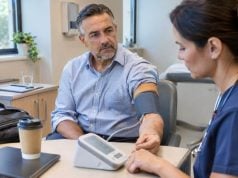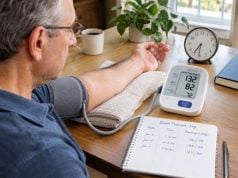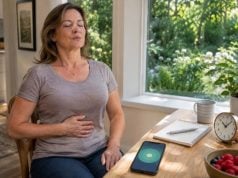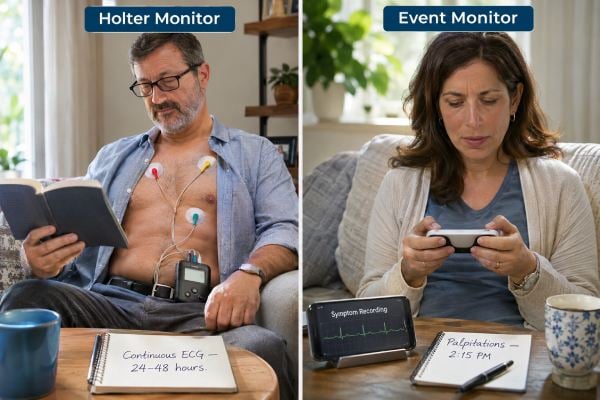
A Holter monitor and an event monitor both record your heart’s electrical activity away from the clinic, but they are designed for different symptom patterns. A Holter monitor records continuously, traditionally for about 24–48 hours, so it works best when palpitations happen every day or nearly every day. Event monitors are usually worn longer—often for days to several weeks—and record when you trigger them, when the device automatically detects an abnormal rhythm, or both. That makes them more useful when symptoms are less frequent or unpredictable. Newer patch monitors blur the old categories because some can record continuously for 7–14 days. The right test is therefore not simply “Holter versus event monitor”; it is the device most likely to capture your typical episode while you are actually wearing it. This guide explains how the monitors differ, how symptom frequency guides the choice, what each can detect, and what happens if the first test is normal.
Table of Contents
- The Main Difference Between Holter and Event Monitors
- Which Monitor Fits How Often You Have Palpitations?
- What Each Monitor Can and Cannot Detect
- What to Expect While Wearing the Monitor
- When Palpitations Need Urgent Evaluation
- What If the Monitor Is Normal?
- How to Get the Most Useful Result
The Main Difference Between Holter and Event Monitors
Both devices are forms of ambulatory electrocardiographic monitoring. They record ECG information while you go about normal life, which matters because palpitations often disappear before you reach a clinic. A standard 12-lead ECG is an important starting test, but it only shows the rhythm during the few seconds it is recorded.
A Holter monitor records continuously. The traditional version uses several adhesive electrodes connected to a small recorder and is commonly worn for 24–48 hours. Some systems record for longer. Because every beat is captured, a Holter can detect rhythms you feel as well as asymptomatic abnormalities that occur during the recording period.
An event monitor is intended for longer-term use. The term covers several device designs. Some are patient-activated: when symptoms begin, you press a button or place the recorder against your chest. External loop recorders continuously keep a short rolling memory and save the ECG from before and after an activation. Many modern systems can also trigger automatically when they detect a rate or rhythm outside programmed limits.
A continuous patch monitor is another common option. A patch may record continuously for 7–14 days, combining the continuous capture advantage of a Holter with a much longer recording period. This is why the exact device matters more than the label printed on the order.
The practical comparison looks like this:
| Feature | Holter monitor | Event or loop monitor | Extended continuous patch |
|---|---|---|---|
| Typical duration | 24–48 hours, sometimes longer | Often 2–4 weeks | Commonly 7–14 days |
| Recording style | Continuous | Triggered, auto-triggered, or looping | Continuous |
| Best fit | Daily or near-daily symptoms | Weekly or less frequent symptoms | Symptoms occurring every few days or unpredictably |
| Can catch asymptomatic rhythm changes? | Yes | Depends on auto-trigger capability | Yes |
| Main limitation | Short monitoring window | May miss events if not triggered and no auto-detection | Skin irritation, data volume, still time-limited |
If you are trying to understand the symptom itself before choosing a device, review common causes and warning signs of heart palpitations. The monitor is only one part of the evaluation.
Which Monitor Fits How Often You Have Palpitations?
The most useful question is: How often does the symptom you want to diagnose actually happen? Diagnostic yield rises when the monitoring period matches the frequency of the episodes.
If palpitations occur several times a day or almost every day, a 24–48 hour Holter often makes sense. The chance of recording a typical episode during a short continuous window is reasonably high, and the clinician can compare the symptom time with the rhythm at that exact moment.
If symptoms occur only once or twice a week, every few weeks, or with no predictable schedule, a short Holter may be too brief. A longer event monitor, external loop recorder, mobile cardiac telemetry system, or extended patch is more likely to capture the problem.
Research comparing monitoring strategies supports this basic principle. In a study of 24-hour Holter, 14-day continuous patch monitoring, and 30-day event monitoring, the longer strategies detected more new atrial fibrillation or atrial flutter than the 24-hour Holter. Longer monitoring does not guarantee a diagnosis, but it gives intermittent rhythms more opportunity to appear.
A simple frequency-based framework is:
- Symptoms every day: short continuous Holter monitoring is often reasonable.
- Symptoms every few days: an extended continuous patch may provide more useful coverage.
- Symptoms weekly to monthly: an event or loop monitor is often a better match.
- Symptoms only a few times per year, especially with fainting: a clinician may consider much longer monitoring, including an implantable loop recorder in selected cases.
The duration is not the only factor. A very brief but dangerous-feeling episode with fainting may justify a different strategy from mild daily skipped beats. Likewise, palpitations that start and stop suddenly may raise different rhythm questions than a gradually rising sinus heart rate during anxiety or exertion.
If your main sensation is an occasional thump or pause, skipped heartbeats such as PVCs and PACs are one possible explanation, but only an ECG recording can establish what the rhythm is during symptoms.
What Each Monitor Can and Cannot Detect
Ambulatory monitors can identify many rhythm disturbances, including premature atrial or ventricular beats, atrial fibrillation, atrial flutter, supraventricular tachycardia, pauses, bradycardia, and some ventricular arrhythmias. They can also show that the rhythm is normal sinus rhythm during an episode of pounding or fluttering, which is useful information rather than a failed test.
Continuous monitors have an advantage when the abnormal rhythm causes no symptoms. If atrial fibrillation occurs overnight and you do not feel it, a Holter or continuous patch can still record it. A purely patient-activated event recorder may not, although modern event and telemetry systems often include automatic detection.
The strongest result is a symptom-rhythm correlation: you mark the time you felt the typical palpitation, and the ECG shows what the heart was doing then. That can distinguish a benign premature beat from an arrhythmia requiring further treatment, or show that symptoms occurred during a normal rhythm.
There are several important limitations:
- A normal result does not prove that no arrhythmia exists if your typical symptoms did not occur during the monitoring window.
- A monitor can produce artifact from poor electrode contact, motion, muscle activity, or loose patches.
- Many ambulatory systems use fewer leads than a standard 12-lead ECG, so they provide less anatomical detail.
- A rhythm monitor does not replace evaluation for non-arrhythmic causes such as anemia, thyroid disease, dehydration, medication effects, panic symptoms, or structural heart disease.
- Consumer devices and smartwatches may capture useful ECG strips, but their automated interpretations are not equivalent to a complete clinical workup.
If you already use a smartwatch, Apple Watch ECG accuracy and safety explains what a single-lead consumer ECG can and cannot tell you. A prescribed monitor may still be needed because it provides longer, more systematic recording and clinician-directed analysis.
What to Expect While Wearing the Monitor
The clinic will prepare the skin and attach electrodes or a patch to your chest. Hair may be clipped so the adhesive sits flat. Good skin contact matters because loose electrodes create electrical noise that can look like an abnormal rhythm or make part of the recording unreadable.
With a Holter, wires may connect the electrodes to a small recorder worn on a belt, strap, or pocket. Some newer systems are compact patches without separate wires. Event monitors vary more. You may wear adhesive electrodes continuously, carry a handheld recorder, or use a loop monitor that saves ECG data when you press a button.
Follow the device-specific instructions about bathing, showering, swimming, and exercise. Some patches are water resistant; traditional wired systems may need to stay dry. Do not assume the rules are the same for every monitor.
During monitoring, try to live a reasonably normal day unless your clinician gives restrictions. The test is more useful if it samples the situations that usually trigger symptoms. If palpitations tend to happen while walking, working, climbing stairs, or lying in bed, note those circumstances.
Keep a symptom diary if requested. Record:
- exact or approximate time of the episode;
- what you felt—racing, fluttering, pounding, pause, skipped beat, dizziness;
- what you were doing just before it began;
- how long it lasted;
- whether there was chest discomfort, breathlessness, near-fainting, or other symptoms;
- whether you pressed the event button.
Do not intentionally provoke symptoms with excessive caffeine, alcohol, stimulant supplements, or unsafe exertion. The goal is to capture your normal problem, not manufacture a more extreme one.
Adhesive irritation is common with longer monitoring. Mild redness may occur, but significant blistering, swelling, or severe itching should be reported so the team can advise whether electrodes need to be moved or replaced.
When Palpitations Need Urgent Evaluation
A monitor is useful for intermittent symptoms in a stable person. It is not a reason to delay emergency care during a potentially dangerous episode.
Seek urgent medical evaluation for palpitations accompanied by chest pressure or pain, fainting, severe shortness of breath, new neurologic symptoms, marked weakness, or a sustained very rapid rhythm that does not settle. The threshold for urgent assessment should also be lower if you have known structural heart disease, a previous serious arrhythmia, or a family history of sudden cardiac death at a young age.
Palpitations with true fainting deserve particular attention because loss of consciousness can indicate a rhythm that temporarily reduces blood flow to the brain. A short event recorder that requires you to press a button may be poorly suited to a person who becomes unconscious during the episode. Automatic continuous monitoring or longer-term strategies may be more appropriate.
Likewise, do not rely on a home pulse reading to decide that a rhythm is harmless. A rate of 150 beats per minute could represent sinus tachycardia during intense exertion, atrial flutter, supraventricular tachycardia, or another rhythm depending on the circumstances. The ECG pattern matters.
For occasional mild symptoms without red flags, arrange a routine evaluation if episodes are recurrent, worsening, prolonged, or affecting daily life. A clinician may review medications and stimulants, perform a physical exam and 12-lead ECG, and order targeted tests such as blood counts, thyroid studies, electrolytes, or an echocardiogram when the history suggests a need.
What If the Monitor Is Normal?
A normal monitor can mean several different things. If you had your typical palpitations and the ECG showed normal sinus rhythm, that is meaningful. It makes a rhythm disturbance less likely as the explanation for that particular symptom and may redirect the evaluation toward premature beats not considered dangerous, heightened heartbeat awareness, stress, medication effects, or another cause.
If you had no symptoms at all during the recording, the result is less conclusive. A 24-hour Holter cannot rule out an arrhythmia that occurs once every three weeks. In that situation, the next step is often longer monitoring rather than repeating the same short test.
Options after a nondiagnostic study may include:
- a 7–14 day continuous patch;
- a 2–4 week external event or loop monitor;
- mobile cardiac telemetry with automatic transmission;
- clinician review of consumer single-lead ECG recordings if they capture a typical episode;
- an implantable loop recorder for very infrequent but concerning events such as unexplained recurrent fainting.
An extended patch may be useful when symptoms are frequent enough to occur within one or two weeks but not every day. The article on Zio patch monitoring explains how one common long-duration patch approach differs from a traditional short Holter.
The clinician may also decide that more rhythm monitoring is not the highest-yield next step. If palpitations consistently happen during exertion, an exercise stress test may be relevant. If there is a murmur, abnormal ECG, or concern for structural disease, echocardiography may be more informative. If episodes track with thyroid symptoms or anemia, laboratory testing may identify the driver.
The point is to keep matching the test to the clinical question rather than accumulating devices without a clear reason.
How to Get the Most Useful Result
Before the monitor is placed, describe your episodes as specifically as possible. “Palpitations” can mean fast regular pounding, irregular fluttering, isolated skipped beats, a brief thump, or a sensation of the heart stopping. The frequency and duration of the typical event help determine the monitoring window.
Ask three practical questions:
- Is this device recording continuously, or only when it is triggered?
- How long will I wear it, and what should I do when symptoms happen?
- Which symptoms should make me seek urgent care instead of waiting for the monitor report?
While wearing it, mark genuine symptoms promptly, keep the diary accurate, and do not remove electrodes unless instructed. If a wire disconnects or a patch loosens, follow the device instructions or contact the monitoring service rather than guessing.
Why the “longest monitor” is not always the best monitor
It is tempting to assume that more days of recording are always better, but monitor choice involves tradeoffs. Longer studies can improve the chance of catching an infrequent rhythm, yet they also generate more data, more incidental findings, more skin exposure to adhesive, and sometimes a longer wait for a final report. A person with unmistakable daily symptoms may get an answer from a 24-hour Holter without needing a month of monitoring.
The recording method also matters. If the concern is a symptom that lasts only five seconds, a patient-activated recorder that begins after you press a button may miss the beginning of the episode unless it has loop memory. If the concern is silent atrial fibrillation, a continuously recording patch or auto-triggered system may be more appropriate than a device that saves data only when symptoms are felt. For fainting, automatic capture becomes especially important because the person may not be able to activate anything.
Comfort can affect diagnostic yield too. A theoretically ideal 30-day monitor is not useful if skin irritation or cumbersome wires lead to early removal. Tell the prescribing team about adhesive allergies, work requirements, sports, or bathing needs so the device can be matched to real life as well as the medical question.
Finally, insurance coverage, local availability, and how quickly results are reviewed can influence the practical choice. These are not merely administrative details. If a clinician suspects a higher-risk rhythm, a device with near-real-time telemetry and an established response pathway may be preferable to a monitor whose data are analyzed only after it is returned.
After the study, the report should be interpreted in context. A list of isolated premature beats may look alarming on paper even when the overall burden is low and benign. Conversely, a short episode of a clinically important arrhythmia can matter even if the rest of the recording is normal.
If episodes are irregular and brief enough to catch with a handheld device, home ECG devices such as KardiaMobile may sometimes complement prescribed monitoring. They are most useful when they capture a readable ECG during symptoms and the tracing is reviewed appropriately—not when they lead to repeated checking without a clinical plan.
In short, choose the monitor by symptom frequency and clinical risk. Daily palpitations often fit a Holter. Less frequent episodes usually call for a longer event, loop, or patch monitor. If the first study misses your typical event, that does not automatically mean the palpitations are imaginary or harmless; it may simply mean the monitoring window was too short.
References
- Ambulatory ECG Monitoring 2026 (Clinical Review)
- Palpitations: A Practical Approach 2025 (Review)
- State of the art of mobile health technologies use in clinical arrhythmia care 2024 (Review)
- Diagnostic Yield, Outcomes, and Resource Utilization With Different Ambulatory Electrocardiographic Monitoring Strategies 2022
- Cardiac monitoring for patients with palpitations 2021 (Review)
Disclaimer
This article is for general education and cannot determine which monitor is appropriate for a specific person. Palpitations accompanied by chest pain, fainting, severe shortness of breath, new neurologic symptoms, or a sustained severe rhythm disturbance require prompt medical evaluation. Device selection and interpretation should be guided by a qualified healthcare professional.