Home ECG devices such as KardiaMobile can be useful when an intermittent rhythm problem is hard to capture in a clinic, especially if you have brief palpitations and can record an ECG while symptoms are happening. KardiaMobile uses small electrodes to record a short electrocardiogram through a connected phone or tablet. The common single-lead model records one electrical view of the heart, while KardiaMobile 6L records six limb leads. These devices can help document atrial fibrillation and other rhythm abnormalities, but they are not a replacement for a full 12-lead ECG, prescribed continuous monitoring, or emergency evaluation. Their automated labels—such as normal, possible atrial fibrillation, tachycardia, bradycardia, or unclassified—also should not be treated as a final diagnosis. The greatest value comes from using the device for a defined clinical question, obtaining clean tracings during symptoms, and sharing those recordings with a qualified clinician. This guide explains who benefits, how to record correctly, and where home ECGs can mislead.
Table of Contents
- What KardiaMobile Records and How It Works
- Who Is Most Likely to Benefit?
- How to Take a Clean Home ECG Recording
- How to Understand the Automated Result
- What Home ECG Devices Can Miss
- KardiaMobile vs Holter, Event Monitors, and Smartwatches
- When to Call Your Clinician or Seek Urgent Care
What KardiaMobile Records and How It Works
An electrocardiogram records the electrical activity that coordinates each heartbeat. In a clinic, a standard 12-lead ECG uses electrodes placed on the chest and limbs to show the heart from multiple electrical angles. A home handheld ECG uses fewer leads, so it provides less information but is much easier to record at the moment symptoms occur.
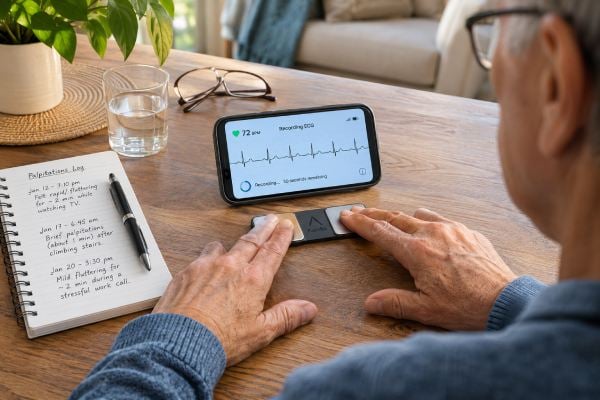
The standard KardiaMobile is a single-lead ECG. You typically place a finger from each hand on the two electrodes while the device communicates with the Kardia app. A recording usually lasts about 30 seconds. KardiaMobile 6L can record six limb leads by adding contact with the left leg, giving a clinician more electrical views than the single-lead model but still not the same information as a conventional 12-lead ECG.
The important advantage is timing. A person may have 30 seconds of fluttering once every few days and a completely normal office ECG. A portable ECG can sometimes capture the electrical rhythm during that short episode. NICE guidance recommends KardiaMobile as an option for people with suspected paroxysmal atrial fibrillation who have symptoms such as palpitations and have been referred by a clinician for ambulatory ECG monitoring.
A home ECG is best understood as an event-capture tool. It answers questions such as, “What rhythm was present when I felt this episode?” It does not continuously monitor every beat while it is sitting in a drawer or pocket.
That distinction matters because many rhythm symptoms are intermittent. If your main problem is a sensation of fluttering, pounding, or racing, the overview of heart palpitations and warning signs can help clarify what information is useful to record alongside the ECG.
Who Is Most Likely to Benefit?
Home ECG devices are most useful when there is a realistic chance that recording a rhythm will change the next clinical decision. They are not automatically helpful for everyone who owns a smartphone.
People who may benefit include:
- People with intermittent palpitations that are too brief or infrequent to capture in a clinic, particularly when a clinician suspects an arrhythmia.
- People being evaluated for paroxysmal atrial fibrillation, which can start and stop unpredictably.
- People with known atrial fibrillation who have been told by their clinician to document symptomatic episodes or check rhythm after a treatment change.
- Selected patients after arrhythmia treatment, when a cardiology team wants symptom-linked rhythm strips between visits.
- People whose episodes are frequent enough to record manually but not frequent enough to make a short office ECG useful.
If atrial fibrillation is the concern, symptoms can include irregular heartbeat, reduced exercise tolerance, fatigue, dizziness, or breathlessness, although some people have no symptoms. See atrial fibrillation symptoms and warning signs for a broader overview.
A home ECG may be less useful when symptoms cause sudden fainting, because you may not be able to activate the device. It is also a poor substitute when the clinical question requires continuous monitoring. An arrhythmia that occurs during sleep without symptoms could be missed completely if you never make a recording.
Routine self-screening in a healthy, low-risk person can also create more noise than benefit. Automated devices sometimes label recordings “unclassified” or “possible AF,” and false alarms can lead to anxiety and unnecessary testing. Screening decisions should consider age, stroke risk, symptoms, and what would happen if an abnormal tracing were found.
People who find themselves recording repeatedly because of health anxiety rather than a clinician-defined question may benefit more from agreeing on a specific monitoring plan. A device should reduce uncertainty by generating interpretable data, not create a cycle of checking every normal heartbeat.
How to Take a Clean Home ECG Recording
Signal quality determines how useful a home ECG is. Motion, tense muscles, poor contact, and electrical interference can create artifact that mimics or hides rhythm abnormalities.
For a standard finger recording:
- Sit down safely and stop walking or talking.
- Open the app and make sure the device is connected as instructed by the manufacturer.
- Place the device on a stable surface if the instructions for your model recommend it.
- Relax your shoulders, arms, and hands.
- Put the appropriate fingers lightly on the electrodes rather than squeezing them hard.
- Stay still and quiet for the full recording, commonly about 30 seconds.
- Save the strip and add a symptom label or note if the app allows it.
- Record what you were doing, when symptoms started, and whether you felt racing, fluttering, skipped beats, dizziness, chest discomfort, or breathlessness.
If your fingers are very dry and the app repeatedly reports poor contact, follow the manufacturer’s troubleshooting guidance rather than improvising with conductive substances. Clean the electrodes as directed and make sure your hands are not moving.
When symptoms happen during activity, stop in a safe place before recording. Never try to make an ECG while driving, cycling in traffic, operating equipment, or standing somewhere you could fall.
A useful recording is one that captures the typical symptom. Taking ten normal tracings every morning may be less informative than one clear strip during the episode that brought you to the doctor.
If you often feel isolated thumps or pauses, note the exact moment you feel them. Premature beats may appear on the strip and can sometimes be correlated with symptoms. The article on skipped beats and PVCs explains why these sensations can feel dramatic even when the rhythm is not always dangerous.
How to Understand the Automated Result
Kardia software can analyze a tracing and return an automated classification. The available labels vary by device, software version, region, heart rate, and subscription features, but common categories can include normal sinus rhythm, possible atrial fibrillation, bradycardia, tachycardia, unclassified, and no analysis.
Treat that label as screening information, not a diagnosis. The algorithm looks for patterns in a limited-lead recording. It does not know your full medical history, symptoms, electrolyte levels, medications, or what a simultaneous 12-lead ECG would show.
Real-world evidence illustrates the difference between a useful algorithm and a definitive diagnosis. In the VITAL-AF primary care study of adults aged 65 and older, an automated “normal” KardiaMobile result had a very high negative predictive value for atrial fibrillation, but an automated “possible AF” result had a positive predictive value of about 52%. The algorithm also labeled a substantial proportion of recordings as unclassified or no analysis. In that screening setting, the automated result was better at helping exclude AF than establishing a diagnosis by itself.
Other research shows that when trained clinicians interpret readable single-lead ECG tracings, many rhythms can be identified with good accuracy. A 2024 study comparing KardiaMobile recordings with electrophysiology-study diagnoses found high interpretation accuracy across several rhythms. That does not mean every consumer tracing is equally reliable; study conditions and expert overreading differ from a hurried recording at home.
Use the automated result this way:
- Normal: reassuring for that short recording, but it does not rule out an arrhythmia that happened earlier or later.
- Possible atrial fibrillation: save the tracing and arrange appropriate clinical review; do not self-start or stop medication based on the label.
- Tachycardia or bradycardia: the device is describing rate as well as rhythm; context and symptoms determine significance.
- Unclassified/no analysis: repeat once under good recording conditions if appropriate, but persistent unreadable or unusual tracings should be reviewed rather than recorded dozens of times.
The ECG strip itself is often more valuable to a clinician than the app’s headline classification.
What Home ECG Devices Can Miss
The largest limitation is obvious but easy to forget: a handheld ECG only records when you use it. If a 10-minute arrhythmia happens at 3 a.m. and you sleep through it, there may be no data. If palpitations last only a few seconds, they may end before you open the app.
A single-lead device also has less diagnostic information than a 12-lead ECG. It may be helpful for rhythm identification but is not designed to evaluate every cause of chest pain, all conduction abnormalities, structural heart disease, or acute coronary syndromes. A reassuring home tracing should never be used to “rule out a heart attack.”
Other limitations include:
- Artifact: tremor, movement, poor skin contact, and muscle tension can distort the trace.
- Ectopic beats: premature atrial or ventricular beats can confuse automated classification.
- Very fast or very slow rates: some algorithms have rate ranges outside which they cannot classify reliably.
- Brief arrhythmias: the event may stop before recording begins.
- Asymptomatic arrhythmias: manual checks may miss them completely.
- False reassurance: a normal 30-second strip says what happened during those 30 seconds, not during the rest of the day.
- False alarms: automated “possible AF” and “unclassified” results require context and often clinician review.
Do not repeatedly re-record until the label becomes “normal.” If one clear tracing during symptoms looks abnormal, save it. Repeating until a later strip is normal can hide the very event you were trying to document.
Home ECGs also cannot measure blood pressure or oxygen delivery, and most do not provide the same ischemia assessment as a medical 12-lead ECG. They are one tool in a larger evaluation.
KardiaMobile vs Holter, Event Monitors, and Smartwatches
The best device depends on the rhythm problem you are trying to capture. KardiaMobile is portable and reusable, but it generally requires you to notice the symptom and make a recording. A Holter or continuous patch automatically records throughout the monitoring period.
| Device | Recording style | Main advantage | Main limitation |
|---|---|---|---|
| KardiaMobile | Short user-initiated ECGs | Easy to capture symptoms repeatedly over time | Misses events when you do not record |
| Holter monitor | Continuous, usually short term | Captures every beat during the recording window | May miss infrequent symptoms |
| Extended patch | Continuous for days to about 2 weeks | Longer automatic coverage | Still limited to the wear period |
| Event/loop monitor | Triggered and/or auto-triggered for weeks | Better for less frequent episodes | Depends on device type and activation |
| ECG smartwatch | On-demand single-lead ECG on supported models | Always on the wrist and convenient | Consumer algorithm and single-lead limitations |
If palpitations happen every day, a Holter may provide more complete information than occasional home recordings. If they occur weekly or monthly, a longer event strategy may be better. Holter versus event monitoring for palpitations explains how clinicians match the recording window to symptom frequency.
An extended continuous patch is another option when a short Holter is likely to miss the event. A Zio patch is one common example of extended continuous rhythm monitoring.
Smartwatch ECGs and KardiaMobile overlap in purpose. Both can produce an on-demand single-lead rhythm strip on supported devices, though hardware, software, lead configuration, and validated indications differ. If you use a watch, Apple Watch ECG accuracy and safety covers similar interpretation limits.
A clinician may use consumer ECGs as useful evidence while still prescribing medical-grade monitoring. These approaches are complementary, not mutually exclusive.
When to Call Your Clinician or Seek Urgent Care
Contact your clinician when a home ECG repeatedly shows a possible arrhythmia, when you capture an abnormal tracing during your typical symptoms, or when palpitations are becoming more frequent, longer, or more intense. Save the original tracing and note the time and symptoms. A clinician may want a 12-lead ECG, laboratory tests, echocardiography, or longer ambulatory monitoring.
Do not change anticoagulants, beta-blockers, antiarrhythmic drugs, or other heart medications based solely on an app result unless you have a specific clinician-approved plan. A false positive can lead to unnecessary treatment, while a false negative can create false reassurance.
Seek urgent or emergency evaluation for chest pressure or pain, severe shortness of breath, fainting or near-fainting, new neurologic symptoms, severe weakness, or a sustained rapid or irregular rhythm with significant symptoms. If you are having symptoms that could represent a heart attack or stroke, do not delay care to obtain a “better” Kardia recording. The article on chest pain causes and warning signs explains why symptom context matters more than a normal consumer ECG label.
Set limits on checking before you start
A home ECG is most useful when you know in advance what will trigger a recording. For example, your plan might be to record during the familiar fluttering episode, once after an episode ends if it was too brief to catch, and at a scheduled time only if your cardiologist specifically requested routine checks. That is very different from recording every time you notice a normal change in heart rate after standing, eating, or climbing stairs.
Agree on how many tracings the care team actually wants to review. Sending dozens of normal strips can bury the one recording that captured the symptom. Label representative recordings clearly with the date, time, symptom, duration, and what you were doing. If the app allows PDF export or a clinician portal, use the method your practice prefers rather than relying on screenshots that crop the ECG.
Also decide what an abnormal app label means in your plan. In many cases, one “possible AF” result should lead to saving the tracing and arranging clinician review, not taking repeated ECGs every few minutes until the app says “normal.” Repeated checking can increase anxiety and does not convert the automated algorithm into a diagnosis.
If you cannot obtain a readable tracing during symptoms despite good technique, or if episodes end before the device is ready, tell your clinician. That is a sign that a continuously recording patch, loop monitor, or telemetry system may fit the problem better.
For stable intermittent symptoms, a simple plan works well:
- Agree with your clinician on what you are trying to capture.
- Record only when scheduled or when the relevant symptom occurs.
- Use good technique so the tracing is readable.
- Label the strip with symptoms and activity.
- Save abnormal or representative recordings rather than repeatedly checking.
- Share the tracings through the method your care team prefers.
- Escalate to prescribed monitoring if episodes are too brief, too infrequent, asymptomatic, or associated with fainting.
Used this way, KardiaMobile can be a valuable bridge between a symptom and a diagnosis. Used without a plan, it can produce a large collection of short ECGs that are difficult to interpret and may increase anxiety.
The device is most helpful when it answers a focused question: what rhythm was present during the episode that matters? That is the information your clinician can use.
References
- KardiaMobile for detecting atrial fibrillation 2023 (NICE HealthTech Guidance; originally published 2022)
- Effectiveness of single-lead ECG devices for detecting atrial fibrillation: An overview of systematic reviews 2024 (Overview of Systematic Reviews)
- Accuracy of a Single-Lead ECG Device for Diagnosis of Cardiac Arrhythmias Compared Against Cardiac Electrophysiology Study 2024
- Performance of Single-Lead Handheld Electrocardiograms for Atrial Fibrillation Screening in Primary Care: The VITAL-AF Trial 2023
- State of the art of mobile health technologies use in clinical arrhythmia care 2024 (Review)
Disclaimer
This article is for general education and does not diagnose an arrhythmia or replace a clinician-interpreted ECG. Consumer ECG classifications should not be used to start, stop, or change heart medication without medical guidance. Seek urgent care for palpitations with chest pain, fainting, severe shortness of breath, new neurologic symptoms, or other severe symptoms.