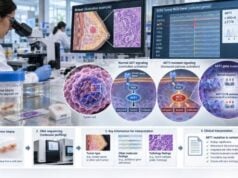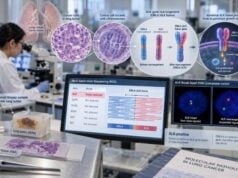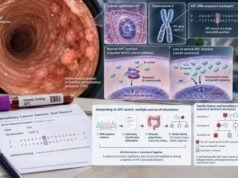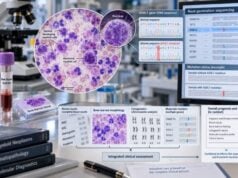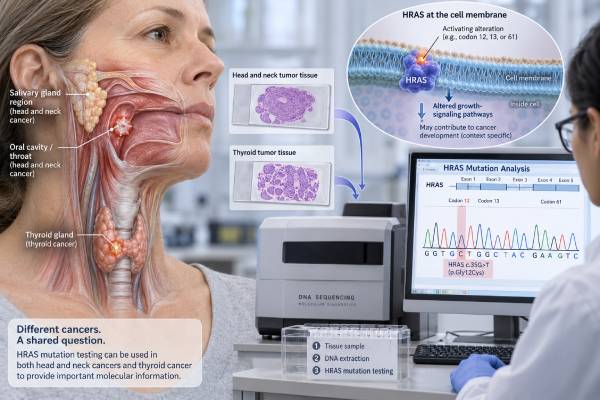
An HRAS mutation test looks for activating DNA changes in the HRAS gene, one of the RAS family genes that control cell growth signaling. The test is most often performed as part of a tumor next-generation sequencing panel rather than as a stand-alone blood test. In head and neck squamous cell carcinoma, HRAS mutations define a small molecular subgroup and have attracted interest as a potential treatment target. In thyroid nodules and thyroid cancer, HRAS is part of a broader “RAS-like” molecular pattern, but a positive result is not specific enough to prove malignancy by itself.
The exact mutation and tumor context matter. Common cancer-associated HRAS changes occur at hotspot codons 12, 13, and 61. A pathology report may also list the variant allele frequency, but there is no universal high or low HRAS level that predicts outcome. A somatic HRAS mutation usually reflects tumor biology rather than inherited risk. Interpretation should combine the molecular result with histology or cytology, imaging, stage, other mutations, and the clinical reason for testing.
- A positive HRAS mutation result means a cancer-associated HRAS DNA change was detected; hotspot variants commonly involve codons 12, 13, or 61.
- HRAS mutations occur in a small subgroup of head and neck squamous cell cancers and may identify a biologically distinct disease.
- In thyroid nodules, an HRAS mutation raises molecular concern but does not prove cancer because RAS mutations can occur in benign, low-risk, and malignant follicular-patterned lesions.
- Variant allele frequency is not a universal severity score and should not be interpreted as a normal/high range.
- A tumor HRAS mutation is usually somatic; hereditary HRAS conditions require separate germline evaluation.
Table of Contents
- What an HRAS mutation test detects
- HRAS in head and neck cancer
- HRAS in thyroid nodules and thyroid cancer
- How HRAS testing is performed
- How to interpret positive, negative, and VUS results
- Treatment, prognosis, and hereditary meaning
- Questions to ask about an HRAS result
What an HRAS mutation test detects
HRAS is one of three classic RAS genes, alongside KRAS and NRAS. The HRAS protein acts as a molecular switch inside the cell. When it is turned on, it sends growth and survival signals through pathways such as RAF-MEK-ERK and PI3K-AKT. Normally, the switch cycles on and off. Certain mutations lock the protein into an abnormally active state.
Cancer-associated HRAS mutations tend to cluster at hotspot codons 12, 13, and 61. Reports may use names such as HRAS G12S or HRAS Q61R, where the letters describe the amino acid change at a specific protein position.
Testing can identify several result classes:
- A pathogenic or oncogenic HRAS mutation.
- A likely pathogenic HRAS mutation.
- A variant of uncertain significance, or VUS.
- No reportable HRAS mutation detected.
- An assay failure or insufficient sample.
Most clinical testing is performed through a cancer gene mutation panel because other alterations may be equally or more important for diagnosis and treatment. A broad panel also helps determine whether HRAS is the dominant driver or one part of a more complex genomic profile.
An HRAS result does not have a normal laboratory reference range. The clinically important features are the exact variant, its classification, the tumor type, and the assay’s technical quality.
Some reports include variant allele frequency, or VAF. A VAF of 20% means that 20% of sequencing reads at that position carried the mutation in that specimen. It does not mean 20% of the cancer is “mutated,” and it does not provide a direct percentage risk of recurrence or death.
HRAS in head and neck cancer
HRAS mutations occur in a small minority of head and neck squamous cell carcinomas (HNSCC). Large molecular analyses have estimated oncogenic HRAS mutations in roughly 3%–4% of HNSCC overall, while selected recurrent or metastatic cohorts can show somewhat different frequencies.
This subgroup has several notable features. HRAS-mutant HNSCC is often HPV-negative, and G12S has been reported as one of the most frequent variants. Studies also suggest a distinct pattern of co-mutations and, in some cohorts, aggressive clinical behavior. These findings make HRAS more than a passive sequencing observation: it can define a molecular subgroup worth recognizing.
Why HRAS is a drug target of interest
HRAS depends on a processing step called farnesylation to attach to the cell membrane and signal effectively. This creates a vulnerability that differs from KRAS and NRAS, which can use alternative prenylation when farnesyltransferase is blocked.
The farnesyltransferase inhibitor tipifarnib has therefore been studied in HRAS-mutant recurrent/metastatic HNSCC. A phase II study in a selected high-VAF group reported substantial tumor responses, providing proof that HRAS can be therapeutically targeted. Later work has explored resistance mechanisms and combinations, including interactions with PI3K-AKT signaling.
The practical interpretation remains nuanced. A positive HRAS result can support clinical-trial consideration or a specialist discussion about HRAS-directed strategies, but the result should not be converted into a treatment prescription without checking the current regulatory status, treatment setting, prior therapies, and guideline recommendations.
A solid tumor NGS panel may also identify other actionable features in advanced HNSCC, so HRAS should be reviewed in the full molecular context.
HRAS in thyroid nodules and thyroid cancer
HRAS has a different role in thyroid disease. RAS-family mutations are common in follicular-patterned thyroid lesions, including some benign adenomas, noninvasive follicular thyroid neoplasms with papillary-like nuclear features (NIFTP), follicular thyroid carcinomas, and subsets of papillary thyroid carcinoma.
That means an HRAS mutation in a thyroid fine-needle aspiration sample is not synonymous with thyroid cancer.
This distinction matters most when cytology is indeterminate, such as Bethesda III or IV. Molecular testing can refine the estimated malignancy risk and help guide the choice between surveillance, diagnostic surgery, or a more individualized approach. However, the molecular result must be combined with:
- Ultrasound pattern and nodule size.
- Cytology category.
- Patient age and clinical risk factors.
- Whether high-risk co-mutations are present.
- The performance characteristics of the specific molecular test.
- Patient preferences about surveillance versus surgery.
A 2024 systematic review and meta-analysis found that RAS positivity increased malignancy risk in indeterminate nodules but also showed substantial heterogeneity across studies. This reflects an important real-world issue: the predictive value of a RAS mutation depends on the population and how tumors are classified.
RAS-mutant follicular thyroid tumors span a biologic continuum from benign to malignant. Pathologists often need to assess capsular or vascular invasion, nuclear features, mitotic activity, necrosis, and additional molecular alterations before assigning a final diagnosis after surgery.
Other thyroid molecular markers can carry different implications. A BRAF V600E mutation, for example, belongs to a different molecular pattern than a classic RAS-like alteration. RET fusions are another distinct driver class.
How HRAS testing is performed
HRAS sequencing can be performed on several specimen types depending on the clinical problem.
Tumor tissue
For head and neck cancer or resected thyroid cancer, testing often uses formalin-fixed, paraffin-embedded tissue from a biopsy or surgery. A pathologist selects an area with adequate viable tumor before DNA extraction.
Thyroid fine-needle aspiration material
In an indeterminate thyroid nodule, molecular testing may use residual cells or a dedicated sample collected during fine-needle aspiration. Commercial assays often evaluate HRAS together with multiple mutations, fusions, and expression features rather than reporting HRAS in isolation.
Liquid biopsy
Circulating tumor DNA from blood can detect HRAS mutations in some advanced cancers. A positive plasma result can be informative, but a negative result may occur if the tumor sheds little DNA. Tissue testing may still be needed when a negative liquid biopsy leaves an important clinical question unanswered.
Sequencing methods
Targeted next-generation sequencing is common because it can detect HRAS and many other cancer genes at the same time. Some focused assays use PCR or other targeted methods for known hotspots.
The test report should show which exons or codons were covered, the variant detected, its classification, and quality-control information. A test that does not adequately cover the relevant HRAS hotspots cannot be interpreted the same way as a validated comprehensive assay.
No fasting or medication changes are required for the molecular analysis itself. Preparation depends on the biopsy, surgery, blood draw, or thyroid aspiration used to obtain the specimen.
When testing is most useful
In head and neck cancer, HRAS is most useful when molecular profiling could change a treatment discussion, identify a clinical-trial option, or clarify an unusual tumor profile. Testing only HRAS may be too narrow in advanced disease because other biomarkers can also affect systemic therapy. Broad profiling can preserve tissue and answer several questions at once.
In thyroid disease, molecular testing is most useful when cytology leaves a meaningful management choice unresolved. An indeterminate nodule that would otherwise lead to diagnostic surgery may benefit from a validated multigene test if the result could reasonably shift the decision toward surveillance or surgery. By contrast, an HRAS result adds less value when imaging, cytology, or clinical findings already make the next step clear.
The pretest probability matters. The same positive molecular result can have different predictive value in practices with different malignancy rates among Bethesda III and IV nodules. This is why commercial test performance should be interpreted in the local clinical setting rather than applying one published percentage to every patient.
How to interpret positive, negative, and VUS results
Pathogenic or oncogenic HRAS mutation detected
A positive pathogenic result means the tumor contains a recognized activating HRAS change. In HNSCC, this can identify a distinct molecular subgroup and may have treatment-research implications. In a thyroid nodule, it supports a RAS-like neoplastic process but does not prove invasive carcinoma.
The same molecular word therefore carries different weight in different organs. A pathology report should explain that distinction rather than simply labeling every HRAS-positive sample “high risk.”
Variant of uncertain significance
A VUS means current evidence is insufficient to determine whether the specific change drives cancer. It should not be treated like a classic hotspot mutation without additional evidence.
A VUS may later be reclassified as more data become available. Keeping the exact variant name is more useful than retaining only a general statement that “HRAS was abnormal.”
No mutation detected
A negative result means no reportable HRAS mutation was identified within the assay’s coverage and sensitivity. It does not exclude cancer and does not rule out other RAS genes or molecular drivers.
For a thyroid nodule, an HRAS-negative result cannot independently prove benignity. For head and neck cancer, it simply means an HRAS-directed interpretation is not supported by that specimen. Other biomarkers may still influence treatment.
Interpreting VAF
Variant allele frequency can help the laboratory assess whether a finding is technically credible and may provide clues about clonality. In some clinical research on HRAS-mutant HNSCC, higher VAF thresholds were used to select patients. That does not create a universal clinical cutoff for every HRAS test.
VAF can change with tumor purity, copy-number state, normal-cell contamination, and specimen type. A 10% result from plasma and a 30% result from tissue should not be compared as though they were the same quantitative test.
Treatment, prognosis, and hereditary meaning
An HRAS mutation can be predictive, prognostic, diagnostic, or simply descriptive depending on the cancer.
In recurrent/metastatic HNSCC, HRAS mutations have been associated in some cohorts with unfavorable outcomes and early recurrence. Tipifarnib has produced responses in selected HRAS-mutant patients, but response is not guaranteed and resistance can develop. The mutation should therefore prompt a current oncology review rather than a fixed assumption about prognosis or therapy.
In thyroid tumors, HRAS is not a simple high-risk marker. RAS-positive lesions can be benign, low risk, or malignant. A meta-analysis of thyroid cancers found associations between RAS mutations overall and higher risks of distant metastasis and mortality, but those population-level findings do not turn an isolated HRAS mutation in an indeterminate nodule into a prognosis for one person.
Co-mutations can change the picture. For example, a RAS mutation alongside high-risk alterations such as TERT promoter or TP53 changes may carry different significance than an isolated RAS mutation. This is one reason multigene testing and integrated pathology interpretation are useful.
Somatic HRAS vs germline HRAS
Most HRAS mutations detected in a cancer sequencing test are somatic, meaning they developed in the tumor. They are not automatically inherited and do not automatically imply increased cancer risk for relatives.
Germline pathogenic HRAS variants can cause Costello syndrome, a rare developmental condition with characteristic features and increased tumor risk. A person with an isolated adult tumor HRAS mutation should not be assumed to have Costello syndrome. If a genetics professional suspects a germline condition based on age, clinical features, family history, or sequencing pattern, confirmation requires dedicated germline testing from a non-tumor sample.
This separation between somatic and germline meaning is especially important when patients receive broad tumor-panel reports that list many genes without clearly distinguishing inherited-risk testing from cancer profiling.
Questions to ask about an HRAS result
Useful follow-up questions include:
- What exact HRAS mutation was found? Hotspot and non-hotspot variants can have different evidence.
- Is it classified as pathogenic/oncogenic or as a VUS? The classification determines how confidently it can be used.
- Why was the test ordered? The interpretation differs between advanced HNSCC and an indeterminate thyroid nodule.
- What other mutations or fusions were found? Co-alterations can change diagnosis, prognosis, or treatment options.
- Does the result change treatment now? For head and neck cancer, ask whether an approved therapy, clinical trial, or investigational strategy is relevant in the current setting.
- For a thyroid nodule, what is the combined malignancy risk? Cytology, ultrasound, test performance, and molecular findings should be combined.
- Does the VAF have a specific validated use in this setting? Do not assume a higher percentage automatically means worse disease.
- Is germline testing indicated? Most tumor HRAS mutations are somatic, but hereditary assessment is separate when clinically appropriate.
The central interpretation rule is simple: HRAS mutation status is context-dependent. In head and neck cancer it can identify a rare targetable biology; in thyroid disease it is often a risk-refining molecular clue rather than a stand-alone cancer diagnosis. The safest interpretation keeps the exact variant and full pathology context together, especially when results are shared between institutions or reconsidered after recurrence.
For head and neck cancer, “targetable biology” should not be confused with a guaranteed approved drug option. Tipifarnib has produced responses in selected HRAS-mutant HNSCC studies and remains important evidence that HRAS can be pharmacologically exploited, but treatment availability depends on the current regulatory setting and clinical-trial landscape. For thyroid nodules, the same mutation is used very differently: it may raise or refine malignancy risk, yet surgery and surveillance decisions still depend on cytology, ultrasound findings, nodule size, patient factors, and the performance characteristics of the molecular test used.
References
- HRAS Mutations Define a Distinct Subgroup in Head and Neck Squamous Cell Carcinoma. 2023
- Targeting Harvey rat sarcoma viral oncogene homolog in head and neck cancer: how to move forward? 2023 (Review)
- Evolutionary dynamics of tipifarnib in HRAS mutated head and neck squamous cell carcinoma 2024
- RAS-Mutant Follicular Thyroid Tumors: A Continuous Challenge for Pathologists 2024 (Review)
- Decoding RAS mutations in thyroid cancer: A meta-analysis unveils specific links to distant metastasis and increased mortality 2025 (Systematic Review)
- Tipifarnib in Head and Neck Squamous Cell Carcinoma With HRAS Mutations 2021
Disclaimer
This article provides general educational information and is not a diagnosis or treatment recommendation. HRAS results must be interpreted according to the exact variant, cancer type, specimen, other molecular findings, and current clinical evidence. In thyroid nodules, an HRAS mutation does not by itself prove malignancy, and tumor HRAS testing does not replace germline genetic evaluation when inherited disease is suspected.