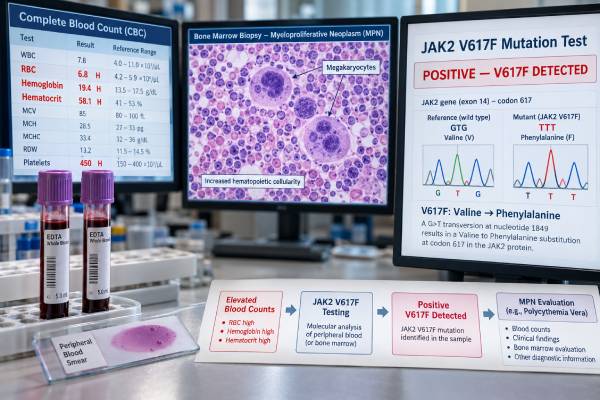
A JAK2 V617F mutation test looks for a specific acquired DNA change that activates JAK-STAT signaling in blood-forming cells. It is one of the most important molecular tests for the classic BCR::ABL1-negative myeloproliferative neoplasms (MPNs): polycythemia vera (PV), essential thrombocythemia (ET), and primary myelofibrosis (PMF). JAK2 V617F is found in about 95% of PV and in roughly half to two thirds of ET and PMF, depending on the population and method. A positive result strongly supports a clonal MPN when the blood counts and bone marrow fit, but it does not tell which MPN is present by itself. PV, ET, and PMF can all carry the same mutation. A negative result also does not exclude an MPN because JAK2 exon 12, CALR, MPL, and other findings may explain the disease. Some laboratories report the JAK2 V617F variant allele frequency (VAF), which can add biological information but is not the same as disease stage or a universal treatment target.
- JAK2 V617F is present in about 95% of polycythemia vera and is also common in essential thrombocythemia and primary myelofibrosis.
- A positive result supports a clonal myeloproliferative neoplasm but cannot distinguish PV, ET, and PMF without blood counts and marrow morphology.
- A negative V617F result should lead to disease-specific follow-up, such as JAK2 exon 12 testing for suspected PV or CALR/MPL testing for ET or PMF.
- JAK2 V617F VAF reflects the proportion of mutant DNA reads, not the exact percentage of abnormal cells or the severity of disease.
- Very low-level JAK2 V617F can occasionally be detected outside overt MPN, so the clinical context matters especially near an assay’s detection limit.
Table of Contents
- What JAK2 V617F Is
- When the JAK2 V617F Test Is Ordered
- What a Positive JAK2 V617F Result Means
- How JAK2 V617F Fits PV, ET, and Myelofibrosis
- What a Negative Result Means
- JAK2 V617F Allele Burden and Prognosis
- Testing Limitations, Monitoring, and Next Steps
What JAK2 V617F Is
JAK2 V617F is an activating mutation in exon 14 of the JAK2 gene. The name describes a single amino-acid substitution: valine (V) is replaced by phenylalanine (F) at position 617. The mutation removes part of the normal internal restraint on the JAK2 tyrosine kinase and keeps downstream JAK-STAT signaling more active than it should be.
JAK2 normally transmits signals from growth-factor receptors involved in making red blood cells, platelets, and other myeloid cells. Constitutive activation gives a mutated hematopoietic stem or progenitor cell a growth advantage. Over time, that clone can produce the blood-count pattern and marrow changes of an MPN.
JAK2 V617F is a somatic mutation in most MPN patients. It is acquired in blood-forming cells rather than inherited in every cell of the body. Standard MPN testing is therefore usually performed on peripheral blood or bone marrow and is not a hereditary cancer test.
The mutation is highly prevalent in the classic MPNs but is not unique to one diagnosis. Contemporary reviews place JAK2 mutations in nearly all PV, with V617F accounting for approximately 95% and exon 12 variants making up much of the remainder. JAK2 V617F occurs in about 55% to 65% of ET and PMF in many series.
That shared biology explains both the power and the limitation of the test. It is an excellent marker of clonality in the right setting, but the same positive mutation can produce different disease phenotypes. The marrow, hemoglobin/hematocrit, platelet count, spleen findings, fibrosis, and other molecular features determine whether the diagnosis is PV, ET, prefibrotic PMF, overt PMF, or another myeloid neoplasm.
When the JAK2 V617F Test Is Ordered
JAK2 V617F is commonly ordered when a blood count suggests a chronic MPN and reactive causes do not fully explain the abnormality. Typical triggers include persistent erythrocytosis, thrombocytosis, leukocytosis, unexplained splenomegaly, marrow features suspicious for an MPN, or an unusual thrombosis such as a splanchnic vein clot.
The exact clinical question changes what happens after the result:
| Clinical pattern | Why JAK2 V617F is useful | Common follow-up if negative |
|---|---|---|
| High hemoglobin/hematocrit | Supports polycythemia vera | JAK2 exon 12 or broader JAK2 exons 12–15 testing |
| Persistent platelets ≥450 × 10⁹/L | Supports clonal thrombocytosis/ET in the right marrow context | CALR and MPL testing; evaluate reactive causes |
| Marrow fibrosis or prefibrotic MPN pattern | Provides a major clonal driver marker | CALR, MPL, and broader myeloid sequencing |
| Splanchnic or other unusual thrombosis | Can uncover an occult MPN even before blood counts are striking | Broader MPN evaluation if suspicion remains |
Most testing uses peripheral blood, and fasting is not required. Methods include allele-specific PCR, quantitative PCR, digital PCR, and NGS. Highly sensitive assays can detect very small JAK2-mutated clones, which is useful but also increases the need for careful interpretation of low-level positives.
Pretest probability matters. A person with repeatedly high hematocrit, suppressed EPO, aquagenic pruritus, and splenomegaly has a very different likelihood of PV from a person whose hematocrit rose once during dehydration. Likewise, platelets persistently above 450 × 10⁹/L after iron deficiency and inflammation have been excluded create a stronger ET question than a short-lived reactive thrombocytosis after surgery. Molecular testing is most informative when the clinical phenotype has first been defined.
Bone marrow sampling is not required merely because a JAK2 test was ordered, but it often becomes central when an MPN diagnosis is being established. Marrow architecture separates ET from prefibrotic PMF, documents fibrosis, and can reveal panmyelosis in PV. A positive JAK2 test cannot supply this morphologic information.
When the clinical picture is broad rather than clearly PV, ET, or PMF, a myeloproliferative neoplasm panel can evaluate the main driver genes together and may include additional mutations that help with prognosis.
What a Positive JAK2 V617F Result Means
A positive JAK2 V617F result means the mutation was detected in the tested blood or marrow above the assay’s threshold. In a patient with persistent erythrocytosis, thrombocytosis, or marrow findings typical of an MPN, this is strong evidence of a clonal myeloid process.
The result does not automatically mean “polycythemia vera.” JAK2 V617F occurs across PV, ET, and PMF. The phenotype must decide the disease name. For example:
- high hemoglobin/hematocrit with PV-type marrow favors PV;
- isolated persistent thrombocytosis with ET-type megakaryocytes may favor ET; and
- characteristic atypical megakaryocytes with marrow fibrosis or a prefibrotic pattern may favor PMF.
A positive result can also appear in other myeloid disorders and, at very low levels, in clonal hematopoiesis without a fully developed MPN. That is especially relevant when an ultrasensitive assay detects a tiny clone in someone whose blood counts are normal or explained by another condition.
For low-level positives, the absolute number should be interpreted with the laboratory’s method and repeatability. A 0.2% VAF detected by digital PCR is not equivalent to a 2% VAF reported by an assay whose lower validated range begins near 1%. If the phenotype is weak or absent, clinicians may confirm the result on a new specimen, review for cardiovascular and thrombotic risk factors, and follow blood counts over time instead of assigning PV, ET, or PMF immediately. If the phenotype is convincing, the same low VAF may represent early clonal disease and justify marrow evaluation.
The report may say “detected,” “positive,” or “JAK2 V617F mutation present.” Some laboratories also provide VAF. The mutation should be interpreted with the complete blood count, erythropoietin when evaluating erythrocytosis, iron studies, marrow morphology, clinical history, and other molecular tests.
A positive result can affect thrombotic risk assessment in ET. Contemporary ET risk models include JAK2 mutation status because JAK2-mutated ET is associated with more thrombosis than some JAK2-wild-type groups, particularly CALR-mutated disease. In PV, however, JAK2 positivity is nearly universal, so age, prior thrombosis, cardiovascular factors, blood counts, and disease features carry more practical weight for routine risk decisions.
How JAK2 V617F Fits PV, ET, and Myelofibrosis
The mutation has a different diagnostic role in each classic MPN.
Polycythemia Vera
PV is a JAK2-driven neoplasm defined by clonal erythrocytosis. A working diagnosis is strongly supported when a JAK2 mutation accompanies hemoglobin/hematocrit above accepted thresholds, and bone marrow morphology usually provides confirmation. The common thresholds used in current frameworks are hemoglobin greater than 16.5 g/dL or hematocrit greater than 49% in men and hemoglobin greater than 16.0 g/dL or hematocrit greater than 48% in women.
If V617F is negative but PV remains suspected, the next molecular step is usually a JAK2 exon 12 mutation test or a broader JAK2 assay covering exons 12–15. Serum erythropoietin and marrow findings help separate PV from secondary erythrocytosis.
Essential Thrombocythemia
ET requires persistent thrombocytosis and characteristic bone marrow megakaryocytes while excluding other myeloid neoplasms and reactive thrombocytosis. JAK2 V617F is found in a large subset but not all ET. CALR and MPL are the other major driver genes. A positive JAK2 result makes clonality much more likely, yet iron deficiency, inflammation, infection, malignancy, and other causes of high platelets still need clinical review when the marrow or history is unclear.
Primary Myelofibrosis
PMF is diagnosed by marrow morphology, fibrosis stage, clinical features, and clonal evidence. JAK2, CALR, and MPL mutations are common drivers, but none is mandatory if other evidence of clonality is present. Additional mutations such as ASXL1, SRSF2, U2AF1, EZH2, IDH1/2, and others can affect prognosis.
The important practical lesson is that JAK2 V617F identifies the signaling driver, not the disease label. The pathology and phenotype still matter.
What a Negative Result Means
A negative JAK2 V617F result means the specific V617F mutation was not detected above the test’s limit of detection. It does not rule out a myeloproliferative neoplasm.
The next step depends on the blood-count pattern. For suspected PV, adequate JAK2 exon 12 or broader exons 12–15 testing is important because nearly all PV remains JAK2-mutated. For thrombocytosis or suspected myelofibrosis, CALR and MPL are the main alternative driver genes. A CALR mutation test and, when appropriate, an MPL mutation test can provide the clonal evidence missing from V617F testing.
Some patients with ET or PMF are “triple negative,” meaning JAK2, CALR, and MPL driver mutations are not found by standard testing. These cases require especially careful marrow review and often broader NGS to look for another clonal marker or an alternative diagnosis.
A negative result can also be falsely reassuring if the clone is below assay sensitivity. ICC discussions emphasize sensitive molecular methods, particularly in early-stage disease or low allele burden. If the clinical and marrow evidence is strong, repeating the test with a more sensitive validated method may be reasonable.
For erythrocytosis, negative JAK2 testing shifts attention toward secondary and hereditary causes such as hypoxia, sleep apnea, smoking, testosterone, kidney disease, EPO-producing tumors, high-affinity hemoglobin variants, and oxygen-sensing pathway disorders.
JAK2 V617F Allele Burden and Prognosis
Many quantitative assays report JAK2 V617F allele burden or VAF. If the VAF is 40%, about 40% of sequence reads at that position contain the mutant allele. The number is influenced by how many blood cells belong to the clone, whether some cells have one versus two mutant copies, and which cell types are represented in the sample.
Higher JAK2 V617F burden in PV has been associated with certain clinical features. A 2024 systematic review and meta-analysis found higher burden associated with higher leukocyte and hematocrit values and greater odds of pruritus, splenomegaly, thrombosis, myelofibrosis, and AML transformation. However, studies used different thresholds and methods, and the authors noted substantial heterogeneity.
This means VAF can provide prognostic context, but there is no single universal percentage that defines mild versus severe PV. A patient with 70% VAF does not automatically have “70% cancer,” and a patient with 10% VAF does not automatically have low-risk disease.
VAF is also not generally used as the sole treatment goal. Current PV management focuses on preventing thrombosis, maintaining hematocrit below the treatment target, controlling symptoms and blood counts, and addressing disease progression. Some therapies can lower JAK2 V617F burden, but a molecular reduction without corresponding clinical and morphologic benefit should not be assumed to prove disease modification.
In ET, the presence of JAK2 itself has clearer routine risk relevance than a particular VAF cutoff. In PMF, overall prognosis relies more heavily on age, symptoms, blood counts, cytogenetics, fibrosis, and additional high-risk mutations than on JAK2 VAF alone.
JAK2 status can also matter when thrombosis is the presenting event. Some patients with splanchnic vein thrombosis have an MPN even when hemoglobin or platelet values are not striking because splenomegaly, iron deficiency, bleeding, or portal hypertension can alter the counts. In that setting, detecting JAK2 V617F may uncover an otherwise hidden clonal disorder and lead to marrow evaluation. The mutation does not prove that the clot was caused only by the MPN, so clinicians still assess other inherited and acquired thrombotic risks when appropriate.
For patients with established ET, JAK2 positivity is incorporated into commonly used thrombosis risk schemes alongside age and prior thrombosis. That role is different from PV, where virtually everyone has a JAK2 mutation and the presence of V617F does not separate patients into a useful yes-or-no risk group.
Testing Limitations, Monitoring, and Next Steps
JAK2 V617F is a powerful test because one recurrent mutation explains a large fraction of classic MPNs. Its limitations come from sensitivity, shared disease biology, and context.
Very sensitive digital PCR can detect clones far below the level of older assays. That can help identify early MPN or monitor a known clone, but it also means that a tiny positive result should not automatically trigger an MPN diagnosis in someone with no supporting blood-count or marrow findings. Low-level JAK2-mutated clonal hematopoiesis exists, and technical confirmation may be appropriate near the detection threshold.
Serial JAK2 VAF can be followed in selected patients, particularly in research, after certain therapies, or around stem cell transplantation. Routine clinical monitoring of PV or ET, however, still relies heavily on blood counts, symptoms, thrombosis history, spleen findings, and marrow evaluation when progression is suspected. A rising or falling VAF should be interpreted as one piece of that larger picture.
Useful questions after receiving a JAK2 result include:
- Was V617F detected, and at what VAF?
- What is the assay’s limit of detection?
- Which blood-count pattern prompted the test—erythrocytosis, thrombocytosis, leukocytosis, or fibrosis?
- Does bone marrow morphology fit PV, ET, or PMF?
- If V617F is negative, which next driver test is appropriate for the suspected disease?
- Are there additional mutations that change prognosis?
- Is the result being used for diagnosis, risk assessment, or serial monitoring?
The most accurate interpretation is: a positive JAK2 V617F result is strong evidence of a clonal MPN in the right clinical setting, but it must be paired with phenotype and marrow findings to determine which MPN is present and what the result means for the individual patient.
References
- Association of JAK2V617F allele burden and clinical correlates in polycythemia vera: a systematic review and meta-analysis 2024 (Systematic Review)
- Advances in Molecular Understanding of Polycythemia Vera, Essential Thrombocythemia, and Primary Myelofibrosis: Towards Precision Medicine 2024 (Review)
- Essential thrombocythemia: 2024 update on diagnosis, risk stratification, and management 2024 (Review)
- Polycythemia vera: 2024 update on diagnosis, risk-stratification, and management 2023 (Review)
- Primary myelofibrosis: 2023 update on diagnosis, risk-stratification, and management 2023 (Review)
- International Consensus Classification of myeloid and lymphoid neoplasms: myeloproliferative neoplasms 2023 (Review)
Disclaimer
A JAK2 V617F test should be interpreted with blood counts, bone marrow morphology, clinical findings, and other molecular studies. A positive result supports a clonal MPN but does not by itself distinguish polycythemia vera, essential thrombocythemia, or primary myelofibrosis. A negative result may require JAK2 exon 12, CALR, MPL, or broader molecular testing depending on the suspected disorder.