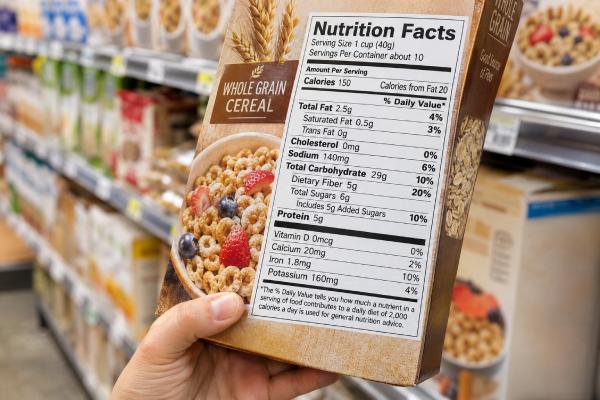
A heart-healthier Nutrition Facts label is not simply the one with the fewest calories or the lowest total fat. The fastest useful scan is to check the serving size first, then compare sodium, saturated fat, dietary fiber, and added sugars. For many packaged foods, those numbers tell you far more about cardiovascular quality than marketing words on the front. The percent Daily Value (%DV) makes comparison easier: as a general rule, 5% DV or less is low and 20% DV or more is high. For nutrients you usually want to limit—especially sodium and saturated fat—lower is generally better. For dietary fiber, higher is usually better. The label is most useful when you compare similar products at the amount you will actually eat. A soup that looks moderate per serving can become very high in sodium if the container holds two servings and you eat all of it. This guide shows exactly what to look at, in what order, and how to make practical heart-health tradeoffs.
Table of Contents
- Use a 30-Second Label Scan
- Start With Serving Size and Percent Daily Value
- Read Sodium Like a Blood Pressure Number
- Look for Fiber, Not Just Whole-Grain Claims
- Focus on Saturated Fat, Not Total Fat Alone
- Compare Added Sugars, Calories, and Ingredients in Context
- Avoid Common Label-Reading Mistakes
Use a 30-Second Label Scan
You do not need to study every line on a package. For heart health, use a repeatable sequence:
- Serving size: Is the listed amount close to what you will actually eat?
- Sodium: How many milligrams and what %DV are in that amount?
- Saturated fat: Is it low enough for the rest of your day?
- Dietary fiber: Does the food contribute meaningful fiber?
- Added sugars: Is sugar doing most of the work in a product that looks healthy?
- Calories: Do they make sense for the portion and purpose of the food?
- Ingredient list: Does the product resemble the type of food you think you are buying?
That order works because the biggest label problems are often hidden in portions. Imagine two frozen meals. Meal A lists 650 mg of sodium per serving and Meal B lists 480 mg. Meal B appears lower. But if Meal B’s package contains two servings and you plan to eat the whole tray, the real intake is 960 mg. The first task is always to convert the label into your portion.
For packaged food, useful heart-health targets can be summarized this way:
| Nutrient | FDA Daily Value | Quick interpretation |
|---|---|---|
| Sodium | 2,300 mg | Lower %DV is usually better |
| Saturated fat | 20 g | Lower %DV is usually better |
| Dietary fiber | 28 g | Higher %DV is usually better |
| Added sugars | 50 g | Lower is generally better for routine foods |
These Daily Values are reference points based on a 2,000-calorie diet. Your personal needs can differ, but the %DV is still very useful for comparing products because it puts nutrients on the same scale.
Start With Serving Size and Percent Daily Value
Serving size is not a recommended amount. It reflects the amount people typically consume and gives a standardized basis for the rest of the label. Every calorie, gram, milligram, and %DV on the panel refers to that serving unless a dual-column label also lists values for the entire package.
If you eat two servings, double the nutrients. If you eat half a serving, cut them in half. This matters most with foods such as soup, chips, cereal, sauces, frozen entrees, sweetened drinks, and snack packages that can easily be consumed in amounts larger than one labeled serving.
The %DV lets you judge whether a serving contains a little or a lot of a nutrient. The FDA’s general guide is:
- 5% DV or less: low.
- 20% DV or more: high.
Use that rule differently depending on the nutrient. A food with 25% DV fiber may be a strong fiber source. A food with 25% DV sodium is a large sodium contribution for one serving.
Do not add all the percentages down the label and expect them to total 100%. Each %DV refers to a different nutrient. Twenty percent DV sodium means that one serving supplies 20% of the daily sodium reference amount; it says nothing about fiber or fat.
Also remember that %DV is best for comparison, not perfection. A higher-sodium food can still fit in a day that is otherwise low in sodium. A food with some saturated fat may be reasonable if it provides useful nutrition and your overall pattern is low in saturated fat. Labels are decision tools, not pass/fail grades.
When comparing two products, match serving sizes as closely as possible. Comparing 1/2 cup of one cereal with 1 cup of another can be misleading. Use the grams listed next to serving size or mentally adjust for the portion you actually eat.
Read Sodium Like a Blood Pressure Number
Sodium deserves special attention because most dietary sodium comes from packaged and prepared foods, not from salt added at the table. High sodium intake can raise blood pressure, especially in people who are salt-sensitive, older, have hypertension, or have certain kidney or cardiovascular conditions.
The FDA Daily Value for sodium is 2,300 mg. Current U.S. blood pressure guidance also uses less than 2,300 mg per day as a practical goal and notes that lower intake can produce additional blood-pressure benefit for many people. You do not have to hit a precise number every day, but frequent high-sodium meals can make the weekly average climb quickly.
A useful label strategy is to look for routine foods that stay closer to 5% DV sodium and reserve higher-sodium choices for occasions when they are difficult to avoid. Foods at 20% DV or more per serving are high in sodium by the FDA’s general rule.
Watch the foods people often underestimate:
- Bread, rolls, tortillas, and bagels.
- Deli meat, smoked meat, and cured meat.
- Cheese and processed cheese products.
- Soups, broths, instant noodles, and sauces.
- Frozen meals and pizza.
- Canned beans or vegetables that are not reduced-sodium.
- Savory snacks and flavored crackers.
- Pickles, olives, condiments, and seasoning blends.
The problem is often accumulation. A sandwich with two slices of bread, deli meat, cheese, mustard, and a side of chips can deliver a large share of a day’s sodium even if no single item tastes extremely salty. Understanding where hidden sodium comes from makes label reading much faster.
When you compare canned foods, look for “no salt added,” “low sodium,” or reduced-sodium versions, but still verify the Nutrition Facts panel because claims have specific legal definitions and products within the same category vary. Draining and rinsing canned beans can also reduce some sodium while preserving their fiber and protein. See heart-healthier canned food choices for pantry examples.
Do not automatically replace sodium with large amounts of potassium-based salt substitute if you have kidney disease or take medicines that can raise potassium. Ask a clinician whether that strategy is safe for you.
Look for Fiber, Not Just Whole-Grain Claims
Dietary fiber is one of the few label numbers where a higher value is often a positive sign. The FDA Daily Value is 28 g. Fiber supports bowel function, fullness, blood sugar regulation, and cholesterol management. Soluble or viscous fibers from foods such as oats, barley, beans, lentils, fruit, and psyllium can help lower LDL cholesterol.
The fiber number can expose products that sound healthier than they are. A cereal may use words such as “multigrain,” “made with whole grains,” or “wheat” but still provide only 1 g of fiber per serving. Those terms do not guarantee that the product is mostly whole grain or meaningfully high in fiber.
For breads, cereals, crackers, and grain products, use three checks together:
- Look for a whole grain near the beginning of the ingredient list, such as whole wheat, oats, brown rice, or whole rye.
- Compare grams of dietary fiber between similar products.
- Check added sugars, because some high-fiber cereals and bars also contain a large amount of added sugar.
There is no single fiber threshold that makes every food “heart healthy.” Context matters. Plain oats may have a modest fiber number per serving but are a useful source of beta-glucan. A bean-based food may provide substantially more fiber along with protein and minerals. A highly processed snack may add isolated fiber while still being high in sodium, saturated fat, or sugar.
If LDL cholesterol is a concern, think beyond “total fiber” and include foods rich in soluble fiber. Soluble fiber for lowering LDL cholesterol is especially useful because it can be increased through familiar foods rather than supplements alone.
Increase fiber gradually if your usual intake is low, and drink enough fluid. A sudden jump from a very low-fiber diet to large amounts of bran, beans, and fiber supplements can cause bloating or discomfort.
Focus on Saturated Fat, Not Total Fat Alone
Total fat is a poor shortcut for judging heart health. Foods rich in unsaturated fats—such as nuts, seeds, olive oil, avocado, and many fish—can be high in total fat while fitting very well into a heart-healthy eating pattern. The more important label line for LDL cholesterol is often saturated fat.
The FDA Daily Value for saturated fat is 20 g on a 2,000-calorie reference diet. A product with 20% DV or more per serving is high by the FDA’s general rule. If you eat multiple servings, the saturated fat also multiplies.
Common packaged-food sources include:
- Butter-heavy baked goods and desserts.
- Full-fat dairy products and ice cream.
- Fatty or processed meats.
- Foods made with coconut oil or palm oil.
- Some frozen meals, pizza, pastries, and snack foods.
The practical goal is not to eliminate fat. It is to replace more saturated fat with unsaturated fats. Choosing olive or canola oil instead of butter, nuts instead of processed snack foods, fish instead of processed meat, and a lower-saturated-fat spread instead of coconut-based products can improve the fat pattern without creating a low-fat diet. The distinction is explained further in saturated versus unsaturated fat and heart risk.
Trans fat is also listed on the Nutrition Facts label, but there is no %DV. Industrial partially hydrogenated oils have been removed from most U.S. foods, yet small amounts of trans fat can occur naturally or remain in limited contexts. “0 g trans fat” can also legally represent a very small amount per serving, so the ingredient list still provides context.
Dietary cholesterol appears on the label, but for most people saturated fat and the overall dietary pattern are more useful everyday targets for LDL management than trying to minimize dietary cholesterol at all costs. Individual response varies, and people with very high LDL or specific medical conditions may need more personalized guidance.
For a practical food-level approach, use heart-healthy fats to choose and limit rather than treating all fat as one category.
Compare Added Sugars, Calories, and Ingredients in Context
Added sugars are listed separately from total sugars. Total sugars include naturally occurring sugars in foods such as milk and fruit as well as sugars added during processing. Added sugars identify the portion added as sweeteners. The FDA Daily Value is 50 g on a 2,000-calorie reference diet.
This distinction is especially useful for yogurt, cereal, granola, flavored oatmeal, plant-based drinks, sauces, and snack bars. A plain yogurt may contain naturally occurring lactose but little or no added sugar. A flavored version can contain a much larger amount of added sugar even when both have similar total sugars.
Added sugar matters for heart health because high intakes can make calorie control difficult and can worsen triglycerides and metabolic health in susceptible people. Sugary drinks are particularly easy to consume without much fullness. If this is a major issue, review where added sugar hides and how much is too much.
Calories still matter, but do not use them alone. A 150-calorie package of cookies and a 200-calorie serving of nuts are not nutritionally equivalent. Nuts provide unsaturated fat, fiber, minerals, and protein; the cookies may mainly provide refined starch, sugar, and saturated fat. On the other hand, nutrient-dense foods can still contribute excess calories if portions are routinely very large.
The ingredient list can clarify what the label numbers mean. Ingredients are listed in descending order by weight. Use the list to answer practical questions:
- Is a whole grain one of the first ingredients?
- Is the product mostly beans, vegetables, oats, nuts, or another recognizable base food?
- Are several forms of sugar near the top?
- Are coconut or palm oils contributing to a high saturated-fat value?
- Is the food heavily seasoned or cured in a way that explains high sodium?
Avoid turning ingredient counting into a purity test. A long ingredient list is not automatically unhealthy, and a short ingredient list is not automatically heart-protective. The nutrient profile and your overall dietary pattern matter more than the number of words on the package.
Avoid Common Label-Reading Mistakes
The biggest mistake is reading the front of the package before the back. Claims such as “natural,” “multigrain,” “made with whole grains,” “plant-based,” “keto,” or “protein” can sound healthy without telling you what matters for blood pressure or cholesterol. Treat front-of-package language as advertising until the Nutrition Facts panel confirms the details.
Other common errors include:
- Ignoring servings per container. A small package may still contain two or more labeled servings.
- Comparing products with different serving sizes. Normalize the portion before deciding which is lower in sodium or saturated fat.
- Choosing the lowest total fat automatically. Low-fat products can be high in refined carbohydrate, added sugar, or sodium.
- Assuming cholesterol-free means heart healthy. Plant-based foods contain no cholesterol but can still be high in saturated fat or sodium.
- Focusing on one nutrient. A high-fiber snack can still be very high in sugar; a low-sodium food can still be high in saturated fat.
- Treating %DV as a strict personal prescription. It is a reference tool, not a replacement for individualized dietary advice.
- Forgetting the day as a whole. A higher-sodium meal can fit more easily if other meals are mostly fresh, minimally processed foods.
For a fast grocery decision, compare two or three products in the same category and choose the one with a better combination of sodium, saturated fat, fiber, and added sugar for your needs. That is often more practical than searching for a “perfect” label.
You can also use a simple “per meal” reality check. If one frozen entree supplies 45% DV sodium and 35% DV saturated fat, it leaves much less room for those nutrients in the rest of the day. By contrast, a meal with 15% DV sodium, 8% DV saturated fat, and 20% DV fiber gives you more flexibility. Thinking in this way turns the label from a collection of numbers into a day-planning tool.
If you have heart failure, chronic kidney disease, diabetes, very high LDL cholesterol, or another condition with specific nutrition targets, your priorities may differ. For example, a person with kidney disease may need to consider potassium or phosphorus in addition to sodium, while someone with familial hypercholesterolemia may need especially aggressive saturated-fat and LDL-lowering strategies.
The best label is ultimately the one that helps you build a better overall eating pattern. Use packaged foods strategically, combine them with vegetables, fruit, legumes, whole grains, and other minimally processed foods, and let the label help you choose the better option when products are otherwise similar.
References
- How to Understand and Use the Nutrition Facts Label 2025
- Daily Value on the Nutrition and Supplement Facts Labels 2024
- Sodium on the Nutrition Facts Label 2024
- The Potential Effectiveness of Nutrient Declarations and Nutrition and Health Claims for Improving Population Diets 2024 (Systematic Review)
- Food Sources of Saturated Fat and Risk of Cardiovascular Disease: A Systematic Review [Internet] 2024 (Systematic Review)
- 2021 Dietary Guidance to Improve Cardiovascular Health: A Scientific Statement From the American Heart Association 2021 (Position Statement)
Disclaimer
This article offers general label-reading guidance and is not individualized nutrition or medical advice. People with kidney disease, heart failure, diabetes, severe hyperlipidemia, food allergies, or other conditions may need different nutrient targets. A registered dietitian or healthcare professional can help translate label values into your personal plan.