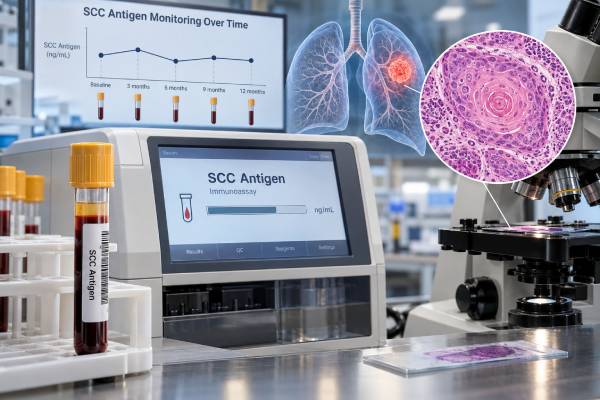
The SCC antigen test is a blood test that measures squamous cell carcinoma antigen, a protein released in higher amounts by some squamous cell cancers. In lung cancer, the marker is most closely associated with squamous cell carcinoma, but it is not accurate enough to diagnose lung cancer, determine its stage, or rule cancer out on its own. Its main potential value is as a supporting marker and, in selected patients whose level is elevated before treatment, as one more way to follow the disease over time. Results need context because kidney dysfunction, inflammatory conditions, and several non-lung cancers can also raise SCC antigen. The most useful interpretation therefore comes from trends, the laboratory’s own reference interval, imaging, pathology, and the patient’s clinical course rather than from a single number. A normal SCC antigen result does not exclude squamous cell lung cancer, and an elevated result does not prove that lung cancer is present.
- What it measures: SCC antigen is a blood marker related to serpin proteins produced by squamous epithelial cells and some squamous cancers.
- What a high result means: An elevated level may occur with lung squamous cell carcinoma, but it is nonspecific and can also reflect kidney disease, inflammation, or another squamous cancer.
- Typical cutoff: Laboratories often use a cutoff near 1.5–2.0 ng/mL, but methods differ, so the reference range printed on the report is the correct one to use.
- Best use in lung cancer: The test may help with monitoring when SCC antigen was clearly elevated before treatment; a falling trend can support response, while a persistent or rising trend may prompt further evaluation.
- What it cannot do: SCC antigen should not be used alone for lung cancer screening, diagnosis, histologic classification, staging, or treatment selection.
Table of Contents
- What the SCC Antigen Test Measures
- Why SCC Antigen Is Used in Lung Cancer
- Understanding SCC Antigen Results
- Causes of an Elevated SCC Antigen Result
- Using SCC Antigen for Monitoring
- How SCC Antigen Compares With Other Lung Cancer Biomarkers
- Practical Testing and Follow-Up
What the SCC Antigen Test Measures
SCC antigen is a circulating protein marker linked to the serpin family, especially SERPINB3 and SERPINB4, historically called squamous cell carcinoma antigen 1 and 2. These proteins can be produced by normal squamous epithelium, but some squamous cancers release enough into the blood to create a measurable increase.
The test is usually performed on serum from a routine venous blood draw. The laboratory reports a concentration, commonly in nanograms per milliliter (ng/mL). There is no universally interchangeable “normal” value because laboratories may use different antibodies, analyzers, calibration systems, and reference populations.
For that reason, the number should always be interpreted against the reference interval printed on the same report. A value of 1.8 ng/mL could be above range in one laboratory and within range in another. Comparing results from different laboratories can also be misleading if the assay methods differ.
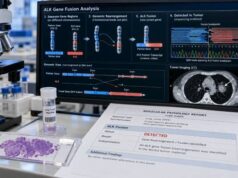
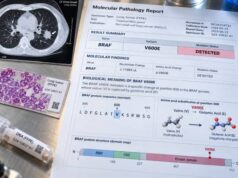
SCC antigen is not a genetic biomarker. It does not identify a mutation, gene fusion, or drug target. It is also not an immunohistochemistry stain used directly on tumor tissue. Those distinctions matter because modern lung cancer workups use several different types of biomarkers for different jobs. Tissue markers such as the p40 squamous cell marker help pathologists classify tumor cells, while molecular tests identify actionable alterations. SCC antigen instead reflects a protein concentration circulating in blood.
A high concentration can be associated with a larger amount of tumor activity in some patients, but the relationship is inconsistent. Some people with advanced squamous lung cancer have a normal SCC antigen level, while some people without lung cancer have an elevated result. That is why the test has limited sensitivity and specificity when used by itself.
Why SCC Antigen Is Used in Lung Cancer
The strongest association between SCC antigen and lung cancer is with squamous cell carcinoma of the lung, one of the major histologic types of non-small cell lung cancer (NSCLC). Studies have generally found higher concentrations and higher positivity rates in lung squamous cell carcinoma than in lung adenocarcinoma or many benign lung conditions.
That association can make the test a useful supporting clue, especially when it is considered alongside other findings. It does not replace biopsy. Pathology remains the basis for confirming lung cancer and establishing whether a tumor is squamous, adenocarcinoma, small cell carcinoma, or another type.
In practice, SCC antigen may be used for three broad purposes:
- Supporting clinical assessment: An elevated level can add information when a patient already has a suspicious lung lesion or a known squamous tumor, but it cannot establish the diagnosis.
- Establishing a baseline before treatment: If the level is clearly elevated before surgery, radiation, chemotherapy, or systemic treatment, that baseline can provide a personal comparison point later.
- Following trends during or after treatment: A sustained decline may parallel reduction in disease burden, while a renewed rise may justify closer assessment when it agrees with symptoms or imaging.
The marker is much less useful when the pretreatment value is normal. If a person’s tumor never produces enough SCC antigen to elevate the blood level, repeated testing is unlikely to become a reliable disease-monitoring tool.
SCC antigen is not recommended as a stand-alone screening test for people without a diagnosis. Screening tests need very strong performance because false-positive results can lead to unnecessary scans and procedures, while false-negative results can create false reassurance. SCC antigen does not meet that standard. Lung cancer screening for eligible high-risk adults is based on low-dose CT rather than serum SCC antigen.
It also should not be confused with a broad lung cancer biomarker panel, which can include molecular alterations and PD-L1 testing that directly influence treatment choices. SCC antigen is primarily a circulating protein marker, not a companion diagnostic for targeted therapy.
Understanding SCC Antigen Results
The safest way to read an SCC antigen result is to start with the laboratory reference range, then ask whether the value is new, persistent, changing, or already known to be elevated in that individual.
Many laboratories use an upper reference limit around 1.5 to 2.0 ng/mL, but cutoffs vary enough that a fixed internet range should not override the report. The result is also more informative as a trend than as an isolated measurement.
| Result pattern | What it may mean | Typical next step |
|---|---|---|
| Within the laboratory reference range | Does not exclude squamous cell lung cancer; the tumor may not release measurable SCC antigen | Interpret using pathology, imaging, and other clinically indicated tests |
| Mildly above range | May reflect cancer, kidney dysfunction, inflammation, skin disease, or assay variation | Review kidney function, clinical context, and whether repeat testing is useful |
| Clearly elevated before treatment | May provide a useful personal baseline if the patient has confirmed squamous cell lung cancer | Consider trend monitoring if it will affect clinical assessment |
| Falls during effective treatment | Can be consistent with reduced tumor activity or burden | Confirm response with the standard clinical and imaging plan |
| Rises repeatedly after a previous decline | May indicate renewed disease activity, but false elevations remain possible | Evaluate alongside symptoms, imaging, examination, and other test results |
A single high result should not be converted directly into a cancer stage. A concentration twice the upper limit of normal does not mean the cancer is “twice as advanced,” and there is no validated conversion between an SCC antigen concentration and tumor size.
Likewise, a change needs to be large enough and persistent enough to be clinically credible. Small fluctuations can occur because of biologic variation, differences in specimen handling, assay imprecision, hydration, or changes in kidney function. When monitoring is planned, using the same laboratory and assay whenever possible makes trends easier to interpret.
The result is most useful when the clinician can answer a specific question, such as: Was SCC antigen elevated before treatment? Did it decrease after surgery? Is it rising on repeated measurements at the same time that symptoms or imaging are becoming more concerning? Without that context, the number has limited value.
Causes of an Elevated SCC Antigen Result
An elevated SCC antigen result is not specific to lung cancer. Several malignant and nonmalignant conditions can increase the concentration, which is one of the main reasons the test cannot diagnose lung cancer by itself.
Other squamous cancers may raise SCC antigen, including cancers of the cervix, head and neck, esophagus, skin, and other sites. If a person has a history of another squamous malignancy, the source of an elevated marker cannot be assumed from the blood test alone.
Non-cancer causes are also important. Reduced kidney clearance can substantially increase SCC antigen, and older studies showed particularly misleading elevations in renal failure. Kidney function should therefore be reviewed when a result is unexpectedly high or changes without an obvious cancer-related explanation.
Benign inflammatory and epithelial conditions can also raise SCC antigen. Reported examples include some chronic skin diseases and inflammatory disorders involving squamous epithelium. The exact degree of elevation varies, and no single threshold perfectly separates benign from malignant causes.
Pre-analytic issues may matter as well. Because SCC antigen proteins can be present in skin and saliva, laboratories use controlled collection and handling procedures to reduce contamination. Clinicians generally do not need to manage these technical details, but an unexpected isolated value can justify repeat measurement before making a major decision.
The key principle is that SCC antigen is a context marker, not a cancer detector. A high level becomes more meaningful when a person already has pathologically confirmed lung squamous cell carcinoma and the marker tracks consistently with treatment and disease status. The same number in a person with no cancer diagnosis has a very different interpretation.
When a lung lesion has not yet been classified, serum markers are secondary to tissue diagnosis. For example, pathology may use p40, cytokeratin markers, or other stains to establish squamous differentiation. A blood SCC antigen result may be supportive, but it cannot replace those tumor-based methods.
Using SCC Antigen for Monitoring
SCC antigen monitoring makes the most sense when the marker was elevated at baseline and changes in a way that has already been shown to reflect the individual patient’s disease. The goal is not to replace scans or clinical review, but to add another data point that may support an emerging pattern.
A useful monitoring sequence often looks like this:
- Measure a pretreatment baseline. A clearly elevated value shows that the tumor may be a measurable source of SCC antigen.
- Repeat at clinically meaningful time points. Testing may be timed with treatment cycles, postoperative follow-up, or scheduled imaging rather than performed randomly.
- Focus on the trend. A sustained decline is generally more reassuring than a single low value. A sustained rise matters more than a small one-time increase.
- Check for alternative explanations. Kidney function, inflammation, another malignancy, and assay differences can distort the trend.
- Confirm important changes with standard assessment. Imaging, symptoms, physical examination, and pathology when needed remain the deciding evidence.
After complete surgical removal of a tumor that was producing SCC antigen, the level may fall. Failure to normalize does not automatically mean residual cancer, but it can trigger a review of other causes and the overall postoperative evaluation. Conversely, normalization does not prove that every cancer cell is gone.
During systemic treatment, falling SCC antigen can be consistent with response. However, serum markers have not replaced radiographic response criteria. CT or other appropriate imaging remains central because tumors can change in size or metabolic activity without a perfectly parallel change in serum markers.
For recurrence surveillance, a rising level can sometimes precede or accompany clinically detectable progression, but the lead time is variable. Acting on an isolated rise without corroborating evidence risks unnecessary testing. The most useful approach is to treat the marker as an early signal that needs verification, not as proof of recurrence.
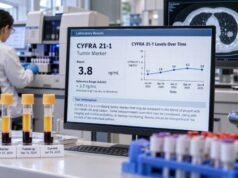
Other circulating markers can sometimes provide complementary information. The CYFRA 21-1 lung cancer test, for example, has been studied extensively in NSCLC and is often elevated in squamous disease. The choice of marker should depend on which one was informative at baseline and how the oncology team uses it in a structured follow-up plan.
How SCC Antigen Compares With Other Lung Cancer Biomarkers
Lung cancer biomarkers fall into several categories, and they should not be treated as interchangeable. SCC antigen belongs to the circulating protein-marker group. It can reflect tumor phenotype or burden in some people, but it usually does not determine a specific therapy.
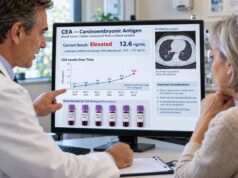
By comparison, CEA and CYFRA 21-1 are other circulating protein markers used in some clinical settings. CEA is more often associated with adenocarcinoma but can rise in several cancers and benign conditions. The CEA test for lung cancer may be followed when elevated at baseline, while CYFRA 21-1 is commonly linked with NSCLC and squamous histology.
Small cell lung cancer has a different marker pattern. ProGRP and neuron-specific enolase are more closely associated with neuroendocrine biology and are more relevant when small cell carcinoma is suspected or already diagnosed.
Tissue immunohistochemistry answers a different question: What type of tumor is this? In a poorly differentiated NSCLC, p40 positivity strongly supports squamous differentiation, while TTF-1 and Napsin A can support adenocarcinoma in the appropriate morphologic context. SCC antigen in blood cannot provide the same level of classification certainty.
Molecular biomarkers answer yet another question: Does this tumor have an alteration that can guide targeted treatment? EGFR mutations, ALK or ROS1 fusions, RET fusions, MET exon 14 skipping, and other driver alterations can be directly actionable. PD-L1 expression can also help guide immunotherapy decisions. SCC antigen does not substitute for any of these tests.
This distinction prevents a common mistake: assuming that all “tumor markers” are used for the same purpose. A marker can be diagnostic, prognostic, predictive, or useful for monitoring, and some are useful in more than one role. SCC antigen is mainly a supportive serum marker with possible monitoring value in selected patients, not a definitive diagnostic or predictive biomarker.
Practical Testing and Follow-Up
The SCC antigen test usually requires only a standard blood draw. Fasting is generally not required unless the laboratory or clinician ordered other tests that require it. There is no special diet that reliably lowers SCC antigen before testing, and trying to manipulate the result would make monitoring less useful.
Before the test, it is reasonable to tell the clinician about known kidney disease, recent major inflammation, chronic skin disease, and any other cancer diagnosis. These factors may change how an elevated result is interpreted.
When reviewing a report, focus on four questions:
- Is the value inside or outside this laboratory’s reference range?
- Was SCC antigen elevated before treatment, or is this the first measurement?
- Is the current value part of a consistent upward or downward trend?
- Do imaging, symptoms, kidney function, and other findings point in the same direction?
If the result is mildly elevated but there is no established lung cancer diagnosis, the appropriate response is not to assume cancer. The clinician may repeat the test, review kidney function, evaluate symptoms, and determine whether imaging or other diagnostic workup is indicated based on the overall clinical picture.
If the patient already has squamous cell lung cancer, the oncology team may decide that serial SCC antigen measurements add useful information. A test that never becomes elevated may simply be discontinued because it is not informative for that patient.
Patients should seek timely medical assessment for new or worsening symptoms such as coughing up blood, increasing shortness of breath, persistent chest pain, new neurologic symptoms, or rapid unexplained decline regardless of the SCC antigen value. A normal tumor marker should never delay evaluation of concerning symptoms.
The practical takeaway is simple: SCC antigen is most valuable when it is treated as one piece of longitudinal evidence. Pathology establishes the cancer type, imaging shows where disease is and how it changes, molecular testing guides treatment when applicable, and the blood marker may add a convenient trend in patients whose tumors release it. Used in that limited role, it can be informative. Used as a stand-alone cancer test, it is too nonspecific and too insensitive to be reliable.
References
- Circulating lung cancer biomarkers: From translational research to clinical practice 2024 (Review)
- Diagnostic potential of protein serum biomarkers for distinguishing small and non-small cell lung cancer in patients with suspicious lung lesions 2024
- Serum tumor markers for response prediction and monitoring of advanced lung cancer: A review focusing on immunotherapy and targeted therapies 2023 (Review)
- Prognostic value of blood-based protein biomarkers in non-small cell lung cancer: A critical review and 2008-2022 update 2024 (Review)
- Diagnostic value of serum tumor markers CEA, CYFRA21-1, SCCAg, NSE and ProGRP for lung cancers of different pathological types 2022
- Blood protein biomarkers in lung cancer 2022 (Review)
Disclaimer
SCC antigen is not a stand-alone test for diagnosing, staging, or ruling out lung cancer. Results should be interpreted by a qualified clinician together with pathology, imaging, kidney function, symptoms, and other relevant findings. Do not change cancer treatment or delay evaluation of concerning symptoms based on an SCC antigen result alone.