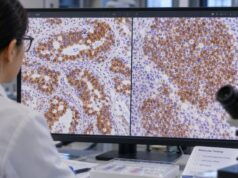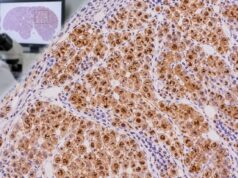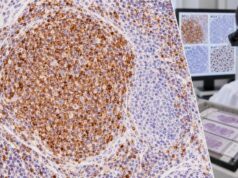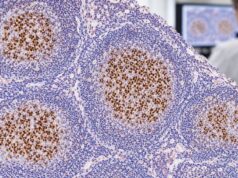
SMAD4 immunohistochemistry (IHC), also called DPC4 IHC, is a tissue stain that shows whether tumor cells retain or lose detectable SMAD4 protein. SMAD4 is a tumor-suppressor protein in the transforming growth factor-beta signaling pathway, and loss of SMAD4 function is a common molecular event in pancreatic ductal adenocarcinoma. In practice, pathologists compare the tumor with non-neoplastic cells on the same slide. Complete loss in the cancer cells, with preserved staining in internal controls such as stromal or inflammatory cells, supports true SMAD4 loss. The finding can help in difficult pancreatic or metastatic carcinoma workups and may provide prognostic information, but it is not specific enough to diagnose pancreatic cancer on its own. Roughly half of pancreatic ductal adenocarcinomas retain SMAD4, and loss can occur in other malignancies. The result therefore works best as one piece of an integrated morphologic, immunohistochemical, molecular, and clinical assessment.
- SMAD4 loss means tumor cells lack expected staining while internal control cells remain positive.
- About half of pancreatic ductal adenocarcinomas show SMAD4 loss, so retained staining does not rule out pancreatic cancer.
- SMAD4 loss is not specific to the pancreas and must be interpreted with morphology and other lineage markers.
- SMAD4 IHC is a tissue test, not a blood test; there is no normal serum range or patient preparation.
- The result can support diagnosis and may carry prognostic information, but it does not by itself select a treatment.
Table of Contents
- What the SMAD4 IHC test detects
- What SMAD4 loss means in pancreatic cancer
- Retained, lost, and technically uncertain SMAD4 patterns
- Diagnostic value and important limitations
- Does SMAD4 loss affect prognosis or treatment?
- How SMAD4 fits into a pancreatic tumor workup
- How to read SMAD4 wording in a pathology report
What the SMAD4 IHC test detects
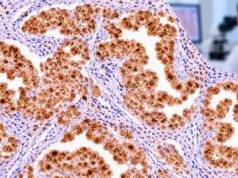
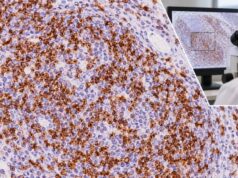
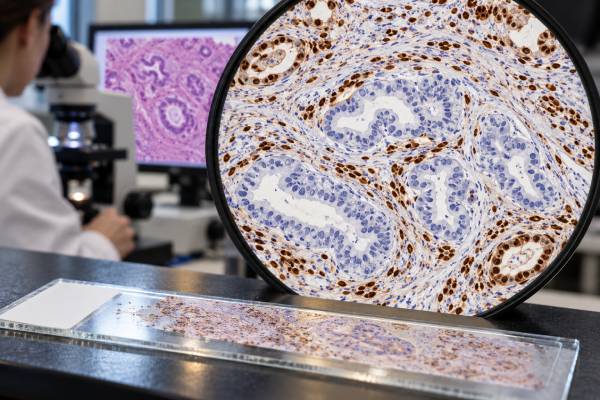
SMAD4 IHC detects the protein product of the SMAD4 gene in formalin-fixed tumor tissue. Normal epithelial cells, stromal cells, lymphocytes, and other non-neoplastic cells generally provide internal positive controls. In a retained pattern, the tumor shows staining comparable with these controls. In a loss pattern, the tumor cells lack convincing staining while the surrounding non-neoplastic cells remain positive.
SMAD4 is also historically called DPC4, so pathology reports may use either name. An DPC4 IHC interpretation and SMAD4 IHC interpretation refer to the same core biologic marker.
The stain is especially useful in pancreatic pathology because genetic inactivation of SMAD4 occurs in a substantial fraction of pancreatic ductal adenocarcinomas. IHC often mirrors the underlying gene status, making it a practical surrogate in routine tissue diagnosis, although molecular testing can provide more detailed genomic information.
What SMAD4 loss means in pancreatic cancer
Loss of SMAD4 supports a molecularly altered tumor phenotype and is seen in approximately 50% to 55% of pancreatic ductal adenocarcinomas in many series. The key word is supports: loss does not prove pancreatic origin, and retained staining does not exclude pancreatic ductal adenocarcinoma.
The result is often most helpful when morphology already suggests pancreaticobiliary adenocarcinoma. For example, in a liver or lung metastasis from a patient with a pancreatic mass, SMAD4 loss that matches the primary tumor can add evidence that both lesions are related. In a small pancreatic biopsy showing atypical glands, loss may also increase concern for malignancy when interpreted with histology, although it is not sufficiently sensitive to be used as a sole cancer screen.
Pathologists may combine SMAD4 with keratins, mucin markers, and site-oriented stains. An MUC5AC IHC result, for example, may contribute to a pancreatobiliary or upper-GI differential but has its own limitations.
Retained, lost, and technically uncertain SMAD4 patterns
The most important distinction is whether the tumor has a credible internal control.
| Pattern | Typical interpretation | Key check |
|---|---|---|
| Retained | Tumor cells show SMAD4 staining | Consistent with preserved protein expression; does not exclude PDAC |
| Complete loss | Tumor cells are negative while surrounding non-neoplastic cells stain | Supports true SMAD4 loss |
| Weak or heterogeneous | Variable staining across tumor | May require another block, technical review, or molecular correlation |
| No staining anywhere | Tumor and internal controls are negative | Technically uninterpretable rather than true biologic loss |
Preanalytic factors such as fixation and tissue damage can affect IHC. This is why an all-negative slide cannot simply be called SMAD4 loss. The pathologist needs positive non-tumor cells on the same section or another valid control to show that the assay worked.
Diagnostic value and important limitations
SMAD4 loss is useful but not organ-specific. Alterations can occur in colorectal, biliary, gastric, and other cancers. Conversely, a large fraction of pancreatic cancers retain the protein. The stain therefore performs poorly as a stand-alone “pancreatic cancer marker.”
Its best use is contextual. A pancreatic mass with classic ductal adenocarcinoma morphology does not need SMAD4 loss to be malignant. A metastatic adenocarcinoma with an uncertain primary may benefit from SMAD4 when it is interpreted alongside CK7, CK20, CDX2, SATB2, TTF-1, PAX8, GATA3, and other stains selected for the specific differential.
SMAD4 can also be informative in precursor lesions and related pancreatic neoplasms, but expression patterns vary by entity. The pathologist must distinguish conventional pancreatic ductal adenocarcinoma from intraductal papillary mucinous neoplasms, pancreatobiliary tumors, acinar neoplasms, and neuroendocrine neoplasms using morphology and broader panels.
Does SMAD4 loss affect prognosis or treatment?
Many studies associate SMAD4 loss or alteration with more aggressive pancreatic ductal adenocarcinoma biology and poorer outcomes, although the magnitude and independence of that effect vary across cohorts and treatment settings. Recent work in patients receiving neoadjuvant therapy continues to evaluate whether retained versus lost SMAD4 identifies clinically meaningful subgroups.
For an individual patient, SMAD4 IHC should not be treated as a stand-alone survival forecast. Stage, resection margins, lymph nodes, tumor grade, performance status, treatment response, and the broader genomic profile remain more important for clinical decisions.
SMAD4 status also does not currently function like a validated companion diagnostic that automatically assigns a specific drug. Molecular profiling may reveal other actionable alterations, and clinical trials continue to investigate how SMAD4 biology affects therapeutic resistance and the tumor microenvironment. The pathology result is therefore best viewed as diagnostic and biologic context rather than a direct prescription.
How SMAD4 fits into a pancreatic tumor workup
A pancreatic tumor workup often combines morphology with cytology or biopsy findings, cross-sectional imaging, serum markers such as CA 19-9, and selective IHC. When the lesion is clearly a conventional ductal adenocarcinoma, an extensive panel may not be needed. When the tumor is poorly differentiated or metastatic, the panel becomes more important.
SMAD4 can be paired with broad epithelial markers and lineage markers while tissue is preserved for next-generation sequencing. This balance matters because small biopsies contain limited tumor. A thoughtful panel answers the key diagnostic question without exhausting material needed for molecular testing.
The same principle applies in a multi-marker tumor IHC panel: pathologists use morphology to choose the smallest informative set of stains, then expand only when results remain ambiguous.
How to read SMAD4 wording in a pathology report
If a report says “loss of SMAD4 expression,” look for evidence that internal controls are retained. That phrase usually means the pathologist considers the pattern biologically meaningful. If the report says “retained,” it means the tumor still shows detectable protein and does not imply that the tumor is benign.
Useful follow-up questions are whether the stain was performed to help establish pancreatic origin, to characterize a known pancreatic cancer, or to assess a difficult biopsy. Ask whether the result changes the final diagnosis or simply supports it.
Patients should avoid translating “SMAD4 loss” into “the cancer has spread” or “treatment will not work.” Those conclusions cannot be made from this stain alone. The oncology team integrates the result with stage, imaging, surgery findings, molecular testing, and treatment response.
References
- Prognostic role and clinicopathological features of SMAD4 gene mutation in pancreatic cancer: a systematic review and meta-analysis. 2026 (Systematic Review)
- New insight into the role of SMAD4 mutation/deficiency in the prognosis and therapeutic resistance of pancreatic ductal adenocarcinomas. 2024 (Review)
- Significance of TP53, CDKN2A, SMAD4 and KRAS in Pancreatic Cancer. 2024 (Review)
- Pancreatic Cancer Biomarkers: Oncogenic Mutations, Tissue and Liquid Biopsies, and Radiomics-A Review 2023 (Review)
- SMAD4 Positive Pancreatic Ductal Adenocarcinomas Are Associated with Better Outcomes in Patients Receiving FOLFIRINOX-Based Neoadjuvant Therapy. 2023 (Study)
- Immunohistochemical labeling for dpc4 mirrors genetic status in pancreatic adenocarcinomas : a new marker of DPC4 inactivation. 2000 (Study)
Disclaimer
SMAD4 IHC is an ancillary pathology test and should not be interpreted as a stand-alone diagnostic, staging, prognostic, or treatment test. The significance of retained or lost staining depends on the tumor type, internal controls, morphology, and the patient’s clinical findings. Discuss the complete pathology report with the treating team.