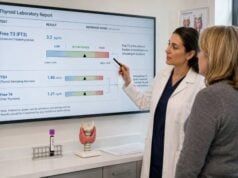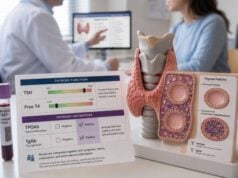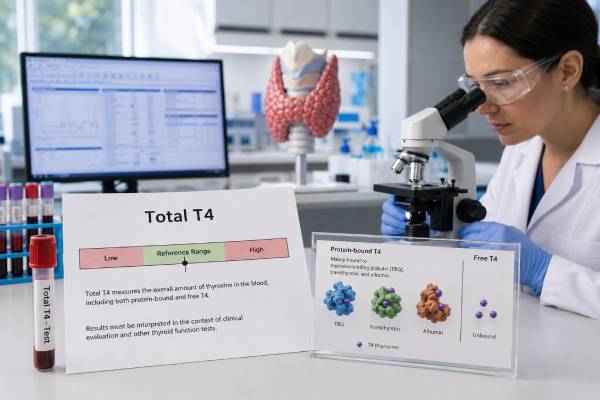
A total T4 test measures all thyroxine in the blood, including hormone bound to transport proteins and the small free fraction. T4 is the main hormone released by the thyroid and serves as the source for much of the body’s T3. The test can help evaluate thyroid function, but it is strongly affected by thyroxine-binding globulin and other carrier proteins. Pregnancy, oral estrogen, inherited binding-protein variants, liver disease, kidney protein loss, and several medicines may raise or lower total T4 without causing true hyperthyroidism or hypothyroidism. TSH and free T4 usually provide a clearer first-line assessment in nonpregnant adults. Total T4 remains useful in selected situations, including pregnancy when free T4 assays are difficult to interpret, newborn screening programs, and investigation of discordant thyroid results. A result should be compared with the laboratory’s age- and method-specific interval and interpreted with TSH, free T4 or free thyroxine index, symptoms, medications, illness, and pregnancy status.
- Total T4 includes both bound and free thyroxine, so binding proteins can change the result without changing thyroid function.
- High total T4 with low TSH usually supports hyperthyroidism; high total T4 with normal TSH often reflects increased binding proteins.
- Low total T4 with high TSH supports primary hypothyroidism; low total T4 with normal TSH may reflect low TBG or illness.
- Many adult reference intervals are roughly 5–12 mcg/dL, but ranges vary by assay, age, and pregnancy status.
- Pregnancy and oral estrogen often raise total T4, while nephrotic syndrome, severe liver disease, and inherited TBG deficiency can lower it.
- Unexpected results should be checked against TSH, a reliable free T4 measure, medication timing, and assay interference.
Table of Contents
- What the Total T4 Test Measures
- When Total T4 Is Used
- Normal Range and Common Result Patterns
- Causes of High Total T4
- Causes of Low Total T4
- Pregnancy, Newborns, and Special Cases
- Preparation, Limitations, and Follow-Up
What the Total T4 Test Measures
Thyroxine, or T4, contains four iodine atoms and is the main hormone secreted by the thyroid gland. T4 has biologic effects of its own, but it also acts as a circulating reserve that tissues convert into the more active hormone T3. The pituitary monitors thyroid hormone exposure and adjusts TSH, which tells the thyroid how much hormone to make.
A total T4 assay measures the entire circulating pool. More than 99.9% of T4 is attached to thyroxine-binding globulin, transthyretin, albumin, and other proteins. Only about 0.02% to 0.04% is free at one time. Because the bound portion is so large, a change in carrier-protein concentration can shift total T4 substantially while the free fraction stays normal.
This is why total T4 is not interchangeable with the free T4 test. Free T4 attempts to measure unbound hormone and usually tracks thyroid status more closely when interpreted with TSH. Total T4 can still be clinically valuable, but its binding-protein dependence must be considered from the start.
The body usually compensates for a carrier-protein change. When TBG rises, more T4 becomes bound, briefly lowering free T4. The pituitary responds, the thyroid produces more hormone, and free T4 returns toward its set point. Total T4 remains higher because the bound reservoir is larger. When TBG falls, the total pool contracts, yet free T4 and TSH may remain normal.
Total T4, T3 uptake, and the free thyroxine index
Before direct free T4 assays became common, laboratories combined total T4 with a thyroid hormone uptake test. High TBG usually produces low T3 uptake, while low TBG produces high uptake. The values are combined into the free thyroxine index, an estimate intended to correct total T4 for ordinary binding changes.
The index remains useful in some laboratories and in selected discordant cases. It is not a direct hormone measurement, and it can fail when binding abnormalities are extreme, several proteins are affected, or severe illness changes hormone-protein interactions. The laboratory’s validated method determines whether a direct free T4, free thyroxine index, or reference procedure such as equilibrium dialysis is most dependable.
When Total T4 Is Used
TSH is usually the first thyroid test in a stable person without suspected pituitary disease. If TSH is abnormal, free T4 is commonly added. Total T4 is ordered when it answers a more specific question or when free T4 measurement has known limitations.
Situations in which total T4 may be useful include:
- Pregnancy, using a gestation- and assay-appropriate range
- Newborn screening programs that measure T4 before or with TSH
- Suspected binding-protein abnormalities
- An implausible or method-dependent free T4 result
- Monitoring selected patients when the local laboratory has validated total T4 targets
- Investigation of inherited TBG, transthyretin, or albumin variants
- Evaluating unusual combinations of TSH, free T4, symptoms, and medication exposure
A total T4 result can also support a diagnosis when it agrees with TSH. High total T4 and suppressed TSH are consistent with hyperthyroidism, particularly when free T4 or T3 is also high. Low total T4 and elevated TSH support primary hypothyroidism. The full thyroid function pattern is more informative than any one number.
Total T4 is not an ideal stand-alone screening test in adults. It can misclassify a person with altered binding proteins, and it may miss subclinical thyroid disease because TSH changes before T4 leaves its range. It also cannot distinguish primary thyroid disease from pituitary disease without TSH and clinical context.
Why a clinician may choose total T4 over free T4
Direct free T4 immunoassays estimate an extremely small unbound fraction while trying not to disturb the equilibrium between bound and free hormone. Pregnancy, severe illness, heparin, unusual albumin variants, autoantibodies, and major binding-protein shifts can affect that measurement differently across platforms. In these settings, total T4 interpreted with a corrected reference interval may be more stable.
The choice is not universal. Some laboratories have strong pregnancy-specific free T4 intervals, while others rely on total T4 or free T4 index. The result must match the method and reference data used by that laboratory rather than a fixed internet target.
Normal Range and Common Result Patterns
Adult total T4 intervals often fall near 5–12 mcg/dL, or approximately 64–154 nmol/L, but there is no universal normal range. Laboratories differ in calibration and population selection. Infants and children have age-specific intervals, and pregnancy raises the expected total T4 concentration. Use the range printed on the report.
A value just outside the interval should be interpreted cautiously. Normal biological variation, time of sampling, recent levothyroxine dosing, a change in estrogen exposure, and method imprecision can move a result across a cutoff. Repeated trends on the same assay are usually more useful than comparisons among unrelated laboratories.
| TSH | Total T4 | Free T4 | Common interpretation |
|---|---|---|---|
| Low | High | High | Overt hyperthyroidism |
| Normal | High | Normal | High TBG, pregnancy, estrogen, inherited binding change, or assay interference |
| High | Low | Low | Primary hypothyroidism |
| Normal | Low | Normal | Low TBG, protein loss, inherited deficiency, or some illness patterns |
| Low or normal | Low | Low | Central hypothyroidism, severe illness, medication effect, or assay issue |
| High | Normal | Normal | Subclinical hypothyroidism or recovery from illness |
The same total T4 value can have different meanings. A concentration of 13 mcg/dL may be high for a nonpregnant adult on one method but expected during later pregnancy. A value of 4 mcg/dL may reflect hypothyroidism when TSH is elevated and free T4 is low, but inherited TBG deficiency when TSH and free T4 are normal.
“Optimal” total T4 targets are not standardized outside defined clinical settings. Treatment should not aim to push every person toward the middle or top of the range. In primary hypothyroidism, TSH is generally the main levothyroxine target. In central hypothyroidism, free T4 and clinical assessment guide treatment because TSH is unreliable.
The direction of change can be as important as the absolute value. A steadily falling total T4 after thyroid surgery, radioactive iodine, or destructive thyroiditis may precede a clear TSH rise because pituitary feedback takes time. Conversely, TSH can remain suppressed for weeks or months after hyperthyroidism improves. Clinicians therefore compare the current result with earlier values, treatment dates, and free hormone measurements rather than expecting every marker to normalize together.
Results also need age context. Newborns and young children have different thyroid hormone concentrations from adults, while older adults may have fewer symptoms despite clinically important disease. A report that does not display an age-appropriate interval should be clarified with the laboratory before conclusions are made.
Causes of High Total T4
High total T4 can reflect true hormone excess, increased binding, reduced clearance, medication exposure, or analytical interference. TSH is the quickest way to separate many of these possibilities.
True hyperthyroidism usually produces suppressed TSH. Causes include Graves disease, toxic multinodular goiter, a toxic adenoma, iodine-induced hyperthyroidism, and some forms of thyroiditis. Free T4 and often T3 rise as well. Antibody testing, uptake imaging, ultrasound in selected cases, and the clinical history identify the cause.
Exogenous thyroid hormone can also raise total T4. A blood sample drawn in the hours after levothyroxine may show a temporary post-dose increase, particularly in free T4. Repeated testing should use consistent timing. Taking more medication than prescribed, accidental ingestion, or factitious use can suppress TSH and raise T4.
High binding proteins with normal thyroid function
Pregnancy and oral estrogen are common reasons for high total T4 with normal TSH. Estrogen raises TBG by increasing its production and slowing clearance. Combined hormonal contraceptives and oral menopausal hormone therapy can have the same effect. Some people taking estrogen who also use levothyroxine need a dose adjustment, but the decision is made from TSH and free hormone status rather than total T4 alone.
Inherited TBG excess and familial dysalbuminemic hyperthyroxinemia can produce persistent high total T4. In familial dysalbuminemic hyperthyroxinemia, an albumin variant binds T4 more strongly. Some free T4 immunoassays may also read high, while TSH and clinical status remain normal. Recognizing the inherited pattern prevents antithyroid treatment or repeated imaging.
Selected liver conditions, acute hepatitis, and certain medications can increase TBG or alter binding. A direct TBG test may clarify a consistent high-total/normal-TSH pattern.
Assay interference
High-dose biotin can cause falsely high total or free T4 on susceptible competitive immunoassays while producing falsely low TSH on sandwich assays. This combination can imitate hyperthyroidism. Thyroid hormone autoantibodies, heterophile antibodies, anti-reagent antibodies, and rare paraprotein effects can also distort measurements.
Clues include severe biochemical abnormality without symptoms, a normal result on another platform, inconsistent T3 values, or a sudden change without a clinical reason. Repeating the sample after an appropriate biotin pause or using a different method is safer than treating an isolated surprising result.
Causes of Low Total T4
Low total T4 with high TSH is the classic pattern of primary hypothyroidism. Hashimoto thyroiditis is a common cause. Other causes include thyroid surgery, radioactive iodine treatment, severe iodine deficiency or excess, destructive thyroiditis after the hyperthyroid phase, and medications that impair thyroid hormone production.
Low total T4 with low or inappropriately normal TSH requires a different approach. It may indicate central hypothyroidism from pituitary or hypothalamic disease, especially when free T4 is also low. Symptoms, other pituitary hormones, headaches, visual changes, prior brain radiation, trauma, or postpartum hemorrhage increase concern. Central hypothyroidism should not be dismissed because TSH falls within the laboratory range.
Severe nonthyroidal illness can lower total T4. Early illness often lowers T3 first; prolonged or critical illness may reduce T4 and alter TSH. Binding proteins, metabolism, transport, and assay behavior all change. Treatment usually focuses on the underlying illness unless there is independent evidence of thyroid failure.
Low binding proteins
Inherited TBG deficiency can produce very low total T4 with normal free T4 and TSH. It is usually harmless and requires no thyroid treatment. Acquired low TBG may occur with nephrotic syndrome, severe liver synthetic failure, malnutrition, major protein loss, androgen or anabolic steroid exposure, and high-dose glucocorticoids.
A low total T4 in a person with edema or heavy urine protein may therefore reflect carrier loss, true thyroid dysfunction, or both. TSH, free T4, albumin, kidney and liver testing, medication review, and clinical findings separate these possibilities.
Certain medicines increase T4 metabolism or displace it from proteins. Antiseizure drugs, rifampin, glucocorticoids, amiodarone, and other agents can produce complex patterns. A medication effect should be assessed rather than inferred from one low result.
Pregnancy, Newborns, and Special Cases
Pregnancy is one of the most important settings for total T4 interpretation. Estrogen raises TBG, so total T4 begins increasing early and reaches a plateau later in gestation. Using a nonpregnant upper limit can incorrectly label normal physiology as hyperthyroidism.
When a laboratory lacks reliable trimester-specific total T4 ranges, some clinical frameworks use an adjusted upper limit that rises progressively and reaches about 1.5 times the nonpregnant range after the first trimester. This is an approximation, not a universal rule. Current pregnancy care increasingly favors assay- and trimester-specific reference data whenever available.
TSH also changes because human chorionic gonadotropin weakly stimulates the thyroid, especially in the first trimester. A low TSH and elevated total T4 may be physiologic, gestational transient thyrotoxicosis, or Graves disease. Symptoms, free or adjusted T4, T3, TRAb or TSI, gestational age, and history determine the diagnosis. The pregnancy thyroid test interpretation should never rely on a nonpregnant range alone.
Total T4 is also important in some newborn screening programs. A T4-first strategy can detect primary hypothyroidism and may identify central hypothyroidism that a TSH-only strategy could miss. Its limitation is a higher false-positive rate from prematurity, illness, low birth weight, medication exposure, and TBG deficiency. Confirmatory serum TSH and free T4 are required after an abnormal screen.
A low newborn total T4 with normal TSH may represent central hypothyroidism, delayed TSH rise, prematurity, illness, or TBG deficiency. These possibilities have very different consequences. The newborn thyroid screening follow-up must follow the local program promptly because early treatment of true congenital hypothyroidism protects brain development.
In people with abnormal albumin variants or extreme binding-protein changes, reference methods such as equilibrium dialysis or ultrafiltration with mass spectrometry may help resolve discordance. These are specialized tests and are not necessary for routine screening.
Preparation, Limitations, and Follow-Up
A total T4 test uses a standard blood sample. Fasting is usually unnecessary unless another test requires it. Tell the clinician and laboratory about pregnancy, estrogen therapy, contraceptives, levothyroxine, liothyronine, desiccated thyroid, amiodarone, antiseizure medicines, glucocorticoids, biotin, recent iodine contrast, and acute illness.
People taking levothyroxine should follow the prescriber’s instructions about blood-draw timing. A sample collected shortly after the morning tablet may be higher than a pre-dose sample. For serial monitoring, use similar timing and the same laboratory when possible. Never skip or double a dose solely to influence the test.
When total T4 is unexpectedly high or low, a practical review includes:
- Check the laboratory interval, units, age group, pregnancy range, and method.
- Review TSH and free T4 from the same time period.
- Identify estrogen, pregnancy, protein loss, liver disease, severe illness, and medication effects.
- Ask about high-dose biotin and other supplements.
- Repeat discordant results after an appropriate interval or on another assay platform.
- Measure TBG or calculate a free thyroxine index when a binding abnormality is suspected.
- Investigate pituitary disease when free T4 is low and TSH is not appropriately elevated.
Total T4 should not be used to diagnose thyroid cancer, determine whether a thyroid nodule is malignant, or measure autoimmune activity. Those questions require different tests and imaging. It also does not reveal tissue-specific thyroid hormone action or prove that nonspecific symptoms come from the thyroid.
Seek urgent assessment for severe symptoms such as chest pain, a very rapid or irregular heartbeat, fainting, high fever, delirium, profound weakness, hypothermia, slowed breathing, or worsening confusion. Thyroid storm and myxedema coma are clinical emergencies; treatment should not wait for a total T4 result.
Used in context, total T4 remains a valuable test. Its greatest strength is also its main limitation: it captures the full circulating reservoir. That makes it informative in pregnancy, newborn screening, and binding-protein disorders, but it means TSH and a dependable estimate of free hormone are essential for judging actual thyroid function.
References
- National recommendations of the Croatian society of medical biochemistry and laboratory medicine: Thyroid function tests from the laboratory point of view 2025 (Recommendations)
- Thyroid Stimulating Hormone and Thyroid Hormones (Triiodothyronine and Thyroxine): An American Thyroid Association-Commissioned Review of Current Clinical and Laboratory Status 2023 (Review)
- Total Thyroxine (TT4) 2021 (Laboratory Guidance)
- Is It Time to Expand Newborn Screening for Congenital Hypothyroidism to Other Rare Thyroid Diseases? 2025 (Review)
- The Complex Web of Interferences With Thyroid Function Tests 2025 (Review)
- Thyroid Function Tests 2024 (Official Resource)
Disclaimer
This article provides general education and is not a diagnosis or treatment plan. Total T4 must be interpreted with the laboratory’s method and range, TSH, a reliable free T4 measure, pregnancy status, medications, illness, and symptoms. Do not start, stop, or change thyroid or hormone medication based on a total T4 result alone.