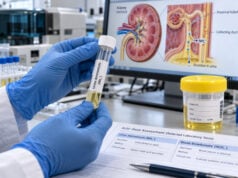
A urine urea nitrogen test measures the amount of nitrogen excreted in urine as urea, usually over 24 hours. Urea is the main nitrogen-containing waste product created when the body breaks down amino acids from dietary protein and body tissues. Because most urinary nitrogen normally leaves the body as urea, a 24-hour urine urea nitrogen result can help clinicians estimate protein intake, assess nitrogen balance in selected patients, and understand how illness, nutrition, and kidney function are affecting protein metabolism. The result is not a direct measure of kidney filtration and should not be interpreted like a blood urea nitrogen, or BUN, level. High urine urea nitrogen can reflect high protein intake or increased protein breakdown, while a low result may occur with low protein intake, incomplete urine collection, low urine output, or reduced kidney function. The most useful interpretation combines the urine result with diet, body weight, clinical condition, blood tests, and collection quality.
- Urine urea nitrogen, or UUN, estimates how much nitrogen leaves the body in urine as urea, usually during a 24-hour collection.
- Higher UUN commonly reflects higher protein intake or increased breakdown of body protein; lower UUN can reflect lower intake, reduced excretion, or an incomplete collection.
- Reference ranges vary by laboratory and may differ by age and sex; one major laboratory lists about 5–22 g/24 hours for adult men and 4–16 g/24 hours for adult women ages 18–70.
- UUN can be used in protein-intake and nitrogen-balance calculations, but those estimates work best when intake and metabolism are relatively stable.
- UUN is not a stand-alone kidney function test; creatinine, eGFR, blood urea nitrogen, urine output, and the clinical setting provide essential context.
Table of Contents
- What urine urea nitrogen measures
- Why the test is ordered
- Collection and reference ranges
- What high urine urea nitrogen can mean
- What low urine urea nitrogen can mean
- Protein intake and nitrogen balance calculations
- Kidney function, interpretation, and next steps
What urine urea nitrogen measures
Urine urea nitrogen measures the nitrogen contained in urinary urea. That distinction matters. Urea is a molecule made in the liver when ammonia from amino-acid breakdown is converted into a form that can be safely carried in blood and excreted by the kidneys. Urea contains nitrogen, but a laboratory may report either the mass of urea itself or the mass of urea nitrogen. Those numbers are not interchangeable.
Under ordinary conditions, urea accounts for most of the nitrogen excreted in urine. A major clinical laboratory notes that roughly 90% to 95% of total urinary nitrogen is present as urea when metabolism is relatively stable. Smaller amounts of nitrogen leave as creatinine, uric acid, ammonium, amino acids, and other compounds. Nitrogen is also lost outside the urine through stool, skin, sweat, wounds, drains, and other routes.
UUN therefore acts as a practical window into protein metabolism. When a person consumes protein, digestive enzymes break it into amino acids. The body uses some amino acids to build and repair tissue and breaks down others. Nitrogen removed from amino acids eventually contributes to urea production. Greater protein intake usually increases urea production and urinary urea nitrogen, provided kidney excretion is adequate.
The body can also generate more urea without eating more protein. During fever, severe infection, burns, trauma, major surgery, uncontrolled inflammation, or other catabolic states, the body may break down its own proteins. That releases amino-acid nitrogen and can increase UUN. Corticosteroid treatment can also increase protein catabolism in some settings.
UUN should not be confused with blood urea nitrogen. BUN measures urea nitrogen circulating in blood, whereas UUN measures how much is excreted in urine over time. The two are related but answer different questions.
Why the test is ordered
The most common reasons to order a 24-hour urine urea nitrogen test are to estimate protein intake, help calculate nitrogen balance, or add context to kidney and nutrition assessment. It is used more often in specialized nutrition, nephrology, critical care, and metabolic evaluations than in routine screening.
In nutrition care, UUN can help determine whether a patient is receiving enough protein relative to protein losses. This has traditionally been useful in hospitalized patients receiving enteral or parenteral nutrition, especially when illness creates large and changing protein requirements. A clinician may compare estimated nitrogen intake with estimated nitrogen losses to see whether the patient is retaining nitrogen or losing more than is being supplied.
In kidney care, UUN can help estimate habitual protein intake when a person is metabolically stable. This may be relevant in chronic kidney disease because protein intake needs to balance several goals: avoiding inadequate nutrition and muscle loss while also avoiding unnecessary excess in people for whom high protein intake may be undesirable. The 2024 KDIGO chronic kidney disease guideline suggests maintaining protein intake around 0.8 g/kg/day in adults with CKD stages G3–G5 and advises avoiding high intake above 1.3 g/kg/day in adults at risk of progression. Those are clinical nutrition recommendations, not UUN reference ranges.
UUN may also be included in a broad 24-hour urine metabolic profile. When measured with urine sodium, potassium, creatinine, uric acid, volume, and other analytes, it can provide an objective clue about diet during the collection day. For example, high UUN plus high urine sodium may suggest a diet high in both protein and salt, while unexpectedly low totals across several analytes may raise concern that part of the collection was missed.
The test is less useful when metabolism is rapidly changing. A patient who has just started nutrition support, is accumulating or losing large amounts of body fluid, has changing kidney function, is receiving dialysis, or is undergoing intense catabolism may not be in the steady state assumed by simple calculations.
A UUN result should also not replace direct kidney assessment. Tests such as blood creatinine and eGFR are more appropriate for estimating filtration, while urine urea nitrogen answers a different metabolic question.
Collection and reference ranges
Urine urea nitrogen is usually measured from a 24-hour urine collection because a single spot urine concentration changes greatly with hydration and timing. The laboratory needs both the urea nitrogen concentration and the total collected urine volume to calculate grams excreted per 24 hours.
A typical collection works like this: discard the first urine at the chosen start time, then collect every urination for the next 24 hours, including overnight urine. At the same time the next day, collect one final specimen to complete the period. Follow the laboratory’s instructions for refrigeration, preservatives, and container handling. One major laboratory specifically instructs patients to refrigerate the urine during collection.
Missing even one meaningful void can falsely lower the daily total. Extending the collection beyond 24 hours can falsely raise it. If the test is being used to estimate protein intake, the collection day should generally reflect usual eating unless the clinician has given a specific diet protocol.
There is no single universal reference range. Laboratories use different methods and populations. For example, Labcorp lists the following 24-hour UUN reference intervals:
| Age | Male | Female |
|---|---|---|
| 18–70 years | 5–22 g/24 hours | 4–16 g/24 hours |
| Older than 70 years | 4–16 g/24 hours | 2–12 g/24 hours |
Some laboratories report urea rather than urea nitrogen. Mayo Clinic Laboratories, for example, lists a 24-hour urinary urea range of 7–42 g/24 hours for adults for one assay. A result labeled “urea, urine” should not be compared directly with a range for “urea nitrogen, urine” without checking the units and analyte name.
The laboratory’s own range is the correct starting point. Even then, a value just outside the interval is not a diagnosis. Protein intake, body size, age, kidney filtration, urine output, catabolic stress, and collection completeness can all shift the result.
What high urine urea nitrogen can mean
A high UUN result most often means that more nitrogen is being converted to urea and excreted. High dietary protein is one common reason. A large increase in meat, fish, dairy, eggs, protein powders, or other concentrated protein sources can raise UUN substantially.
The second major possibility is increased protein breakdown inside the body. Serious illness can create a catabolic state in which muscle and other tissues are broken down faster than they are rebuilt. Sepsis, burns, major trauma, surgery, fever, and severe inflammation are examples. In these settings, UUN may be high even when dietary protein intake is not especially high.
A high result can also occur with higher filtration and urine flow. Urea is freely filtered at the glomerulus, and some is reabsorbed along the nephron. Water balance changes that alter urea handling can therefore affect urinary urea excretion. The number should always be interpreted with urine volume and blood chemistry.
In a stable outpatient, high UUN may be useful as an objective check on reported protein intake. If someone reports a very low-protein diet but repeatedly has high UUN on complete collections, the clinician may review portion sizes, protein supplements, meal-replacement products, and eating patterns more carefully.
High UUN does not automatically mean the kidneys are “working too hard,” nor does it prove kidney damage. Healthy kidneys normally excrete the nitrogen generated from protein metabolism. The clinical concern depends on the person’s overall health, kidney function, nutrition goals, and reason for testing.
For someone with CKD, an unexpectedly high UUN may support the possibility that protein intake is above the prescribed target. That finding should lead to a dietary review rather than unsupervised restriction. Older adults, people with poor appetite, and patients with muscle loss can be harmed by overly aggressive protein reduction.
Collection error can also produce a falsely high daily total. A collection that lasted 27 or 30 hours instead of 24 hours may look high simply because more time was included. This is why start and stop times matter.
What low urine urea nitrogen can mean
Low UUN often reflects lower protein intake, but that is only one possibility. A person eating little because of poor appetite, nausea, a restrictive diet, or illness may produce less urea. A carefully planned lower-protein diet can do the same.
An incomplete 24-hour collection is another common explanation. If UUN is unexpectedly low, clinicians often look at total urine volume and 24-hour urine creatinine to see whether the specimen seems plausible. Low creatinine does not prove a missed collection because muscle mass varies, but multiple unexpectedly low daily totals make collection error more likely.
Reduced kidney function can lower urinary urea excretion because less urea is filtered and excreted. At the same time, blood urea may rise as urea accumulates. This illustrates why urine and blood urea values should not be interpreted in isolation. A patient can have low urinary urea nitrogen and high BUN when kidney clearance is reduced.
Low urine output can also lower urea excretion. Severe dehydration, acute kidney injury, urinary obstruction, or other causes of oliguria require assessment based on the broader clinical picture. A low UUN value in that setting is not primarily a nutrition result.
Liver dysfunction can affect urea production because the liver converts ammonia to urea through the urea cycle. Severe impairment may reduce urea synthesis, although routine interpretation of a low UUN should not jump to liver disease without supporting clinical or laboratory evidence.
A low UUN result is not automatically a sign that more protein should be added. Protein needs differ in pregnancy, older age, athletic training, critical illness, liver disease, kidney disease, dialysis, and recovery from surgery. Nutrition decisions should consider body weight, calorie intake, muscle status, kidney function, and the underlying condition.
If the result is being used for nitrogen balance, low UUN can actually occur during a period of protein retention, but only if intake and non-urinary losses are known well enough to interpret the calculation. That is one reason nitrogen balance is more informative as a structured assessment than as a single laboratory number.
Protein intake and nitrogen balance calculations
UUN is widely used because dietary protein and nitrogen are mathematically related. Most mixed dietary protein is approximately 16% nitrogen, so clinicians often convert between them using the factor 6.25. In simple terms, 1 gram of nitrogen corresponds to about 6.25 grams of protein.
A rough estimate of protein intake in a metabolically stable adult may use urinary urea nitrogen plus an allowance for nitrogen lost in other forms. One commonly used bedside approximation is:
Estimated protein intake ≈ 6.25 × (UUN + estimated non-urea nitrogen losses)
If a clinician assumes about 4 g/day of non-urea nitrogen loss, a UUN of 10 g/day would correspond to roughly 87.5 g/day of protein: 6.25 × (10 + 4). That is only an estimate, not a precise measurement of food intake.
For stable patients with chronic kidney disease, formulas derived from nitrogen balance work have often estimated non-urea nitrogen losses based partly on body weight. A commonly cited approach uses about 0.031 g nitrogen/kg/day for non-urea nitrogen losses. These methods work best when body urea stores are stable and protein intake is not changing rapidly.
Nitrogen balance compares nitrogen entering the body with nitrogen leaving it:
Nitrogen balance = nitrogen intake − nitrogen losses
Positive nitrogen balance means estimated intake exceeds measured and estimated losses, suggesting net nitrogen retention. This is expected during growth and can occur during tissue rebuilding. Negative balance means estimated losses exceed intake and may occur during starvation, severe illness, trauma, or other catabolic states.
The calculation has important limitations. UUN does not capture all urinary nitrogen, and standard formulas estimate rather than measure many non-urinary losses. Diarrhea, fistulas, drains, large wounds, burns, heavy sweating, and dialysis can create substantial additional nitrogen loss. Rapid changes in blood urea can also matter because nitrogen can move into or out of the body’s urea pool instead of being immediately excreted.
Modern nutrition research also recognizes limitations in nitrogen-balance methods for defining human protein requirements. Recent systematic reviews and tracer studies show that estimates can vary with study design, adaptation time, energy intake, measurement error, and assumptions about unmeasured losses. Nitrogen balance remains useful in selected clinical settings, but it should not be treated as an exact measure of muscle gain or loss.
The key practical point is that UUN-based calculations are most trustworthy when the patient is clinically stable, intake is known, the urine collection is complete, and major extra losses are absent.
Kidney function, interpretation, and next steps
Urine urea nitrogen is influenced by kidney function, but it is not a direct filtration marker. Urea is filtered by the kidneys and variably reabsorbed, so urinary excretion changes with filtration, hydration, urine flow, protein metabolism, and hormones. A low or high UUN cannot by itself diagnose chronic kidney disease or acute kidney injury.
If kidney function is the concern, clinicians usually rely on blood creatinine and estimated glomerular filtration rate, sometimes supplemented by cystatin C and urine albumin. The BUN-to-creatinine ratio may add context in selected situations, although it also has important limitations.
A useful way to review a UUN result is to ask four questions:
- Was the 24-hour collection complete? Check start and stop times, missed voids, total volume, and whether urine creatinine is plausible for the person.
- What was the actual protein intake? Include meals, snacks, protein shakes, supplements, tube feeds, and parenteral nutrition.
- Was metabolism stable? Fever, surgery, infection, corticosteroids, trauma, and rapid recovery can change protein breakdown substantially.
- What is kidney function doing? Review BUN, creatinine, eGFR, urine output, and recent trends rather than relying on UUN alone.
If UUN is being used to guide a CKD diet, avoid making large protein changes from one result. A dietitian or clinician can compare the urine estimate with body weight, calorie needs, muscle mass, appetite, and kidney stage. Too little protein can worsen malnutrition, while excessive intake may be inappropriate for some patients with CKD.
In hospitalized or critically ill patients, nitrogen balance may be repeated because a single day’s result can be distorted by changing physiology. Research suggests that trends in nitrogen balance may be more meaningful than one isolated value, but the method still has enough uncertainty that clinical status and nutrition tolerance remain essential.
Seek prompt medical attention for very low urine output, inability to urinate, severe dehydration, confusion, persistent vomiting, or rapidly worsening illness. Those symptoms require evaluation of kidney function and overall health rather than interpretation of a UUN number alone.
For most people, the best use of a urine urea nitrogen result is to answer a focused question: Does the collection support the reported protein intake? Is a patient losing more nitrogen than expected? Is reduced kidney excretion affecting the result? Once that question is clear, UUN becomes much easier to interpret.
References
- Urea Nitrogen, 24-Hour Urine 2026
- KDIGO 2024 Clinical Practice Guideline for the Evaluation and Management of Chronic Kidney Disease 2024 (Guideline)
- Nitrogen balance and outcomes in critically ill patients: A systematic review and meta-analysis 2022 (Systematic Review)
- Post-prandial tracer studies of protein and amino acid utilisation: what can they tell us about human amino acid and protein requirements? 2024 (Review)
- Evaluation of dietary protein and amino acid requirements: a systematic review 2025 (Systematic Review)
- Nitrogen Requirements in Healthy Adults: A Systematic Review and Meta-Analysis of Nitrogen Balance Studies 2025 (Systematic Review)
Disclaimer
Urine urea nitrogen is a context-dependent nutrition and metabolism test and should not be used alone to diagnose kidney disease or decide how much protein a person should eat. Protein targets can change substantially with kidney disease, dialysis, critical illness, pregnancy, age, and nutritional status. Discuss abnormal results or major diet changes with a qualified clinician or dietitian.