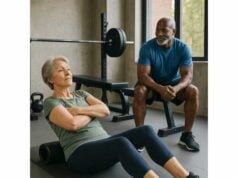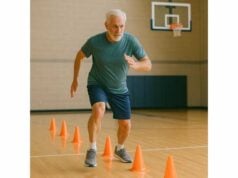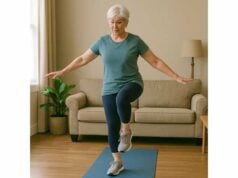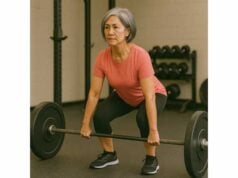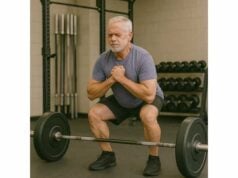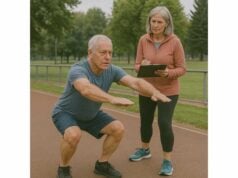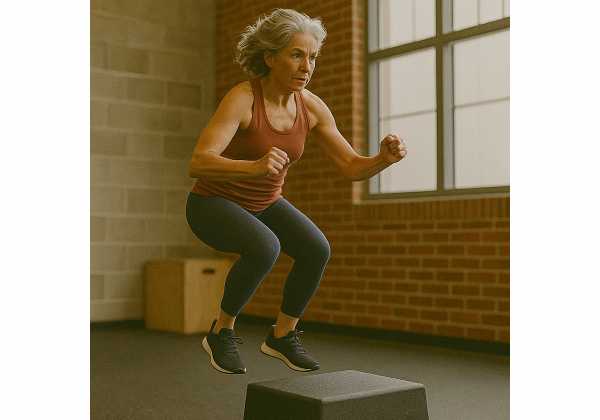
Power is the ability to produce force quickly. It shows up when you climb stairs without grabbing the rail, catch yourself after a stumble, lift a suitcase into a car, step off a curb, or hurry across a street. Strength matters, but power adds speed to strength. That speed becomes more important with age because daily life rarely gives you five seconds to react.
Power training uses quick, crisp movements with careful control. It does not require reckless jumping, all-out sprinting, or training like a competitive athlete. Safe power work starts with low impact, small ranges, light tools, long rests, and excellent technique. Jumps, throws, and short accelerations give the nervous system a clear signal: move with intent, absorb force well, and stay coordinated under changing demands. Done correctly, power training fits beside strength, aerobic fitness, mobility, and balance work as a practical tool for healthy aging.
Table of Contents
- Why Power Matters With Age
- Before You Start: Safety Screen
- How Power Training Should Feel
- Safe Jumps and Landings
- Throws for Upper Body Power
- Sprints and Fast Steps Without Recklessness
- Weekly Programming and Progression
- Common Mistakes and Simple Fixes
Why Power Matters With Age
Power declines because muscles lose size, nerves send signals less efficiently, tendons lose spring, and many adults stop practicing fast movement. Slow strength work protects muscle and bone, but it does not fully replace the ability to move quickly. A strong person who only trains slowly still needs practice producing force at the right time.
Daily tasks often reward speed more than maximum strength. A trip recovery happens in a fraction of a second. Rising from a low chair requires force, but rising quickly without rocking takes power. Carrying groceries up stairs requires strength, yet stepping confidently from one stair to the next also needs rapid force from the hips, calves, and feet.
Power training supports four aging-related abilities:
- Trip recovery: Quick foot placement and strong hip extension help you regain balance.
- Stair and hill confidence: The legs learn to push forcefully without grinding through every step.
- Bone and tendon loading: Carefully dosed impact and fast muscle action provide signals that slow, easy movement does not provide.
- Reaction speed: The brain and body rehearse fast decisions, especially when drills include direction changes or target throws.
Power training also makes regular strength training feel more useful. Heavy squats, deadlifts, rows, and presses build capacity. Jumps, throws, and accelerations teach the body to use that capacity fast. A complete routine includes both. A practical weekly strength plan provides the base, while power drills sharpen how that strength appears in movement.
Power does not require exhaustion. In fact, fatigue often ruins it. A good power rep feels snappy, coordinated, and repeatable. The set ends before speed drops much. That is why power sessions use low reps and generous rests.
Before You Start: Safety Screen
Power training is safest when the entry point matches your joints, balance, conditioning, and medical history. The first decision is not which jump or sprint looks impressive. The first decision is whether your body is ready for fast loading today.
Get professional guidance before adding jumps, throws, or sprints if you have unstable chest pain, unexplained fainting, uncontrolled high blood pressure, recent surgery, a recent fracture, a new neurological symptom, severe osteoporosis, active joint swelling, or a tendon injury that hurts with quick movement. A clinician or physical therapist should also guide training after joint replacement, significant spine pain, or a major fall.
For most healthy adults, the readiness check is practical:
- You walk briskly for 10 minutes without unusual shortness of breath, chest pressure, dizziness, or calf pain.
- You can rise from a chair 10 times with control.
- You can stand on one leg near a support for 10 seconds per side.
- You can perform a shallow squat or hip hinge without sharp joint pain.
- You can step up and down from a low step without wobbling or collapsing inward at the knee.
Power training should never start cold. A focused warm-up raises tissue temperature, rehearses the landing positions, and lets you check how the body feels that day. Use 8–12 minutes of marching, easy cycling, ankle rocks, hip hinges, squats to a box, light skips in place, wall pushes, and practice landings. A structured joint prep and activation warm-up works well before this style of training.
Joint history shapes exercise choice. Sensitive knees often prefer step-ups, low pogo hops, hill accelerations, and hip-dominant throws before deeper jumps. Irritable hips often prefer shorter stride accelerations, lateral step drills, and lower boxes. If pain changes your movement, reduce the range, impact, speed, or volume. Knee and hip friendly substitutions belong in the plan from day one, not after pain flares. Useful options include low boxes, soft surfaces, incline walking sprints, sled pushes, and modified landings from a knee and hip friendly training approach.
How Power Training Should Feel
Power work should feel fast, fresh, and precise. It is not a conditioning circuit. Breathing should rise, but you should not be gasping during every set. The movement should look almost the same from the first rep to the last rep. When coordination fades, the useful part of the set is over.
Use these simple rules:
| Training element | Good starting point | Stop or reduce when |
|---|---|---|
| Jumps | 2–4 sets of 3–5 low-impact reps | Landings get loud, knees cave in, or balance feels rushed |
| Throws | 3–5 sets of 3–6 throws with a light ball | Throws slow down or the back arches to create force |
| Sprints or fast steps | 4–8 efforts of 5–10 seconds | Stride gets sloppy, breathing stays high, or joints feel sharp |
| Rest periods | 60–120 seconds between sets | You feel tempted to shorten rest for a sweatier workout |
The best effort level for most adults is “fast but not frantic.” Think 7–9 out of 10 for intent, not 10 out of 10 strain. Leave one or two good reps in reserve. Power training rewards intent more than grind.
Load stays light at first. A medicine ball of 1–3 kg works for many adults. A jump that leaves the floor by only 2–5 cm still trains stiffness, rhythm, and force absorption. A sprint does not need to be a race; a brisk 6-second acceleration up a mild hill often gives a better training signal with less joint stress than flat all-out running.
Place power drills early in the workout, after the warm-up and before heavy strength or long conditioning. Freshness protects technique. A simple order is:
- Warm-up and movement prep.
- Power drill: jumps, throws, or accelerations.
- Strength training.
- Aerobic work or easy cooldown.
- Mobility or recovery work.
This order works because the nervous system practices speed while fresh, then strength work builds the tissue capacity that supports future power. For people who track training details, sets, reps, tempo, and RPE help keep power work crisp instead of drifting into fatigue training.
Safe Jumps and Landings
Jump training for healthy aging starts with landing skill. The landing matters more than jump height. A quiet landing shows that the ankles, knees, hips, trunk, and feet share force instead of dumping it into one joint.
Start with no-jump landing practice. Stand tall, rise onto the balls of the feet, then drop the heels softly while bending the knees and hips. Next, practice a small “snap down”: reach tall, then quickly move into an athletic stance with hips back, knees tracking over toes, ribs stacked over pelvis, and whole foot on the floor. This teaches the body to absorb force before leaving the ground.
Beginner jump options include:
- Heel pop: Rise quickly onto the balls of the feet, then lower with control.
- Low pogo: Small two-foot bounces with stiff ankles and quiet landings.
- Step-off to stick: Step from a 10–15 cm platform and hold the landing for two seconds.
- Sit-to-stand fast: Stand quickly from a chair, then sit down slowly.
- Low box step-up with drive: Step up and drive the opposite knee without jumping down.
Intermediate options include squat jumps, lateral line hops, skater steps, and small bounds. The jump height stays modest. The landing stays quiet. The body stops cleanly before the next rep.
Depth jumps, high box jumps, repeated broad jumps, and hard single-leg hops belong much later, and many adults never need them. They create higher landing forces and demand better tendon capacity. Healthspan training favors useful power, not social-media difficulty.
A progression for jumps looks like this:
| Level | Main drill | Readiness to progress |
|---|---|---|
| Level 1 | Fast sit-to-stand, heel pops, snap downs | No pain, quiet control, steady balance |
| Level 2 | Low pogos, step-off to stick, quick step-ups | Landings stay quiet for every rep |
| Level 3 | Low squat jumps, lateral line hops, small skater steps | Good knee tracking and no next-day tendon soreness |
| Level 4 | Small bounds, low box jumps, light multidirectional hops | Consistent control under direction changes |
Two sessions per week is enough for most people. Start with 20–30 total contacts per session. A contact means one landing. Ten sets of three low pogos equals 30 contacts. Build slowly and keep at least 48 hours between impact sessions early on.
Impact training also overlaps with bone health. Bones respond to loading that is stronger or different from normal daily walking. The dose must match the person. A low-impact progression sits between regular resistance training and higher-impact work, and it pairs naturally with resistance and impact training for bone density. Adults who need an even gentler starting point should use low-impact plyometric progressions before adding jumps that leave the ground.
Throws for Upper Body Power
Medicine ball throws train power without requiring heavy joint impact. They also feel more playful than most gym exercises. Throws teach the hips, trunk, shoulders, arms, and hands to transfer force in sequence. That transfer matters when lifting luggage, pushing a heavy door, catching yourself with your arms, or rotating quickly during sport and daily life.
A throw should be explosive, but the ball should be light enough that speed stays high. For many adults, 1–3 kg is plenty. Larger or stronger adults sometimes use 4–5 kg, but heavy balls often turn throws into slow heaves. Power improves when the ball flies fast.
Good starter throws include:
- Chest pass to wall: Stand 1–2 meters from a sturdy wall, push the ball from the chest, catch after the rebound, reset.
- Tall-kneeling chest pass: Kneel on both knees to reduce leg drive and emphasize trunk control.
- Overhead slam: Lift the ball overhead, keep ribs down, and throw it to the floor with a strong exhale.
- Rotational scoop toss: Stand side-on to a wall and throw from hip to wall using the hips and trunk.
- Half-kneeling side toss: Use a split-kneeling position to train rotation without overstriding.
Walls, floors, and equipment must tolerate impact. Do not throw against drywall, glass, mirrors, or crowded gym areas. Use a ball designed for throwing. Some medicine balls bounce sharply; others absorb force. Choose the tool based on the drill and the environment.
The shoulders should feel warm and smooth before throws. Use arm circles, scapular push-ups against a wall, band pull-aparts, light rows, and easy practice throws. Avoid aggressive overhead slams if you have painful shoulder impingement, recent rotator cuff symptoms, or poor overhead range. Chest passes, scoop tosses, and low slams often work better. A shoulder health routine helps keep the shoulder blade and rib cage moving well enough for throwing.
Rotational throws deserve special care. The power should come from the ground, hips, and torso, not from yanking through the lower back. Pivot the feet. Let the hips turn. Keep the ball close during the loading phase. Finish tall rather than collapsing into the throw.
A simple throwing session looks like this:
- Chest pass: 4 sets of 4 throws.
- Overhead slam: 3 sets of 5 throws.
- Rotational scoop toss: 3 sets of 3 throws per side.
- Rest: 60–90 seconds between sets.
Stop when the ball speed drops or accuracy disappears. Throws are skill work as much as power work. Better to perform 25 excellent throws than 60 tired ones.
Sprints and Fast Steps Without Recklessness
Sprinting for healthy aging means short, fast efforts scaled to the body in front of you. It does not mean maximal 100-meter races. The safest sprint is often not a flat sprint at all. A hill walk acceleration, fast sled push, stair march, bike sprint, or pool run gives a power stimulus with less braking force.
Running sprints require more tendon and hamstring capacity than most people expect. Flat ground sprinting has high peak forces, long stride positions, and rapid leg recovery. Adults who have not sprinted for years should spend several weeks on fast walking, incline accelerations, marching drills, and low-level jumps before trying true sprints.
Safe sprint alternatives include:
- Hill acceleration: Walk or run fast uphill for 5–8 seconds. The incline reduces overstriding.
- Fast stair march: Drive the arms and step quickly, using a rail as needed.
- Sled push: Push a light-to-moderate sled for 10–15 meters with strong posture.
- Bike sprint: Pedal fast for 8–15 seconds with controlled resistance.
- Pool sprint: Run or kick hard in water for short bursts.
- Fast feet drill: Take quick steps in place or over a line for 5–10 seconds.
True running accelerations should start at 60–70% effort. Increase only after several sessions without hamstring tightness, Achilles soreness, knee pain, or back irritation. Most adults get enough benefit from 75–90% efforts. All-out sprinting is rarely necessary for longevity training.
Technique keeps sprinting safer. Stay tall, lean slightly from the ankles, push the ground behind you, and use compact arm drive. Avoid reaching far ahead with the front foot. Overstriding increases braking and hamstring demand. Short accelerations also need long rest. A 6-second sprint often deserves 90 seconds of easy walking before the next effort.
Sprints overlap with aerobic fitness, but they are not a substitute for steady aerobic work. Zone 2 training and intervals build different parts of the fitness picture. Short accelerations fit well beside a VO₂max interval playbook, but they should not replace easy weekly movement. Hills, stairs, and uneven terrain also give safe ways to build leg drive when chosen carefully, especially within outdoor conditioning sessions.
Weekly Programming and Progression
Power training works best in small doses repeated consistently. One to three sessions per week suits most adults. Two sessions is the sweet spot for many: enough practice to improve, with enough recovery to protect joints and tendons.
A weekly plan might look like this:
| Day | Power focus | Other training |
|---|---|---|
| Monday | Low jumps and chest passes | Lower-body strength |
| Tuesday | None | Zone 2 walk, cycle, or easy ruck |
| Wednesday | None | Mobility, balance, or rest |
| Thursday | Hill accelerations and rotational throws | Upper-body strength |
| Friday | None | Easy walk or recovery session |
| Weekend | Optional light agility or play | Long walk, hike, sport, or family activity |
Progress one variable at a time. Do not add height, speed, volume, and complexity in the same week. A clean progression follows this order:
- Improve control at the current level.
- Add one set.
- Add a slightly faster intent.
- Add a small range increase.
- Add a more complex direction or surface.
- Add load only when speed remains high.
For jumps, progress from landing control to small repeated contacts, then to directional hops. For throws, progress from tall-kneeling or standing chest passes to rotational throws and step-behind throws. For sprints, progress from hill walking accelerations to hill run accelerations, then short flat accelerations if the body tolerates them.
A simple 8-week plan works well:
- Weeks 1–2: Learn landings, light throws, and fast walking accelerations.
- Weeks 3–4: Add low pogos, chest passes, slams, and hill accelerations.
- Weeks 5–6: Add low squat jumps, rotational throws, and slightly faster 6–8 second efforts.
- Weeks 7–8: Add lateral hops, longer rests for higher quality, and optional flat accelerations at 70–85%.
Recovery decides whether the plan is working. Mild muscle soreness is normal after a new drill. Joint pain, tendon stiffness that worsens during warm-up, swelling, limping, or soreness that lasts more than 48 hours means the dose was too high. Reduce contacts, speed, surface hardness, or range.
Deload every fourth to sixth week by cutting power volume in half. Keep a few fast reps so the skill stays sharp, but remove the extra contacts and sprints. This rhythm pairs well with active recovery and deloads, especially for adults who also lift weights and perform conditioning.
Track a few simple markers. The best ones are movement quality, next-day joint response, and a repeatable field test. A chair-rise time, stair climb, standing long jump, medicine ball chest pass distance, or fast 10-meter walk shows whether power is improving. Keep testing low pressure and consistent. Broader fitness field tests help place power alongside strength, aerobic capacity, balance, and mobility.
Common Mistakes and Simple Fixes
The biggest mistake is turning power training into punishment. Fast work needs rest. If every drill becomes a breathless circuit, the session trains fatigue tolerance more than power. Keep reps low and rest long enough for speed to return.
Another mistake is starting with impressive exercises instead of useful ones. High box jumps, depth jumps, long bounds, and flat sprints look athletic, but they are poor entry points for most adults. A quiet low pogo, a fast sit-to-stand, a chest pass, or an uphill acceleration often produces a cleaner signal with less risk.
Common problems and fixes:
| Problem | Likely cause | Simple fix |
|---|---|---|
| Loud landings | Too much height, stiff hips, or poor foot control | Lower the jump, practice snap downs, and land with hips back |
| Knee caves inward | Weak hip control or too much speed | Use step-ups, mini-band squats, and slower landing practice |
| Achilles soreness | Too many contacts or too much bouncing | Cut volume by 50%, use step drills, and rebuild gradually |
| Hamstring tightness after sprints | Overstriding or sprinting too hard too soon | Return to hills, shorten efforts, and stay below 80% effort |
| Shoulder pain with throws | Ball too heavy or overhead range not ready | Use chest passes, lighter balls, and more shoulder prep |
| Loss of balance after reps | Complexity is too high | Use a wall, rail, wider stance, or two-foot landing |
Footwear and surface matter. Choose shoes that fit well and give traction without forcing an awkward foot position. Use rubber gym flooring, turf, a track, firm grass, or a mild hill. Avoid slippery floors, uneven pavement, deep sand, and hard downhill sprinting.
Breathing also matters. Brace lightly before jumps and throws, then exhale during the explosive effort. Do not hold the breath for long strings of reps. People with blood pressure concerns should avoid maximal straining and use lower loads, shorter sets, and smooth breathing.
Power training should leave you feeling alert, not wrecked. A good session often feels almost too short. That is a strength, not a flaw. The body adapts to the signal it receives. Crisp reps teach crisp movement. Sloppy reps teach compensation.
The most sustainable plan keeps power playful. Toss a ball against a wall. Do three small jumps before a strength session. Add six hill accelerations to a walk. Practice quick feet before a game of tennis or pickleball. Aging bodies still respond to speed when the dose is smart, the setup is safe, and the movements stay within today’s capacity.
References
- Global consensus on optimal exercise recommendations for enhancing healthy longevity in older adults (ICFSR) 2025 (Guideline)
- International Exercise Recommendations in Older Adults (ICFSR): Expert Consensus Guidelines 2021 (Guideline)
- Comparison of Power Training vs Traditional Strength Training on Physical Function in Older Adults: A Systematic Review and Meta-analysis 2022 (Systematic Review)
- Effectiveness of power training compared to strength training in older adults: a systematic review and meta-analysis 2022 (Systematic Review)
- The Efficacy and Safety of Lower-Limb Plyometric Training in Older Adults: A Systematic Review 2019 (Systematic Review)
- The impact of sprint interval training versus moderate intensity continuous training on blood pressure and cardiorespiratory health in adults: a systematic review and meta-analysis 2024 (Systematic Review)
Disclaimer
This article is educational and does not replace medical care, physical therapy, or individualized coaching. People with heart symptoms, uncontrolled blood pressure, recent injury, osteoporosis, balance problems, or joint replacement should get guidance from a qualified professional before adding jumps, throws, or sprints. Stop any drill that causes sharp pain, dizziness, chest pressure, unusual shortness of breath, or a sudden change in coordination.