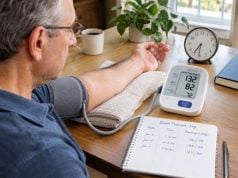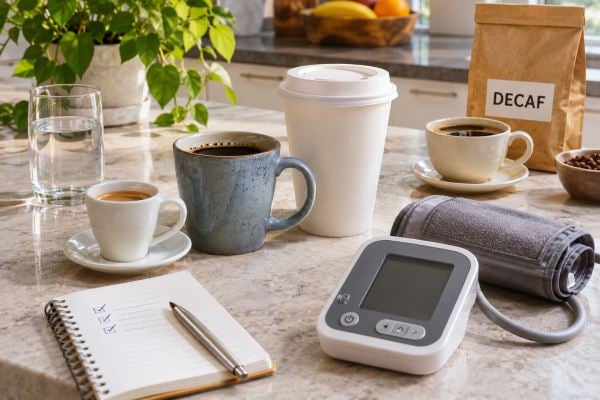
Caffeine can raise blood pressure for a few hours, especially if you are sensitive to it or do not consume it regularly. For most healthy adults, up to about 400 mg of caffeine a day is generally considered an amount not usually associated with harmful effects, but that number is not a blood pressure target. Some people develop a noticeable pressure increase with much less, while regular coffee drinkers may develop partial tolerance. The most useful question is therefore not “Is caffeine good or bad?” but “What does caffeine do to my blood pressure, sleep, heart rate, and symptoms?” If you have hypertension, you usually do not need to give up coffee automatically. A short home test can show whether caffeine causes a meaningful spike for you. Cutting back makes more sense when your readings rise repeatedly after caffeine, you rely on large doses, or caffeine worsens palpitations, anxiety, or sleep.
Table of Contents
- How Caffeine Affects Blood Pressure
- How Much Caffeine Is Usually Safe?
- Coffee vs Caffeine Supplements and Energy Drinks
- How to Test Your Own Blood Pressure Response
- When to Cut Back on Caffeine
- How to Reduce Caffeine Without Withdrawal
- Special Situations and Warning Signs
How Caffeine Affects Blood Pressure
Caffeine can cause a small, temporary rise in blood pressure, but the size of the effect varies widely from person to person. Caffeine blocks adenosine receptors in the nervous system. This increases alertness and can increase sympathetic nervous system activity, which may temporarily tighten blood vessels and raise pressure.
A 2023 systematic review and dose-response meta-analysis of randomized trials found that caffeine supplementation increased systolic blood pressure by about 2 mm Hg and diastolic pressure by about 1.7 mm Hg on average. The average was modest, but some individual studies and some people show larger responses. The review also found greater effects at higher doses.
The key word is temporary. After a dose of caffeine, blood pressure may rise within roughly 30 to 120 minutes and then drift back toward baseline over the next several hours. Regular users often develop some tolerance, so the acute response may be smaller than it is in someone who rarely consumes caffeine.
That helps explain an apparent contradiction in the research: caffeine itself can raise blood pressure acutely, yet long-term observational studies of coffee drinkers do not consistently show a higher risk of developing hypertension. Some 2022 and 2023 meta-analyses found no increased hypertension risk among habitual coffee drinkers and, in some analyses, an inverse association. Observational studies cannot prove coffee prevents hypertension, however, because coffee drinkers differ in many other ways and coffee contains hundreds of compounds besides caffeine.
The response also depends on your starting state. Someone who slept poorly, is anxious, has not eaten, and drinks a large cold brew quickly may experience a much stronger heart-rate and pressure response than the same person drinking a small coffee with breakfast on a rested day. Nicotine, decongestants, stimulant medication, intense exercise, and pain can add to the effect. This is why one dramatic reading after a stressful morning does not necessarily prove that caffeine alone caused the change.
Caffeine can also change how you feel before it changes the cuff number. Jitteriness, hand tremor, stomach upset, urgency to urinate, a pounding heartbeat, or a sense of being “wired” are signs the dose may be higher than your personal tolerance. Those symptoms are useful feedback even if your average blood pressure remains acceptable.
If your readings jump during stress as well as after coffee, stress-related blood pressure changes may be contributing to the pattern.
How Much Caffeine Is Usually Safe?
For most healthy adults, the FDA cites 400 mg of caffeine per day as an amount not generally associated with negative effects. That is a general safety ceiling, not a recommendation to consume 400 mg and not proof that 400 mg is harmless for everyone with high blood pressure.
Caffeine content varies widely. Approximate amounts are useful for planning, but labels or manufacturer information are better when available.
| Product | Typical serving | Approximate caffeine |
|---|---|---|
| Brewed coffee | 8 fl oz | About 80–120 mg |
| Espresso | 1 fl oz shot | About 60–75 mg |
| Black tea | 8 fl oz | About 30–50 mg |
| Green tea | 8 fl oz | About 20–45 mg |
| Cola | 12 fl oz | About 30–45 mg |
| Energy drink | 8–16 fl oz | Often 80–200+ mg |
| Caffeine tablet | 1 tablet | Often 100–200 mg |
A large café coffee may contain two to three times as much caffeine as a small home-brewed cup. “Two coffees a day” therefore tells you much less than the actual milligram total.
People with hypertension often do well with less than the general 400 mg ceiling, especially if they are sensitive. A practical range for many people is 100 to 300 mg per day, spread earlier in the day, but there is no single hypertension-specific safe dose that fits everyone.
Pregnancy is different. Professional guidance generally recommends limiting caffeine to less than 200 mg per day. People who are breastfeeding, taking stimulant medications, or managing certain arrhythmias may also need more individualized limits.
Timing matters almost as much as the daily total. Caffeine’s effects can last for hours, and the amount remaining in the body falls gradually rather than disappearing at once. A person who drinks 300 mg before 9 a.m. may tolerate it well, while the same total split into morning and late-afternoon doses may disturb sleep. Because poor sleep itself can make blood pressure harder to control, moving caffeine earlier in the day is often the first adjustment to try before eliminating it completely.
For people who are newly diagnosed with hypertension, it is reasonable to keep caffeine habits stable for several days while establishing a home blood pressure baseline. Then, if the average remains high or there is a clear post-caffeine rise, reduce the dose and compare another week under similar conditions. Changing caffeine, sodium, exercise, sleep, and medication all at once makes it difficult to know which change mattered.
Coffee vs Caffeine Supplements and Energy Drinks
Coffee and isolated caffeine are not physiologically identical, and concentrated products deserve more caution. Coffee contains polyphenols and other compounds that may partially offset some of caffeine’s vascular effects. That may help explain why studies of caffeine supplements often show a clearer blood pressure increase than long-term studies of habitual coffee intake.
A 2022 meta-analysis of cohort studies found no significant overall association between coffee intake and incident hypertension. A 2023 systematic review similarly found that higher coffee intake was not linked to greater hypertension risk in observational data. These results do not mean unlimited coffee is safe. They simply show that regular coffee consumption is more complicated than giving an isolated dose of caffeine.
Energy drinks are a separate category. They may combine high caffeine doses with sugar, guarana, other stimulants, or ingredients that make total caffeine harder to estimate. Some are consumed rapidly, creating a larger peak dose than slowly drinking coffee or tea. If you have hypertension or palpitations, energy drinks and high blood pressure deserve particular caution.
Caffeine pills and pre-workout powders can also deliver 150 to 300 mg or more in a single serving. Because they are concentrated, it is easier to overshoot your usual intake. Dry-scooping stimulant powders is especially risky and should be avoided.
Coffee can still become a problem when the dose is large, the serving is late in the day, or the drink contains large amounts of added sugar and cream. If you drink coffee mainly for enjoyment, a smaller serving, half-caf blend, or decaf can preserve the ritual while reducing stimulant exposure.
Tea is another useful middle ground. Black and green tea usually contain less caffeine per serving than brewed coffee, although steeping time and product type change the amount. Switching one of two daily coffees to tea can reduce the total dose without requiring a caffeine-free routine. For people who enjoy the flavor and warmth more than the stimulant effect, decaf coffee and caffeine-free herbal teas make the transition even easier.
Remember that “natural” does not mean caffeine-free. Guarana, yerba mate, kola nut, and some headache medicines contain caffeine. A pre-workout powder may list caffeine directly or combine it with plant ingredients that contribute additional stimulant exposure. Add up all sources when you are trying to understand why your pressure or heart rate changes.
How to Test Your Own Blood Pressure Response
A simple home test can show whether caffeine causes a meaningful blood pressure rise for you. This is more useful than guessing based on population averages.
Use a validated upper-arm monitor with the correct cuff size. Avoid testing on a day when you are sick, severely sleep-deprived, unusually stressed, or immediately after exercise, because those factors can obscure the result.
- Do the test at a time when you have not had caffeine for at least several hours, ideally after your usual overnight break.
- Sit quietly for five minutes with your back supported, feet flat, and arm supported at heart level.
- Take two blood pressure readings about one minute apart and record the average.
- Consume your usual caffeinated drink without changing the dose.
- Repeat the same measurement process about 30 to 60 minutes later and, if useful, again around 90 to 120 minutes.
- Repeat the experiment on two or three separate days rather than relying on one result.
A repeated increase of roughly 5 to 10 mm Hg or more may indicate meaningful sensitivity, especially if accompanied by a racing heartbeat, tremor, anxiety, or headache. Smaller changes can fall within ordinary blood pressure variability.
The experiment is most informative when the dose is standardized. Use the same coffee size, brewing method, or labeled caffeine amount on each test day. If one day involves an 8-ounce drip coffee and another involves a 20-ounce cold brew, the comparison is not meaningful. Keep food, exercise, and measurement posture reasonably similar as well.
If your pressure rises once but not on repeat testing, treat the first result as a clue rather than a verdict. Blood pressure is noisy data. A consistent pattern over several days is more useful than any single spike. If home readings are frequently elevated even without caffeine, the underlying hypertension deserves attention rather than focusing only on the drink.
Do not intentionally take a large caffeine dose just to test yourself. Use your normal amount. Also remember that the home experiment is not a diagnostic test for hypertension.
Good technique matters. A cuff that is too small, talking during the reading, crossing your legs, or measuring over clothing can distort the result. Review proper home blood pressure technique before drawing conclusions.
When to Cut Back on Caffeine
Cutting back is most sensible when caffeine repeatedly raises your pressure, worsens symptoms, or interferes with sleep. You do not have to wait for a formal diagnosis of caffeine sensitivity.
Consider reducing your intake if:
- Your systolic pressure repeatedly rises by about 5 to 10 mm Hg or more after caffeine.
- You have uncontrolled hypertension despite following your treatment plan.
- You develop palpitations, tremor, anxiety, headache, or chest discomfort after caffeinated products.
- You need progressively larger doses to feel alert.
- You use energy drinks or high-dose supplements rather than moderate coffee or tea.
- Caffeine after lunch or early afternoon keeps you awake or reduces sleep quality.
- You are pregnant or have been given a lower caffeine limit by your clinician.
Sleep deserves special attention because caffeine can indirectly worsen blood pressure even when the direct daytime effect is small. Caffeine has a half-life of several hours, so a late-afternoon coffee can still be active at bedtime. Poor sleep, especially when chronic, can increase sympathetic activity and make blood pressure harder to control. If your sleep is inconsistent, sleep and blood pressure may be as important as the morning coffee itself.
People who feel jittery or anxious after small amounts may benefit from reducing caffeine even if their blood pressure does not rise dramatically. Caffeine sensitivity often shows up through several symptoms at once rather than one number.
How to Reduce Caffeine Without Withdrawal
Tapering over several days is usually easier than stopping abruptly. Sudden caffeine withdrawal can cause headache, fatigue, irritability, poor concentration, and sleepiness, which may tempt you to return quickly to the previous dose.
A simple taper might look like this:
| Days | Strategy |
|---|---|
| 1–3 | Reduce usual intake by about 25% |
| 4–6 | Reduce to about 50% of the original amount |
| 7–9 | Move most caffeine to the morning only |
| 10+ | Settle at the lowest amount that supports alertness without symptoms |
Ways to make the change easier include mixing regular and decaf coffee, ordering a smaller size, using one espresso shot instead of two, switching an afternoon coffee to herbal tea, or diluting strong cold brew. Caffeine content in decaf is low rather than literally zero, but it is much lower than regular coffee.
Also address why you need the caffeine. If the real problem is chronic sleep deprivation, dehydration, skipped meals, untreated sleep apnea, or a medication side effect, reducing caffeine without fixing the cause of fatigue may feel impossible.
Do not compensate by adding large amounts of sugar. A sweet coffee drink can contain hundreds of calories and substantial added sugar, undermining cardiometabolic goals even if the caffeine dose is modest.
Withdrawal usually peaks within the first day or two after a large reduction and then improves. If headaches are severe, slow the taper rather than forcing a rapid stop. Staying hydrated, eating regular meals, getting morning light, and using a short walk for alertness can reduce the urge to reach for another dose. If you depend on caffeine to stay awake while driving or doing safety-sensitive work, address the underlying sleep problem rather than abruptly removing the stimulant without a plan.
Once you reach a lower dose, give your body a week or two before deciding whether it “works.” People often mistake temporary withdrawal fatigue for proof that they cannot function with less caffeine. Energy and concentration usually stabilize as the body adjusts.
Special Situations and Warning Signs
People with very high blood pressure, pregnancy, arrhythmias, or stimulant use should be more cautious with caffeine. Individual medical advice matters because caffeine can interact with symptoms, medications, and underlying conditions.
If you take prescription stimulants for ADHD, decongestants containing sympathomimetic ingredients, or other activating medications, ask your prescriber whether high caffeine intake could add to heart rate or blood pressure effects. The same applies to pre-workout products that contain multiple stimulants.
For people with palpitations, moderate coffee is not automatically forbidden, but symptoms should guide the decision. If caffeine reliably triggers skipped beats or a rapid heartbeat, reducing the dose is reasonable even if research does not show that coffee universally causes dangerous arrhythmias.
A reading at or above roughly 180/120 mm Hg should not be managed by simply skipping coffee and waiting. Recheck using correct technique. If severe blood pressure is accompanied by chest pain, shortness of breath, weakness, numbness, confusion, trouble speaking, vision changes, or another concerning symptom, seek emergency care. The 2025 high blood pressure guideline treats severe hypertension as a situation requiring prompt clinical evaluation even when acute organ-damage symptoms are absent.
For everyday decisions, the simplest rule is this: use the lowest caffeine dose that gives you the benefit you want without repeatedly worsening blood pressure, sleep, or symptoms. Most people with controlled hypertension can still enjoy coffee or tea, but personal response matters more than a universal cup count.
References
- The effects of caffeine supplementation on blood pressure in adults: A systematic review and dose-response meta-analysis 2023 (Systematic Review)
- Coffee Intake and Risk of Hypertension: A Meta-Analysis of Cohort Studies 2022 (Systematic Review)
- Coffee Consumption and Risk of Hypertension in Adults: Systematic Review and Meta-Analysis. 2023 (Systematic Review)
- Spilling the Beans: How Much Caffeine is Too Much? 2024 (Official Guidance)
- 2025 High Blood Pressure Guideline 2025 (Guideline)
Disclaimer
This article is for general education and does not replace individualized medical advice. If you have uncontrolled hypertension, an arrhythmia, cardiovascular disease, pregnancy, or take stimulant medications, ask your clinician what caffeine limit is appropriate for you. Seek urgent care for severe blood pressure with concerning symptoms.