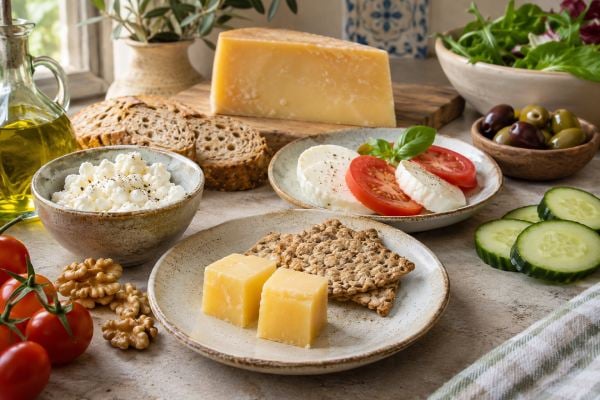
Cheese can fit into a heart-healthy diet, but the details matter. Many cheeses are concentrated sources of saturated fat, sodium, and calories, so large portions can make it harder to lower LDL cholesterol or stay within a sensible energy intake. At the same time, cheese is not simply “butter with protein.” It provides protein, calcium, phosphorus, and other nutrients, and studies of whole dairy foods do not show that moderate cheese intake automatically raises cardiovascular risk. The practical answer is to treat cheese as a flavorful ingredient rather than an unlimited snack. A portion of about 1 ounce (28 g) of a firm cheese is a useful starting point, then adjust for your overall diet, cholesterol level, blood pressure, and calorie needs. If LDL cholesterol is high, the biggest opportunity is often not eliminating cheese completely, but choosing smaller portions, comparing saturated fat and sodium on labels, and replacing some high-saturated-fat foods with unsaturated-fat foods such as nuts, seeds, avocado, olive oil, and fish.
Table of Contents
- Is cheese good or bad for your heart?
- How saturated fat in cheese affects LDL
- What a heart-smart cheese portion looks like
- How to compare cheeses at the store
- Smarter ways to eat cheese
- When to be more careful with cheese
- A practical cheese plan for heart health
Is cheese good or bad for your heart?
Cheese is best viewed as a food with both strengths and tradeoffs rather than as a food that is universally “good” or “bad” for the heart. Its main cardiovascular concern is that many varieties contain a meaningful amount of saturated fat and sodium. Its strengths include protein, calcium, phosphorus, vitamin B12, and, in some cheeses, fermentation-related compounds that may affect how the food behaves in the body.
Large prospective studies and reviews have generally found neutral or modestly favorable associations between cheese intake and cardiovascular outcomes. That does not prove that cheese prevents heart disease. People who eat cheese differ in many ways, and observational studies cannot fully separate cheese itself from the rest of the diet and lifestyle. Randomized trials examining dairy foods also do not support the idea that eating more dairy automatically worsens cholesterol or blood pressure, but the evidence is not precise enough to declare every type and portion of cheese equally heart healthy.
The most useful way to interpret this evidence is to focus on the whole dietary pattern. If a small amount of cheese makes vegetables, beans, whole grains, or a salad more satisfying, it may fit well. If cheese is added on top of a diet already heavy in butter, fatty processed meats, pastries, and fried foods, saturated fat can climb quickly.
This distinction matters because LDL cholesterol is one of the major causal drivers of atherosclerotic cardiovascular disease. If you are trying to understand your lipid panel, LDL, HDL, and triglycerides each tell you something different. Cheese choices are most relevant to LDL when they change the amount and type of fat you eat overall.
How saturated fat in cheese affects LDL
Saturated fat tends to raise LDL cholesterol when it replaces unsaturated fat in the diet. That is why major cardiovascular and nutrition guidance continues to recommend limiting saturated fat and favoring unsaturated fats from foods such as olive oil, nuts, seeds, fish, and avocado.
For a person eating 2,000 calories per day, 10% of calories from saturated fat equals about 22 g per day. People who need a stronger LDL-lowering approach are often advised to aim lower than that in consultation with a clinician or dietitian. Cheese can use up a large part of the daily total surprisingly quickly. Depending on the variety, 1 ounce may contain roughly 3 to 6 g of saturated fat, while a generous restaurant portion can be several ounces.
That does not mean every gram of saturated fat from cheese has exactly the same health effect as the same amount from butter. Whole foods have complex structures. In cheese, fat is contained within a protein- and calcium-rich matrix, and fermentation may also influence digestion and metabolism. This “food matrix” is one reason cardiovascular outcomes seen with cheese do not always match what would be predicted from saturated fat content alone.
Still, the matrix is not a reason to ignore LDL. If your LDL rises when your cheese, butter, cream, coconut oil, or fatty meat intake rises, the blood result matters. A reasonable first step is to reduce the major saturated-fat sources for 6 to 12 weeks and repeat testing. You can also build meals around foods that lower LDL through soluble fiber and healthier fat replacement rather than focusing only on what to remove.
The replacement food is crucial. Cutting cheese and replacing it with refined crackers, sweets, or other ultra-processed carbohydrates is unlikely to be an improvement. Replacing some cheese with hummus, nuts, seeds, avocado, olive-oil dressings, beans, or fish is more likely to shift the diet in a heart-supportive direction.
What a heart-smart cheese portion looks like
For many adults, about 1 ounce (28 g) of firm or semi-firm cheese is a practical portion. Visually, that is roughly the size of four standard dice, although weighing it a few times at home is more accurate than relying on visual estimates. Soft cheeses and shredded cheese vary more in volume, so the nutrition label is the better guide.
Portion size matters because cheese is calorie-dense. A modest serving can add flavor and protein; a 3- or 4-ounce serving can turn a snack into several hundred calories and deliver a large amount of saturated fat and sodium. This is especially easy with cheese boards, pizza, nachos, casseroles, and restaurant sandwiches, where the amount is difficult to judge.
A useful strategy is to decide what role cheese is playing in the meal. If it is a garnish, 0.5 to 1 ounce may be enough. If it is the main protein, a somewhat larger portion may fit, but pair it with vegetables, fruit, legumes, or whole grains rather than additional high-saturated-fat foods.
| Situation | Smarter approach | Why it helps |
|---|---|---|
| Salad | Use 0.5–1 oz of a strongly flavored cheese | You get flavor in every bite with less total cheese |
| Sandwich | Choose one measured slice instead of multiple overlapping slices | Keeps saturated fat and calories predictable |
| Pasta | Grate 1–2 tablespoons of Parmesan-style cheese over the finished dish | Fine grating spreads flavor over more food |
| Snack | Pair 1 oz cheese with fruit, vegetables, or whole-grain crackers | Adds fiber and volume instead of more cheese |
| Pizza | Use less cheese and more vegetables; choose a thinner layer rather than extra cheese | Reduces a major source of saturated fat and calories |
If weight management is also a goal, portion awareness can help without forcing you to remove foods you enjoy. Weight is only one part of cardiovascular health, but even modest weight loss can improve several risk factors in people carrying excess weight. The broader changes are explained in what improves first with weight loss and what can take longer.
How to compare cheeses at the store
Names such as “natural,” “artisan,” “grass-fed,” or “keto-friendly” do not tell you whether a cheese is a better cardiovascular choice. The nutrition label is more useful. Compare products using the same serving size and pay special attention to saturated fat and sodium.
There is no single cheese that is always lowest in both. Fresh cheeses such as part-skim ricotta or some cottage cheeses may be lower in saturated fat than many aged cheeses, but cottage cheese can be high in sodium unless you choose a reduced-sodium version. Some reduced-fat cheeses lower saturated fat substantially but may have similar or higher sodium. Strongly flavored aged cheeses can be high in both, yet a small amount may provide enough flavor that you use less.
When comparing options, use this order:
- Check the serving size first. A label that looks “better” may simply use a smaller portion.
- Compare saturated fat per serving. If two cheeses work equally well for you, the lower-saturated-fat option can help reduce your daily total.
- Compare sodium, especially if you have high blood pressure, kidney disease, heart failure, or have been told to limit sodium.
- Look at protein and calories in the context of the meal, not as stand-alone scores.
- Choose a cheese you actually enjoy enough to use a reasonable portion. An unsatisfying “diet” product can backfire if you eat twice as much.
Typical cheese values vary by brand and moisture content, sometimes substantially. That is why a fixed ranking of “best” and “worst” cheeses can be misleading. A better habit is to compare the two or three products you would genuinely buy. If sodium is your main concern, reading nutrition labels for sodium, fiber, and fats makes those comparisons faster.
Also notice what the cheese replaces. Choosing part-skim mozzarella instead of a higher-fat cheese can reduce saturated fat, but the benefit is larger if it replaces several ounces of cheese rather than being added to the same meal. Likewise, a reduced-fat cheese is not automatically a better choice if you dislike it and compensate by using more. A useful test is whether the swap lowers the saturated fat of the entire meal while keeping the meal satisfying.
Pre-shredded, sliced, and individually wrapped cheeses can make portions easier to estimate, but convenience does not guarantee a better nutrition profile. Compare them the same way you would a block of cheese. With shredded cheese, measure the amount at least a few times; a loosely filled quarter-cup and a densely packed quarter-cup can be quite different. For cheese boards, portion your serving onto a plate before eating rather than grazing from the board. These small environmental changes make portion control more reliable without requiring constant calorie counting.
Smarter ways to eat cheese
The heart-health effect of a cheese habit depends heavily on what surrounds it. A small amount of cheese in a Mediterranean- or DASH-style meal is different from a meal built around cheese, processed meat, refined bread, and fries.
Start by using cheese as a flavor booster. Crumble feta-style cheese over a large bean-and-vegetable salad, grate Parmesan-style cheese over roasted vegetables, or add a thin slice of cheese to a whole-grain sandwich filled with vegetables. Stronger flavors can be useful because you may be satisfied with less.
Next, make the rest of the plate do more cardiovascular work. Aim for vegetables or fruit, a high-fiber carbohydrate such as oats, barley, beans, lentils, or whole grains, and a source of unsaturated fat. Soluble fiber is especially helpful for LDL cholesterol because it reduces absorption of bile acids and cholesterol in the gut. If you want a practical target and food ideas, see how much soluble fiber can help lower cholesterol.
You can also rotate cheese with other protein foods instead of treating it as the default. Examples include beans, lentils, tofu, fish, skinless poultry, yogurt, or eggs depending on your preferences and health goals. This automatically creates more variety in the fat, fiber, and micronutrient profile of your week.
For cooking, do not assume that reduced-fat cheese is always necessary. Sometimes a smaller amount of full-flavor cheese works better than a larger amount of a mild reduced-fat product. The key question is the total saturated fat and sodium in the finished meal. Measure once or twice until you learn what a satisfying portion looks like.
When to be more careful with cheese
Some people have more reason to pay close attention to cheese intake than others. If your LDL cholesterol is high, particularly if it is very high or there is a family history of premature heart disease, reducing saturated fat is a sensible part of the plan. A persistently high LDL can reflect genetics as well as diet, so do not assume that stricter eating is always enough.
If you have hypertension, the sodium in cheese may be just as important as the saturated fat. Sodium can vary widely among cheeses and brands. People who are sodium-sensitive may see a meaningful blood pressure improvement when they reduce high-sodium foods across the day. The article on cheese, sodium, and lower-salt choices focuses on that issue in more detail.
People with heart failure or certain kidney conditions may have individualized sodium or fluid instructions, so generic targets may not apply. Similarly, anyone with established cardiovascular disease, diabetes, familial hypercholesterolemia, or markedly elevated LDL should discuss overall lipid targets with a clinician rather than relying on one food change.
Consider a more structured review of your cheese habit if:
- Cheese appears at most meals or snacks.
- You routinely eat more than 1–2 ounces at a time.
- Your diet also contains substantial butter, cream, fatty meat, coconut oil, or baked goods rich in saturated fat.
- Your LDL remains above your recommended range despite otherwise good habits.
- Your blood pressure is high and cheese is one of several major sodium sources.
Do not stop prescribed cholesterol medication because you improved your diet. Lifestyle and medication are not competing philosophies; they are tools that can be combined according to your level of risk. If you are unsure what your cholesterol result means, cholesterol ranges and targets can help you prepare for a discussion with your clinician.
A practical cheese plan for heart health
A heart-smart approach to cheese does not require perfection. It works best when it turns vague advice into a few repeatable decisions.
For one week, simply observe. Note which meals contain cheese, estimate the portion, and look at the saturated fat and sodium on the products you use most. Many people discover that one or two situations account for most of their intake, such as oversized sandwiches, evening snacking, pizza, or cheese-heavy restaurant meals.
In week two, change the highest-impact habit. You might measure a 1-ounce snack portion, use one slice instead of two on sandwiches, order regular rather than extra cheese, or replace cheese at one meal with beans, fish, hummus, or another lower-saturated-fat protein. Keep the change easy enough to repeat.
Then improve the surrounding foods. Add fruit to the cheese snack, vegetables and beans to the lunch, or a whole grain to dinner. If your overall diet is low in plants, increasing those foods often matters more than debating tiny differences between cheddar, Swiss, mozzarella, or feta.
If LDL is the main target, give a consistent dietary pattern enough time to show up in bloodwork. Lipids can begin changing within weeks, and clinicians often reassess after roughly 6 to 12 weeks when making meaningful lifestyle or treatment changes. If the change is smaller than you need, that is useful information rather than failure. It may mean you need a stronger saturated-fat reduction, more soluble fiber, weight loss if appropriate, or medication based on your baseline risk.
The bottom line is simple: cheese can stay on the menu for many people. Keep portions deliberate, let saturated fat and sodium guide comparisons, and build the majority of your diet from minimally processed plant foods, fish or other lean proteins, whole grains, and unsaturated fats. That approach protects the pleasure of eating cheese while keeping the bigger cardiovascular picture in view.
References
– Cheese consumption and multiple health outcomes: an umbrella review and updated meta-analysis of prospective studies 2023. Systematic review and meta-analysis. – Effects of Dairy Intake on Markers of Cardiometabolic Health in Adults: A Systematic Review with Network Meta-Analysis 2023. Systematic review and network meta-analysis. – Dairy Product Consumption and Cardiovascular Health: A Systematic Review and Meta-analysis of Prospective Cohort Studies 2022. Systematic review and meta-analysis. – Saturated fatty acid and trans-fatty acid intake for adults and children: WHO guideline 2023. Guideline. – 2021 Dietary Guidance to Improve Cardiovascular Health: A Scientific Statement From the American Heart Association 2021. Scientific statement.
Disclaimer
This article provides general education about cheese and cardiovascular health and is not a substitute for individualized medical or nutrition advice. People with very high LDL cholesterol, cardiovascular disease, heart failure, kidney disease, or prescribed sodium restrictions should follow targets set by their healthcare team. Do not change or stop cholesterol or blood pressure medication based on dietary changes without discussing it with your clinician.