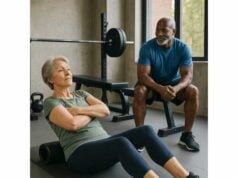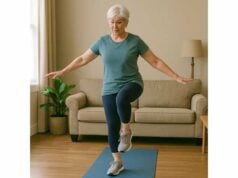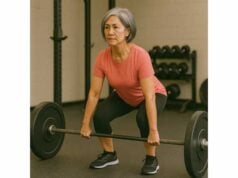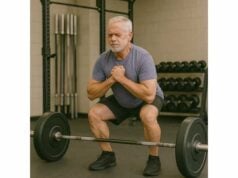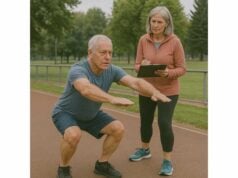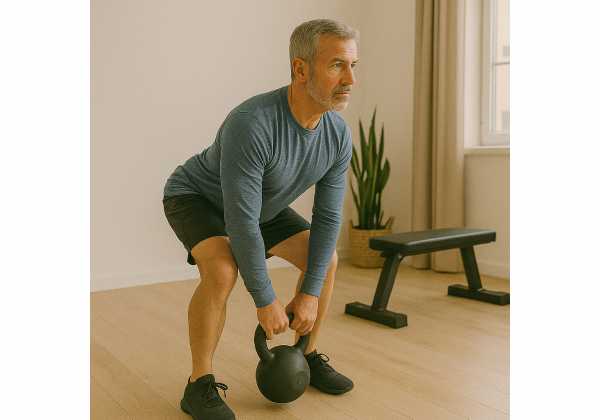
A strong back in later life is built through practiced movement, not fear of movement. The spine is made to bend, rotate, and transfer force, but it needs help from the hips, trunk, and legs when the load gets heavier. Spine-smart training teaches that division of labor. The hips create most of the motion, the trunk controls position, and the legs provide the drive.
The hinge pattern sits at the center of this skill. It is the way you pick up a box, load a dishwasher, garden, swing a kettlebell, or lift a suitcase without turning every bend into a low-back effort. Anti-flexion training adds the missing support: the ability to resist being pulled into a rounded position when life, fatigue, or weight tries to fold you forward. Together, these skills protect independence, build posterior-chain strength, and make everyday lifting feel more predictable.
Table of Contents
- Why Spine-Smart Training Matters
- The Hip Hinge Pattern
- Anti-Flexion and Trunk Control
- Best Exercises and Progressions
- Sets, Reps, and Weekly Planning
- Technique Cues and Common Mistakes
- Using the Skill in Real Life
- When to Modify or Get Help
Why Spine-Smart Training Matters
Spine-smart training keeps the back strong while teaching the hips and trunk to share work well. It does not mean keeping the spine stiff all day or treating every rounded position as dangerous. It means knowing when to move freely, when to brace, and when to use the hips as the main engine.
Healthy aging raises the value of this skill. Muscle mass and power tend to decline with age, and the loss affects daily tasks before it affects gym numbers. Picking up groceries, leaning over a sink, getting bags out of a car, lifting a grandchild, or carrying firewood all ask the same question: does the body have enough strength and coordination to manage load without panic or compensation?
The spine itself is not weak. The issue is usually capacity. A back that only experiences sitting, light walking, and occasional awkward lifting gets surprised by sudden demand. A back that trains hinges, carries, rows, step-ups, squats, and trunk control receives regular, graded practice. That practice raises the gap between what life demands and what the body can handle.
A good longevity routine trains three qualities together:
- Strength: enough hip, leg, and back strength to lift normal objects with reserve.
- Control: enough trunk awareness to resist unwanted rounding under load.
- Tolerance: enough gradual exposure that bending and lifting do not feel threatening.
This is why hinge training belongs next to squats, pushes, pulls, balance work, and walking. It fills a movement gap. Squats train knee and hip bending together. Hinges emphasize hip motion with a steadier knee angle. Carries train the trunk while walking. Rows train the upper back, which supports posture during lifting. A balanced program reduces the odds that one region does too much of the work.
Spine-smart training also respects recovery. Heavy deadlifts are not required for every adult. Some people thrive with trap-bar deadlifts, kettlebell deadlifts, cable pull-throughs, hip thrusts, Romanian deadlifts, or loaded carries. Others start with a dowel, a wall touch drill, and a light box lift. The right version is the one that builds capacity without leaving the back irritated for days.
For a broader foundation on lifting form, technique fundamentals for longevity lifts pair well with the hinge skills in this article.
The Hip Hinge Pattern
The hip hinge is a backward movement of the hips with a controlled torso angle. The hips travel back, the spine stays long, the ribs and pelvis remain connected, and the feet stay rooted. The knees bend a little, but they do not turn the movement into a squat.
A simple way to feel the difference is this: in a squat, the hips go down; in a hinge, the hips go back. Both patterns are useful. The hinge places more emphasis on the glutes, hamstrings, spinal erectors, and upper-back stabilizers. These muscles form much of the posterior chain, the line of tissue that helps you stand tall, climb, lift, and slow your body when you bend forward.
What a good hinge feels like
A good hinge feels like tension across the back of the hips and thighs, not a sharp pull in the low back. The torso leans forward because the hips move back, not because the spine collapses. The shins stay closer to vertical than they would in a squat. The weight stays balanced over the midfoot, with the whole foot on the floor.
Useful cues include:
- “Push the hips back toward the wall.”
- “Keep the ribs stacked over the pelvis.”
- “Reach the crown of the head long.”
- “Keep the weight close to the body.”
- “Stand up by driving the floor away.”
The hinge is easiest to learn with no load. Stand about one foot from a wall, face away from it, soften the knees, and push the hips back until the glutes touch the wall. Then stand tall. Step slightly farther away as the pattern improves. The wall gives clear feedback: if the knees bend too much, the hips will not reach it; if the spine rounds early, the movement feels cramped.
Why the hips matter for the back
The hips are built for large movement and force. The gluteus maximus is one of the strongest muscles in the body. The hamstrings cross the hip and knee and help extend the hip during lifting. When these muscles work well, the low back still contributes, but it does not become the only worker on the job.
Limited hip motion changes the hinge. If hip flexion is restricted, the body often borrows motion from the lumbar spine. If hamstrings feel tight, the pelvis may tuck under too early. If the ankles, hips, or upper back lack mobility, the person may still lift successfully but with less margin. A short mobility warm-up helps, especially before loaded hinges. A few minutes of hip airplanes with support, hamstring flossing, glute bridges, and light hinge drills often works better than long static stretching before training.
The hinge is also a balance skill. As the torso leans forward, the hips must travel back enough to keep the center of mass over the feet. Older adults who feel unsteady often bend from the spine while keeping the hips tucked under them, because that feels safer in the moment. In training, a dowel, wall, chair, or rack gives confidence while the pattern becomes familiar.
For people who need a simple joint-prep sequence before lifting, warm-ups for longevity training give the hinge a cleaner starting point.
Anti-Flexion and Trunk Control
Anti-flexion means resisting unwanted forward rounding of the spine. It is not the same as never flexing the spine. Normal life includes bending to tie shoes, curl up in bed, stretch, and reach. The training issue appears when the body must manage load, speed, fatigue, or awkward leverage. In those moments, the trunk needs enough stiffness to keep the spine from being pulled into a position the person cannot control.
Think of anti-flexion as a braking system. When you hold a kettlebell, lift a box, carry a bag in front of you, or perform a Romanian deadlift, gravity tries to fold the torso forward. The trunk muscles resist that pull. The abdominal wall, spinal erectors, lats, diaphragm, pelvic floor, and deep stabilizers coordinate to create a cylinder of support.
Bracing is central here. A brace is not sucking in the stomach. It is a 360-degree expansion and firming of the torso, as if preparing to receive a gentle push from any direction. The breath starts low and wide. The ribs do not flare upward. The pelvis does not dump forward. This type of pressure gives the hips and legs a stable platform to push from.
Anti-flexion also builds confidence. Many adults with recurring back pain become afraid of bending. Fear often leads to stiff, guarded movement, which reduces options. Training graded anti-flexion gives the person a controlled middle path: the spine is allowed to move in life, while loaded training teaches strong positions under demand.
Good anti-flexion drills include:
- Front-loaded carries
- Goblet hold marches
- Kettlebell deadlifts from blocks
- Romanian deadlifts with light dumbbells
- Hip-hinge isometric holds
- Back extensions with a neutral, controlled torso
- Heavy-enough rows performed without torso collapse
Some familiar “core” exercises train different anti-movement qualities. A plank usually trains anti-extension. A Pallof press trains anti-rotation. A suitcase carry trains anti-lateral flexion. These are valuable, but anti-flexion deserves direct practice because daily lifting often pulls the body forward. For a full trunk plan, anti-extension and anti-rotation core work rounds out the picture.
Best Exercises and Progressions
Spine-smart training works best when exercises progress from simple to demanding. The body learns position first, then tension, then load, then speed or fatigue. Skipping steps often creates the exact problem the training was meant to solve.
The table below shows a practical progression. Most people do not need every step. Choose the first level that feels smooth, repeatable, and pain-free, then move forward gradually.
| Level | Main exercise | What it teaches | Ready to progress when |
|---|---|---|---|
| 1 | Wall hip hinge | Hips move back while spine stays controlled | 10 slow reps feel natural |
| 2 | Dowel hinge | Head, upper back, and pelvis stay connected | Dowel contact stays steady |
| 3 | Kettlebell deadlift from blocks | Load stays close; legs and hips drive the lift | 3 sets of 8 feel crisp |
| 4 | Romanian deadlift | Hip control through a longer range | No back irritation the next day |
| 5 | Trap-bar deadlift or elevated barbell deadlift | Higher load with a spine-friendly setup | Technique holds under moderate effort |
| 6 | Loaded carries and hinge combinations | Trunk control while moving and breathing | Posture stays strong while walking |
Start with pattern drills
The wall hinge and dowel hinge look simple, but they solve common problems quickly. For the dowel hinge, hold a broomstick or dowel along the back so it touches the back of the head, upper back, and pelvis. Hinge without losing those three points. This teaches the difference between hip motion and spinal rounding.
Do 2 sets of 8 to 10 slow reps before loaded training. The drill should feel clean, not exhausting. It is practice, not a workout.
Use elevated deadlifts before floor deadlifts
Many adults struggle to lift from the floor because the starting position demands more hip mobility, trunk control, and confidence than they currently have. Raising the weight solves this. Place a kettlebell, dumbbell, trap bar, or barbell on blocks so the handles sit around mid-shin, below the knee, or even just above the knee at first.
Elevated lifting lets the person train the hinge without forcing a range they cannot control. Over time, lower the height as skill improves. This approach works especially well for tall adults, people with long legs, people with limited hip motion, and anyone returning after back irritation.
Add carries for real-world strength
Carries connect trunk control to walking. A front-loaded carry with a sandbag, medicine ball, kettlebell, or weighted backpack trains anti-flexion directly because the object pulls the torso forward. Keep the object close to the body, breathe behind the brace, and walk slowly.
Use 10- to 30-meter carries or 20- to 45-second carries. Stop before posture collapses. Carries should finish with the feeling that you could have gone a little farther with good form.
A small home setup works well for this style of training. A kettlebell, adjustable dumbbells, a resistance band, and a sturdy step cover most hinge and carry needs. For simple equipment ideas, a minimal home gym for longevity is enough for years of progress.
Sets, Reps, and Weekly Planning
Hinge training belongs in a weekly strength plan 1 to 3 times per week, depending on the person’s training age, recovery, and total workload. Two weekly exposures suit most adults: one focused strength hinge and one lighter hinge or carry session.
A useful starting dose is 2 to 3 sets of 6 to 10 reps for the main hinge, using a load that leaves 2 to 4 good reps in reserve. The last few reps should require attention, but they should not force back rounding, breath-holding panic, or a shaky lockout. For carries, use 2 to 4 rounds of 20 to 45 seconds.
Beginners often progress fastest by adding control before weight. Examples include slower lowering, a one-second pause near the bottom, a slightly longer range, or better breathing. Once the movement stays consistent, add small load jumps. For dumbbells and kettlebells, 2 to 5 kg increases are plenty. For barbell or trap-bar lifts, 2.5 to 10 kg increases work when technique remains solid.
A simple weekly layout looks like this:
- Day 1: Main hinge, upper-body pull, squat or step-up, trunk brace drill.
- Day 2: Lighter hinge drill, carries, single-leg strength, mobility.
- Day 3: Optional power or strength day with low volume and excellent form.
The hinge should not be crushed every session. Posterior-chain work often creates soreness because it loads hamstrings, glutes, and spinal erectors through a long range. Mild muscle soreness for 24 to 48 hours is normal after a new exercise. Sharp pain, nerve symptoms, or soreness that worsens across several sessions calls for a change.
Rate of perceived exertion, or RPE, helps control effort. On a 1 to 10 scale, most hinge work for healthy aging belongs around RPE 6 to 8. That means challenging but repeatable. Save RPE 9 efforts for experienced lifters with strong technique and good recovery. Repeated max-effort deadlifts offer little benefit for most longevity-focused adults.
Heavy hinges also need spacing from other demanding work. A hard hill session, long ruck, heavy squat day, or intense yard-work weekend all load the hips and back. Treat them as part of the total week. A person who feels great on paper but tired in real life should reduce sets, range, or load before technique breaks.
For a complete weekly structure, strength training for longevity helps place hinge work alongside pushes, pulls, squats, carries, and recovery.
Technique Cues and Common Mistakes
Good hinge technique is quiet. The bar or bell stays close, the feet stay grounded, the trunk stays organized, and the hips finish the lift without overextending the low back. Most mistakes come from rushing, using too much range, or chasing weight before the pattern is stable.
Set the body before the lift
Before a loaded hinge, stand with the feet about hip-width to shoulder-width apart. Create a tripod foot: big toe base, little toe base, and heel all stay connected to the floor. Soften the knees. Breathe low into the trunk. Gently brace. Pull the shoulders down and back enough to keep the weight close, without forcing a stiff military posture.
During the descent, the hips move back first. The hands travel down close to the thighs. Stop when the hamstrings limit the motion, not when the weight reaches an arbitrary depth. For many adults, just below the knees is a productive Romanian deadlift range. More depth is useful only when control stays the same.
During the ascent, push the floor away and bring the hips forward. Finish tall with glutes engaged. Do not lean back at the top. The lift ends when the body is stacked, not when the ribs flare and the low back arches.
Common mistakes
The most common hinge mistakes are easy to spot:
- Turning the hinge into a squat: The knees travel far forward and the hips drop down. Use the wall hinge to relearn “hips back.”
- Reaching for the floor: The spine rounds because the person chases depth. Raise the weight or shorten the range.
- Letting the load drift away: The farther the weight moves from the body, the harder the back works. Keep the object close.
- Losing the brace at the bottom: The bottom position is where control matters most. Pause higher if the brace disappears.
- Rushing the lowering phase: Fast lowering hides poor control. Use a 2- to 3-second descent.
- Overextending at lockout: Leaning back at the top adds low-back compression without adding useful strength.
Video helps. Record one set from the side and one set from a front angle. Look for a consistent torso position, steady foot pressure, and a weight path that stays close. The goal is not a perfect social-media lift; it is a repeatable pattern that looks similar from rep 1 to rep 8.
Breathing deserves special attention. Holding the breath for every rep is not necessary for moderate training, but exhaling all air during the hardest part often weakens the brace. A practical method is to inhale and brace before the rep, exhale lightly through the sticking point, and reset at the top. Heavier sets need a stronger breath strategy. bracing and breathing for longevity lifting gives that skill its own focus.
Using the Skill in Real Life
Hinge training pays off when it changes normal behavior. The gym teaches the pattern; life tests it with laundry baskets, pets, luggage, garden soil, groceries, tools, and awkward furniture. The same rules apply: get close, set the feet, brace, use the hips, and avoid twisting while loaded.
For a box on the floor, step close enough that the box is between the feet or just in front of the shins. Hinge down, bend the knees as needed, grip firmly, bring the box close, then stand. If the box is wide, tilt it onto an edge before lifting. If it is heavy, split the load or slide it to a higher surface first.
For dishwasher loading or gardening, repeated low-level bending creates fatigue even without heavy weight. Use a staggered stance and place one hand on a thigh, counter, or raised bed when possible. Switch sides often. Take short standing breaks before the back starts sending warning signals.
For luggage, avoid the long-arm yank. Stand close, hinge, brace, and lift the bag onto a chair or bed before zipping and organizing. Use wheels when available. When placing luggage into a car, move the feet instead of twisting through the spine with the bag held away from the body.
For caregiving tasks, the stakes are higher because another person’s movement is less predictable than a dumbbell. Get close, widen the stance, keep the load close, and ask for help or use assistive equipment when needed. A strong hinge helps, but it does not replace safe transfer technique.
Spine-smart training also supports fall prevention. Strong hips help recover balance when the body tips forward. Carries improve posture while walking. Hinges train the posterior chain that helps control deceleration on stairs, slopes, and uneven ground. Pairing hinge work with daily balance drills gives older adults both strength and reaction options.
This is where longevity training becomes practical. A person who deadlifts well but cannot carry groceries comfortably still has a gap. A person who performs planks but rounds under every front-loaded task also has a gap. Hinge patterns and anti-flexion drills connect gym strength to the messy angles of normal life.
When to Modify or Get Help
Modify hinge training when the back feels worse during the set, symptoms travel down the leg, form changes suddenly, or soreness increases from session to session. A good training plan gives the body a clear signal and then allows recovery. It does not keep poking the same irritated tissue.
Pain does not always mean damage, but it is useful information. A mild, familiar ache that settles during warm-up and does not worsen afterward is different from sharp pain, numbness, tingling, weakness, or pain that changes walking. Stop loaded hinge work and seek qualified help when symptoms include loss of bladder or bowel control, saddle numbness, unexplained fever, recent major trauma, progressive leg weakness, unexplained weight loss, or severe night pain.
Most non-emergency modifications are straightforward:
- Raise the weight higher from the floor.
- Reduce the range of motion.
- Switch from barbell to trap bar, kettlebell, cable, or dumbbells.
- Use tempo instead of heavier load.
- Replace deadlifts with hip thrusts, bridges, or pull-throughs for a short phase.
- Reduce total weekly hinge volume.
- Add more recovery between hard lower-body sessions.
Older adults returning after a flare-up often do best with an entry point that feels almost too easy. That is not weakness; it is smart exposure. Start with unloaded hinges, then light carries, then elevated deadlifts, then Romanian deadlifts. Increase one variable at a time. If load goes up, keep range and sets stable. If range increases, keep load stable. If sets increase, avoid changing weight in the same week.
Hip and knee issues also deserve adjustments. Some people tolerate trap-bar deadlifts better than straight-bar deadlifts because the load sits closer to the body’s center. Others prefer kettlebell deadlifts because the setup is simpler. People with knee irritation often prefer Romanian deadlifts, hip thrusts, or rack pulls. People with hip irritation often need a narrower stance, shorter range, or more glute bridge work before deeper hinges. knee- and hip-friendly training modifications help tailor the movement without abandoning strength work.
Spine-smart training is successful when the person feels more capable outside the gym. The best signs are simple: lifting feels smoother, the back feels less threatened by chores, posture holds during carries, and recovery stays predictable. Over months, those changes become a larger physical reserve. That reserve is one of the most useful forms of strength in healthy aging.
References
- Older Adult Activity: An Overview 2025 (Official Page)
- Science Spotlight | ACSM Releases New Position Stand on Resistance Training 2026 (Official Page)
- Effects of Resistance Training on Pain Control and Physical Function in Older Adults With Low Back Pain: A Systematic Review With Meta-analysis 2023 (Systematic Review)
- Effect of an Exercise Program That Includes Deadlifts on Low Back Pain 2021 (Review)
- Effects of combined hip exercise and passive stretching on muscle stiffness, pain perception and pain-related disability, and physical function in older adults with low back pain 2022 (RCT)
- WHO guidelines on physical activity and sedentary behaviour 2020 (Guideline)
Disclaimer
This article is educational and does not replace care from a qualified health professional. People with current back pain, osteoporosis, nerve symptoms, recent injury, balance problems, or medical restrictions should get individualized guidance before adding loaded hinges or heavy carries. Stop any exercise that causes sharp pain, spreading symptoms, or loss of control.