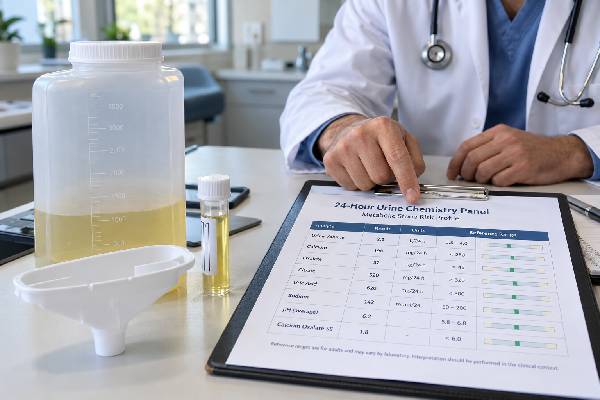
The Litholink 24-hour urine test is an at-home kidney stone evaluation that measures how much urine you make and how much calcium, oxalate, citrate, uric acid, sodium, and other substances you excrete over a full day. It also calculates urine supersaturation, which estimates how strongly the urine favors formation of common stone crystals. Doctors most often order the test for people with recurrent stones, multiple stones, high-risk stone types, or a strong reason to look for a preventable metabolic cause. The value of the test is not one isolated number. A useful interpretation looks at the pattern: urine volume, mineral load, protective factors such as citrate, urine pH, dietary clues, and collection quality together. Because food, fluid intake, medications, and an incomplete collection can change the result, the sample should represent an ordinary day unless your clinician gives different instructions.
- Litholink measures a full stone-risk profile, not just one urine marker: volume, calcium, oxalate, citrate, uric acid, pH, sodium, creatinine, and supersaturation are among the key results.
- A complete collection matters: missing several hours of urine can make calcium, sodium, citrate, and other 24-hour totals look falsely low.
- Current Litholink adult reference ranges include urine volume above 2,500 mL/day, with sex-specific ranges for calcium, oxalate, citrate, and uric acid.
- Results are interpreted as a pattern: high calcium may matter more when urine volume is low, citrate is low, or calcium oxalate supersaturation is high.
- Repeat testing is common after treatment changes: it can show whether hydration, diet, or medication actually changed the urinary risk factors being targeted.
Table of Contents
- What the Litholink test measures
- Who may need a Litholink 24-hour urine test
- How to collect the sample correctly
- How to understand Litholink results
- Common kidney stone risk patterns
- What happens after testing
- Limitations, errors, and questions to ask
What the Litholink test measures
A Litholink 24-hour urine test measures substances that promote or inhibit crystal formation during an entire collection period. That makes it different from a routine urinalysis, which is usually a small spot sample and is designed to answer different questions.
The standard Litholink kidney stone panel includes urine volume and measurements of calcium, creatinine, citrate, phosphorus, pH, sodium, urea nitrogen, oxalate, chloride, ammonium, magnesium, potassium, uric acid, and sulfate. It also includes a qualitative cystine screen and calculations of supersaturation for common stone-forming salts. If cystinuria is known or suspected, a separate cystine-focused panel can measure quantitative cystine and related risk calculations.
Several parts of the report are especially important:
- Urine volume shows how diluted or concentrated the urine is over 24 hours. More urine generally lowers crystal concentration.
- Urine calcium reflects how much calcium reaches the urine. Higher calcium excretion can raise calcium oxalate and calcium phosphate stone risk.
- Urine oxalate is a major driver of calcium oxalate supersaturation. Even moderate increases may matter when urine calcium is also high.
- Urine citrate is protective because citrate binds calcium and reduces calcium crystal formation.
- Urine pH changes which crystals are favored. Persistently acidic urine promotes uric acid crystallization, while a higher pH can favor calcium phosphate and, in an infection setting, struvite.
- Urine uric acid can contribute to uric acid stones and may also influence some calcium stone formers.
- Urine sodium is partly a dietary marker. Higher sodium intake can increase urinary calcium in many people.
- Creatinine helps the clinician judge whether the collection was reasonably complete for the person’s body size and muscle mass.
The report also provides supersaturation values. Supersaturation is not the same as the amount of a mineral in the urine. It is a calculated estimate of how close the urine is to forming crystals of substances such as calcium oxalate, calcium phosphate, or uric acid. A person can therefore have a calcium result that is only mildly high but still have substantial stone risk if urine volume is low and oxalate is high. For a broader explanation of the same type of metabolic work-up, see the 24-hour urine stone risk profile and the urine supersaturation test.
Who may need a Litholink 24-hour urine test
A 24-hour urine evaluation is most useful when the result is likely to change prevention. It is commonly ordered after recurrent kidney stones, multiple stones, stones at a young age, bilateral stones, a solitary kidney, unusual stone composition, or a strong family history. It is also valuable when a clinician suspects a metabolic problem such as hypercalciuria, hyperoxaluria, hypocitraturia, cystinuria, renal tubular acidosis, or excessive uric acid production.
People with uric acid, cystine, and infection-related stones are generally considered high-risk stone formers. Calcium stone formers may also be high risk when stones recur, when imaging shows a substantial stone burden, or when medical conditions increase the chance of recurrence.
The test is usually only one part of a complete evaluation. Depending on the history and stone type, a clinician may also order blood calcium, creatinine, electrolytes, bicarbonate, uric acid, phosphorus, and parathyroid hormone. If a stone has been captured or removed, laboratory analysis of the stone can identify whether it is calcium oxalate, calcium phosphate, uric acid, struvite, cystine, or another material.
Testing is not always necessary after a single uncomplicated first stone in a person with no high-risk features. Some clinicians start with general prevention advice, stone analysis, basic blood work, and a routine urine test, then reserve a full 24-hour collection for recurrent or higher-risk disease. Guidelines differ somewhat in how broadly they recommend metabolic testing, but they agree that a detailed urine profile is especially useful when recurrence risk is high or when targeted medication is being considered.
The timing also matters. The goal is to capture your usual physiology, not the temporary effects of vomiting, severe pain, fasting, an infection, an unusually restrictive diet, or heavy IV fluid use during an acute stone episode. A collection is generally most informative when you are stable and back to your normal eating and drinking pattern.
How to collect the sample correctly
The test is only as reliable as the collection. A 24-hour total is calculated from every urination during the collection period, so missed urine can make the daily excretion values look lower than they really are.
Litholink provides an at-home kit and specific instructions. The exact kit directions should take priority, because preservatives, shipping requirements, and preparation details can change. A typical collection works like this:
- Choose a normal day. Unless your clinician tells you otherwise, eat and drink as you usually do. Avoid deliberately overdrinking just to make the result look better.
- Start by emptying your bladder. On the morning you begin, urinate into the toilet and record that as the start time. This first void is not collected.
- Collect every urination after that. Add every urine sample during the day and overnight to the designated collection container according to the kit instructions.
- Finish at the same time the next day. At the end of the collection period, urinate one final time into the collection. That final void belongs in the container.
- Record the timing and requested information. The laboratory needs the collection duration and other details on the form.
- Prepare and ship the sample exactly as directed. Litholink uses its own preservative and shipping process, so do not substitute another container or handling method.
Litholink’s standard specimen requirement accepts a 22- to 26-hour collection, but the target is a true 24-hour day. A collection that is much shorter or longer can distort the daily totals. If you forget a urine sample, spill a meaningful amount, have a bowel movement contaminate the container, or accidentally follow the wrong storage instructions, contact the laboratory or ordering office before sending the kit. Repeating the collection may be more useful than interpreting a knowingly incomplete sample.
Preparation can also affect accuracy. Follow the current kit instructions for supplements and medications. Litholink specifically warns about higher-dose pill-form vitamin C before collection because vitamin C can affect oxalate-related testing. Do not stop a prescribed medicine on your own just to obtain a “clean” result. In many cases, the clinician wants to see urine chemistry under the treatment you are actually using.
If two collections are ordered, complete both as instructed. Two 24-hour samples can reveal day-to-day variation and reduce the chance that an unusual day drives the treatment plan. The concept is similar to other timed collections, but the kidney stone panel is more detailed than a basic 24-hour urine collection test.
How to understand Litholink results
The safest way to read a Litholink report is to start with the overall pattern, then examine individual values. Reference ranges are useful, but stone risk is continuous rather than an on/off state. A value just inside a laboratory range does not guarantee low risk, and a small abnormality does not automatically require medication.
Litholink updated several adult reference ranges in 2026. The standard adult ranges listed on its test menu include the following:
| Marker | Current adult Litholink reference range | Why it matters |
|---|---|---|
| Urine volume | >2,500 mL/24 hr | Higher volume lowers concentration of stone-forming solutes |
| Urine calcium | Male 40–250 mg/24 hr; female 30–200 mg/24 hr | Higher excretion can raise calcium stone risk |
| Urine oxalate | Male <46 mg/24 hr; female <37 mg/24 hr | Higher oxalate raises calcium oxalate supersaturation |
| Urine citrate | Male >400 mg/24 hr; female >530 mg/24 hr | Citrate inhibits calcium crystal formation |
| Urine pH | 5.70–6.30 | Low pH favors uric acid; higher pH can favor calcium phosphate |
| Urine uric acid | Male 460–800 mg/24 hr; female 370–750 mg/24 hr | High uric acid may contribute to uric acid or calcium stone risk |
| Urine sodium | 50–120 mmol/24 hr | Often reflects salt intake and can influence urinary calcium |
These are laboratory reference ranges, not universal treatment targets. A clinician may set a different goal based on stone composition, medications, age, kidney function, body size, and prior results. For example, people with cystinuria often need a much higher urine volume than the usual calcium-stone target. A person taking alkali for uric acid stones may also need a pH goal above the general reference range.
Supersaturation values help connect the individual measurements. If calcium oxalate supersaturation remains high, the reason may be one large abnormality or several smaller ones: low volume, high calcium, high oxalate, or low citrate. The urine calcium result and the urine citrate result should therefore be read in context rather than in isolation.
Common kidney stone risk patterns
Certain combinations appear repeatedly in stone prevention clinics. Recognizing the pattern explains why two people with the same stone type may receive different advice.
Low urine volume with otherwise modest abnormalities
Low volume is one of the most direct ways to raise supersaturation. A person may have calcium and oxalate values that are not markedly high, yet still create concentrated urine that favors crystal growth. The practical target is usually based on urine output, not simply how many glasses of water were consumed. Fluid needs rise with heat, exercise, sweating, diarrhea, and some occupations. A dedicated urine volume test interpretation can help explain why output may remain low despite apparently good fluid intake.
High urine calcium with high sodium
This pattern can suggest that sodium intake is contributing to calcium loss into urine. It may also occur with idiopathic hypercalciuria, primary hyperparathyroidism, high calcium supplement use, excess vitamin D, or other causes. The blood calcium and PTH results help distinguish some of these conditions. Simply cutting all dietary calcium is usually not the answer, because normal dietary calcium can reduce intestinal oxalate absorption.
High oxalate with low calcium intake or intestinal disease
Oxalate can rise with large amounts of high-oxalate foods, high-dose vitamin C, fat malabsorption, inflammatory bowel disease, or some bariatric procedures. If dietary calcium is too low, more free oxalate can be absorbed from the intestine. The pattern is best interpreted alongside the urine oxalate test, diet history, and gastrointestinal history.
Low citrate
Low citrate removes a natural inhibitor of calcium crystal formation. It can occur with high dietary acid load, chronic diarrhea, low potassium, metabolic acidosis, distal renal tubular acidosis, or some medications. Potassium citrate is often considered when hypocitraturia is clinically important, but treatment depends on kidney function, serum potassium, urine pH, and stone type.
Acidic urine with uric acid risk
A persistently low urine pH is a major driver of uric acid crystallization. This can occur even when the total 24-hour uric acid excretion is not extremely high. Obesity, insulin resistance, type 2 diabetes, gout, high animal-protein intake, and chronic gastrointestinal alkali loss can contribute. If the report shows a high uric acid supersaturation, urine alkalinization may be more important than simply lowering the uric acid amount.
What happens after testing
The purpose of the Litholink test is to turn a general recommendation such as “drink more water” into a targeted prevention plan. Treatment should match the abnormalities that are actually present.
Common responses to the results include:
- increasing fluid intake until urine output reaches the clinician’s target;
- reducing sodium when urinary sodium and calcium are high;
- keeping normal food-based calcium intake, often around 1,000–1,200 mg/day for adults unless another condition requires a different plan;
- pairing calcium-containing foods with meals when high oxalate is an issue;
- moderating excessive animal protein if it contributes to acid load, uric acid, or low citrate;
- using potassium citrate or another alkali when low citrate or low urine pH is a treatment target;
- considering a thiazide-type medicine in selected patients with calcium stone disease and persistent hypercalciuria;
- treating an underlying condition such as hyperparathyroidism, recurrent infection, bowel disease, or cystinuria.
Medication decisions require more than the urine panel. Serum potassium, creatinine, calcium, bicarbonate, uric acid, blood pressure, and other clinical factors can change what is safe. The report can guide the discussion, but it does not replace a medical assessment.
Follow-up testing is useful because intended changes do not always produce the expected urine response. Guidelines commonly suggest repeating a 24-hour urine collection roughly 8–12 weeks after starting pharmacologic prevention, then adjusting treatment if key risk factors remain abnormal. Once a stable pattern is achieved, many higher-risk stone formers are retested periodically, often about yearly, although frequency is individualized.
A good follow-up comparison looks for direction and magnitude of change. For example, did urine volume actually rise from 1.5 to 2.6 L/day? Did sodium fall along with calcium? Did potassium citrate raise citrate without pushing calcium phosphate supersaturation too high? Those paired changes are often more informative than whether every value lands inside a printed range.
Limitations, errors, and questions to ask
A Litholink report is a detailed snapshot of one or two days, not a permanent description of your metabolism. Day-to-day diet, exercise, temperature, fluid intake, supplements, medications, and collection completeness can all change the numbers.
The most important limitations include incomplete collection, unusual eating or drinking during the test, collection during an acute illness, and interpreting a single marker without stone composition or clinical context. Creatinine can help identify some questionable collections, but it cannot detect every missed void. A “normal” collection also does not rule out future stones, because anatomy, genetics, infection, and episodic changes in urine chemistry can contribute.
Useful questions for the follow-up visit include:
- Which one or two abnormalities are contributing most to my supersaturation?
- Was the collection complete enough to trust?
- What stone type am I trying to prevent?
- What urine volume should I personally target?
- Do I need normal dietary calcium, calcium with meals, or any change in supplements?
- Is my urine pH appropriate for my stone type?
- Should I change diet first, start medication, or do both?
- When should the 24-hour urine test be repeated?
- Do I also need blood calcium, PTH, kidney function testing, or stone analysis?
If the test reveals a pattern suggesting a systemic disorder, the next step is usually confirmation rather than self-treatment. High urine calcium with high blood calcium may prompt a parathyroid evaluation. Very high oxalate may require investigation for intestinal or genetic causes. A positive cystine screen needs quantitative testing. Alkaline urine with infection findings may require urine culture and evaluation for an infection stone.
The most useful Litholink result is therefore not a single red or green number. It is a set of measurements that explains why the urine is favorable or unfavorable for a particular crystal and gives the clinician measurable targets for prevention.
References
- Urine Test Menu | Litholink 2026 (Official page)
- Litholink 24-hour At-Home Urine Testing 2023 (Official instructions)
- Metabolic Evaluation and Recurrence Prevention – EAU Guidelines on Urolithiasis – Uroweb 2026 (Guideline)
- 24-Hour Urinary Chemistries and Kidney Stone Risk 2024
- Metabolic evaluation for prevention of kidney stones – CARI Guidelines 2025 (Guideline)
Disclaimer
This article is for general education about kidney stone testing and does not diagnose the cause of an individual’s stones. Litholink reference ranges and collection instructions can change, so follow the current kit directions and discuss your report with the clinician who ordered it. Seek urgent medical care for severe pain with fever, inability to urinate, persistent vomiting, or other signs of a possible obstructed or infected urinary tract.