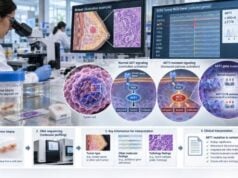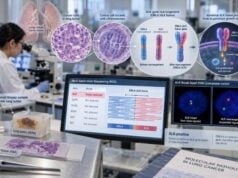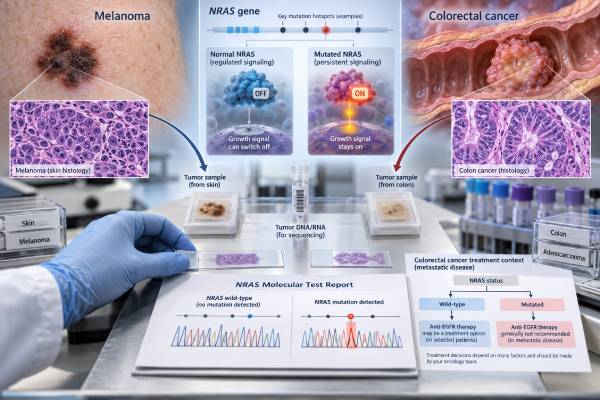
An NRAS mutation test looks for activating changes in the NRAS gene within cancer cells. The result is most often used as part of tumor profiling in melanoma and colorectal cancer, although NRAS alterations also occur in several other malignancies. A positive result means the tested sample contains an NRAS mutation; it does not mean the mutation was inherited or that every cancer with NRAS behaves the same way. In metastatic colorectal cancer, an NRAS mutation is especially important because it places the tumor in the RAS-mutant group and generally predicts lack of benefit from anti-EGFR antibodies such as cetuximab or panitumumab. In melanoma, NRAS helps define a molecular subtype and may influence treatment planning, clinical-trial options, and interpretation of other biomarkers. The exact variant, tumor type, test method, specimen quality, disease stage, and other molecular findings all matter when turning an NRAS report into a clinical decision.
- A positive NRAS result means an activating NRAS mutation was detected in the tested tumor sample.
- In metastatic colorectal cancer, an NRAS mutation generally predicts resistance to cetuximab and panitumumab and makes the tumor RAS-mutant.
- In melanoma, NRAS mutations commonly involve codon 61 and identify a biologically distinct subgroup, but they do not automatically determine one specific treatment.
- A negative result means no reportable NRAS mutation was found by that assay; it does not exclude other cancer-driving mutations or a mutation below the test’s detection limit.
- Tumor NRAS mutations are usually somatic, meaning acquired in cancer cells rather than inherited through the family.
Table of Contents
- What an NRAS Mutation Test Measures
- NRAS Mutations in Melanoma
- NRAS Mutations in Colorectal Cancer
- How to Interpret Positive, Negative, and Variant Results
- Testing Methods, Samples, and Limitations
- How NRAS Results Affect Treatment and Follow-Up
- Questions to Ask About an NRAS Report
What an NRAS Mutation Test Measures
NRAS is one of the three major RAS genes, along with KRAS and HRAS. These genes encode small signaling proteins that act like molecular switches. In their normal state, RAS proteins cycle between an active and inactive form in response to growth signals. Certain mutations interfere with the switch-off process, leaving the protein active for too long. That can drive signaling through pathways such as RAF-MEK-ERK, commonly called the MAPK pathway, and can support cancer-cell growth and survival.
An NRAS mutation test is therefore not a measurement of how much NRAS protein is present. It is a DNA-based test that asks whether a clinically relevant sequence change is present. Depending on the laboratory, NRAS may be tested alone, together with KRAS and BRAF, or as one gene on a broader solid-tumor next-generation sequencing panel.
The report usually identifies a specific variant using protein and/or DNA notation. Examples include NRAS p.Q61R, p.Q61K, p.G12D, or p.G13R. The letter-number-letter format describes the amino acid that changed. For example, Q61R means glutamine (Q) at position 61 was replaced by arginine (R).
The clinically important hotspots differ somewhat by cancer type. In melanoma, codon 61 alterations dominate. In colorectal cancer, laboratories generally assess NRAS as part of extended RAS testing, including clinically relevant variants in exons 2, 3, and 4. That broader approach matters because an uncommon RAS mutation can carry the same treatment implication as a more familiar hotspot.
NRAS testing is usually performed on tumor tissue, so the result generally describes the cancer rather than the person’s inherited DNA. A somatic NRAS mutation can arise during tumor development and need not be present in blood, saliva, or normal tissue. A tumor result therefore should not be interpreted as a hereditary cancer test unless the laboratory and clinical team specifically evaluated a germline sample for that purpose.
NRAS Mutations in Melanoma
NRAS is one of the most common oncogenic drivers in cutaneous melanoma. Roughly 15%–25% of cutaneous melanomas carry an NRAS mutation, depending on the population and tumor series. Most involve codon 61, especially Q61R, Q61K, and related substitutions. These mutations strongly activate MAPK signaling and may also affect PI3K-AKT signaling.
Knowing NRAS status helps place a melanoma into a molecular subgroup. That distinction is useful because the treatment implications are different from those of a BRAF V600 mutation. BRAF V600-positive melanoma has established BRAF-plus-MEK targeted therapy options. NRAS-mutant melanoma does not simply use those same BRAF inhibitors, because the signaling biology is different and first-generation BRAF inhibition can be ineffective or counterproductive outside the appropriate BRAF-mutant setting.
A positive NRAS result also does not mean immunotherapy will or will not work. Immune checkpoint inhibitors remain central systemic treatments for advanced melanoma, and studies have produced mixed results on whether NRAS mutation status independently predicts a better response. A systematic review and meta-analysis found a modestly higher objective response probability in NRAS-mutant cutaneous melanoma, while a large multicenter registry analysis found similar progression-free and overall survival between NRAS-mutant and NRAS-wild-type groups receiving anti-PD-1-based therapy. In practice, clinicians do not use NRAS status alone to decide whether a patient should receive checkpoint immunotherapy.
NRAS status can be especially useful when considering clinical trials or newer MAPK-pathway strategies. MEK inhibitors, RAF-directed approaches, combinations with CDK4/6 inhibitors, and direct or indirect RAS-targeting strategies have been studied. Drug availability and regulatory approval differ by country, and treatment evolves quickly. A report should therefore be interpreted in the context of current melanoma guidelines rather than as a permanent list of eligible drugs.
What an NRAS-positive melanoma result does not tell you
It does not, by itself, establish the stage of melanoma, the speed at which the cancer will progress, or the probability that an individual treatment will succeed. Tumor burden, sites of spread, lactate dehydrogenase level, brain metastases, performance status, prior therapy, additional mutations, and immune-related factors can all influence prognosis and treatment selection.
The mutation can be biologically meaningful without being the only factor that matters. That is why the NRAS line on a molecular report should be read alongside pathology, staging, imaging, and the rest of the molecular profile.
NRAS Mutations in Colorectal Cancer
NRAS mutations are less common in colorectal cancer than KRAS mutations, occurring in only a few percent of tumors in many series. Despite the lower frequency, the finding has a major predictive role in metastatic disease because treatment decisions are based on extended RAS status, not KRAS alone.
If a metastatic colorectal tumor contains a pathogenic activating NRAS mutation, the tumor is considered RAS-mutant. Current treatment guidelines restrict anti-EGFR antibodies such as cetuximab and panitumumab to appropriately selected RAS-wild-type disease. This is why a report that says “KRAS wild-type” is not enough if NRAS was not assessed. Comprehensive RAS analysis reduces the risk of giving anti-EGFR therapy to a tumor with another RAS alteration that is unlikely to benefit.
A broader colorectal cancer biomarker workup may also evaluate BRAF, microsatellite instability or mismatch-repair status, HER2 amplification in selected settings, and other actionable alterations. These markers answer different questions. For example, a tumor can be NRAS wild-type but still have a different biomarker that changes treatment planning.
The sidedness of the primary colorectal cancer also matters. In first-line metastatic disease, guidelines distinguish left-sided and right-sided RAS-wild-type cancers when considering anti-EGFR therapy. Therefore, “NRAS negative” is not equivalent to “cetuximab is definitely appropriate.” It is one eligibility step within a larger clinical decision.
It is also important to distinguish NRAS from KRAS mutation testing. Both genes belong to the same RAS family and can carry treatment-predictive mutations, but they are separate genes. A laboratory should specify exactly which exons or codons were covered. If a panel tested only selected hotspots, the report may not support the same conclusions as a modern extended RAS assay.
How to Interpret Positive, Negative, and Variant Results
The most useful interpretation starts with the exact wording of the report rather than the word “abnormal.” NRAS is not a blood chemistry with a normal range. Results are generally categorical and variant-specific.
| Report wording | What it usually means | What to check next |
|---|---|---|
| Pathogenic/likely pathogenic NRAS mutation detected | A cancer-associated NRAS alteration was found in the tested sample. | Exact variant, tumor type, variant allele fraction, treatment implications, and other biomarkers. |
| No NRAS mutation detected | No reportable NRAS alteration was found within the assay’s tested regions and sensitivity. | Coverage, sample quality, tumor percentage, and whether other driver genes were tested. |
| Variant of uncertain significance | A change was found, but current evidence is insufficient to classify it as cancer-driving. | Do not treat it as a proven activating NRAS mutation unless additional evidence supports reclassification. |
| Quantity not sufficient / indeterminate | The laboratory could not produce a reliable answer. | Whether repeat tissue testing, another block, or a liquid-biopsy approach is appropriate. |
A positive result should be interpreted at the variant level. Classic hotspot mutations in codons 12, 13, or 61 have much stronger evidence as activating oncogenic changes than an unusual alteration with limited data. Laboratories often classify variants using terms such as pathogenic, likely pathogenic, or variant of uncertain significance.
A negative result has boundaries. It means the assay did not identify a reportable NRAS mutation in the material tested. It does not prove that every cancer cell is NRAS wild-type, and it does not exclude KRAS, BRAF, NF1, or another driver. Low tumor content, degraded DNA, limited hotspot coverage, or low levels of circulating tumor DNA can also reduce sensitivity.
Variant allele fraction, sometimes abbreviated VAF, is the proportion of sequencing reads that contain the variant. A VAF of 20%, for example, does not mean 20% of the body has the mutation. Tumor purity, copy number, normal-cell admixture, and tumor clonality all affect the number. VAF should not be used as a stand-alone measure of cancer burden unless the assay and clinical setting specifically support that use.
Testing Methods, Samples, and Limitations
NRAS can be detected with targeted PCR, allele-specific assays, Sanger sequencing, pyrosequencing, or next-generation sequencing. Modern broad NGS panels are common because they can evaluate NRAS alongside other treatment-relevant genes in one test. The best method depends on the cancer type, tissue availability, turnaround needs, and the range of variants that must be covered.
Tumor tissue
Formalin-fixed, paraffin-embedded tumor tissue from a biopsy or surgery is a standard source. The pathology laboratory first confirms that the block contains enough tumor. If the tumor fraction is too low, a mutation may fall below the assay’s limit of detection. Decalcified specimens, old tissue, and highly necrotic samples can also produce poorer DNA quality.
Liquid biopsy
Some patients can be tested using circulating tumor DNA in plasma. A ctDNA mutation panel can be useful when tissue is difficult to obtain, when a rapid result is needed, or when clinicians are studying molecular changes over time. However, a negative plasma result is less definitive when the cancer sheds little DNA into blood. Small-volume disease, certain metastatic sites, and treatment response can lower ctDNA levels.
Hotspot testing versus broad sequencing
A focused assay may be fast and sensitive for common NRAS hotspots but will not necessarily detect every relevant alteration. Broad sequencing can evaluate many genes and variant classes, but each panel still has defined coverage and detection limits. The report’s methods section should specify which NRAS exons or regions were examined and what kinds of variants the assay can detect.
Tumors can also evolve. A specimen collected years earlier may not perfectly represent a later metastatic lesion after several therapies. In selected cases, repeat tissue testing or ctDNA profiling may identify newly detectable resistance alterations. That does not mean every patient needs repeated NRAS testing; the decision depends on whether a new result could change management.
How NRAS Results Affect Treatment and Follow-Up
The same NRAS mutation can have different treatment meaning in different cancers, so the tumor type must always come first.
In metastatic colorectal cancer, a pathogenic activating NRAS mutation is primarily a negative predictive biomarker for anti-EGFR antibodies. The result helps prevent use of cetuximab or panitumumab in a molecular setting where benefit is not expected. It does not mean there are no treatment options. Chemotherapy, anti-VEGF therapy, immunotherapy for MSI-high/dMMR cancers, later-line drugs, surgery or local therapy in selected metastatic disease, and clinical trials may still be relevant based on the full case.
In melanoma, NRAS mutation status does not currently function like a simple on/off prescription for one universally standard matched therapy. Immune checkpoint therapy remains important, and treatment is guided by stage, prior therapy, BRAF status, symptoms, disease tempo, brain involvement, and other factors. NRAS status may increase the relevance of clinical trials testing direct RAS inhibitors, pan-RAF inhibitors, MEK-pathway combinations, or other rational approaches.
The result can also help avoid a common error: assuming that all MAPK-driven melanomas should receive BRAF inhibitors. Standard BRAF-directed regimens are designed for specific activating BRAF mutations, especially V600 alterations, not for an isolated NRAS mutation.
Follow-up testing is not usually based on repeatedly measuring tissue NRAS as though it were a serum tumor marker. Once a tumor’s driver mutation has been established, response is generally tracked through clinical assessment, imaging, and cancer-specific laboratory measures. Serial ctDNA is being used and studied in some settings, but whether it should guide routine care depends on tumor type, assay, and clinical scenario.
A molecular result should trigger a discussion about all actionable findings, not NRAS alone. Modern oncology increasingly uses the full biomarker pattern because one alteration can affect the meaning of another.
Another practical point is that a report may use the term RAS wild-type only after both KRAS and NRAS have been adequately assessed. If the laboratory tested a limited set of hotspots or older tissue with poor DNA quality, clinicians may need to confirm whether the result meets current testing requirements before using it to select therapy.
Questions to Ask About an NRAS Report
An NRAS report is easiest to use when the test method and clinical purpose are clear. Useful questions include:
- What exact NRAS variant was found, and is it classified as pathogenic or likely pathogenic?
- Was the test performed on tumor tissue, blood ctDNA, or another specimen?
- Which NRAS exons or codons did the assay cover?
- Was KRAS, BRAF, and other relevant tumor-specific biomarker testing performed at the same time?
- If the result was negative, was the sample adequate and was tumor content sufficient?
- For colorectal cancer, does the complete extended RAS result affect anti-EGFR eligibility?
- For melanoma, does the result change standard treatment, trial eligibility, or the need to review another molecular marker?
- Is the mutation considered somatic, and is there any separate reason to consider hereditary cancer testing?
- Would repeating testing on a newer specimen or plasma add useful information now?
The key is to interpret NRAS as part of a clinical decision, not as an isolated “good” or “bad” result. In colorectal cancer, its strongest established role is predicting lack of benefit from anti-EGFR therapy when the tumor is RAS-mutant. In melanoma, it identifies an important molecular subtype and may shape targeted-research options, while immunotherapy and other treatment choices remain driven by the broader clinical picture.
References
- Cutaneous melanoma: ESMO Clinical Practice Guideline for diagnosis, treatment and follow-up 2025 (Guideline)
- Treatment of Metastatic Colorectal Cancer: ASCO Guideline 2023 (Guideline)
- Metastatic colorectal cancer: ESMO Clinical Practice Guideline for diagnosis, treatment and follow-up 2023 (Guideline)
- Targeting the MAPK pathway for NRAS mutant melanoma: from mechanism to clinic 2025 (Review)
- Objective response to immune checkpoint inhibitor therapy in NRAS-mutant melanoma: A systematic review and meta-analysis. 2023 (Systematic Review)
Disclaimer
NRAS test results should be interpreted by an oncology team together with the cancer type, stage, pathology, test method, and full biomarker profile. Treatment recommendations can change as new drugs and guidelines become available, and a negative or uncertain result may require additional testing in some situations. This article is educational and is not a substitute for personalized medical advice.