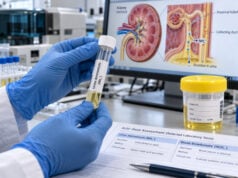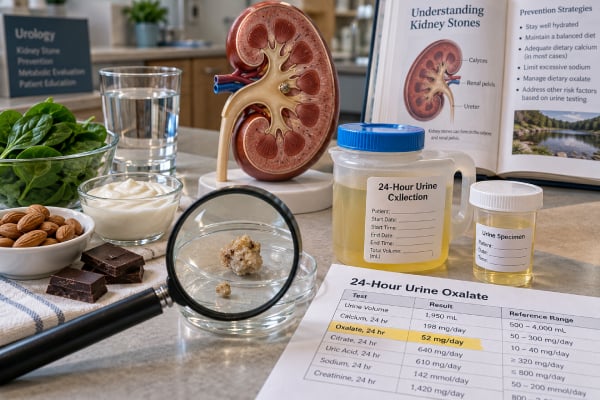
A urine oxalate test measures how much oxalate is excreted in urine, usually over 24 hours. Oxalate is a small organic compound that comes from both normal metabolism and the diet. Humans cannot break oxalate down further, so it must leave the body, mainly through the kidneys. In urine, oxalate can bind calcium and form calcium oxalate crystals, the main mineral in the most common type of kidney stone. Even modest increases in urinary oxalate can raise calcium oxalate supersaturation, especially when urine volume is low or urine calcium is high. High urine oxalate, called hyperoxaluria, can result from high intestinal absorption, fat malabsorption, excess vitamin C, dietary patterns, or rare inherited disorders called primary hyperoxalurias. The result is most useful when interpreted with urine calcium, citrate, volume, sodium, pH, and supersaturation rather than as a stand-alone number. Markedly elevated values or recurrent stones at a young age may require evaluation for primary hyperoxaluria.
- High urine oxalate raises calcium oxalate stone risk because oxalate combines with calcium and increases crystal supersaturation.
- A common adult 24-hour reference interval is about 9.7–40.5 mg/day, but laboratory ranges vary; values above the lab limit are considered hyperoxaluria.
- Fat malabsorption, bariatric surgery, inflammatory bowel disease, excess vitamin C, and some high-oxalate dietary patterns can increase urinary oxalate.
- Very high or persistent oxalate excretion, nephrocalcinosis, early recurrent stones, or unexplained kidney disease can raise concern for primary hyperoxaluria.
- Stone prevention usually focuses on high urine volume, normal dietary calcium with meals, limiting excessive oxalate and vitamin C, and treating the cause rather than simply eliminating all oxalate foods.
Table of Contents
- What Urine Oxalate Measures
- Normal and High Urine Oxalate
- Why Oxalate Causes Calcium Oxalate Stones
- Causes of Hyperoxaluria
- How the 24-Hour Urine Test Is Collected
- How High Urine Oxalate Is Lowered
- When Results Need Specialist Evaluation
- Practical Oxalate Patterns and Follow-Up
What Urine Oxalate Measures
Oxalate is produced in the body from metabolic pathways involving glyoxylate and other precursors, and it is also absorbed from food. Because humans do not have an enzyme that degrades oxalate, absorbed or internally produced oxalate must be eliminated. The kidneys are a major route of excretion.
The standard test for stone evaluation is a 24-hour urine oxalate measurement. A timed collection estimates total daily oxalate excretion and allows the result to be interpreted with other stone-risk factors measured from the same urine, including calcium, citrate, sodium, uric acid, magnesium, pH, and total volume.
Random urine oxalate-to-creatinine ratios are useful in selected settings, especially in children or when a full 24-hour collection is difficult. However, age-specific reference ranges are essential, particularly in children, because the ratio is naturally much higher in infancy and falls with growth.
Urine oxalate is not a general kidney function test. A high level may increase stone and crystal-injury risk even when eGFR is normal. Conversely, advanced kidney failure can reduce urinary oxalate excretion because the kidneys cannot clear oxalate effectively, causing plasma oxalate to rise. In that setting, urine values alone may underestimate total oxalate burden.
A 24-hour kidney stone risk test provides the context needed to understand whether an oxalate value is clinically important.
Normal and High Urine Oxalate
Reference intervals vary by laboratory and assay. One major laboratory reports 0.11–0.46 mmol/24 hours, equivalent to 9.7–40.5 mg/24 hours, for a 24-hour adult test. Values above the laboratory upper limit are considered elevated, but stone risk is continuous rather than binary. A person near the upper end of the range may still benefit from lowering oxalate if calcium oxalate supersaturation is high or stones are recurrent.
Clinicians often describe urinary oxalate in broad categories:
| Pattern | Possible meaning | Next considerations |
|---|---|---|
| Within laboratory range | Does not exclude calcium oxalate stone risk | Review calcium, citrate, volume, sodium, and supersaturation |
| Mild to moderate elevation | Dietary, idiopathic, or enteric hyperoxaluria are common possibilities | Diet, vitamin C, bowel disease, surgery, fat malabsorption |
| Marked or repeated elevation | Severe enteric hyperoxaluria or primary hyperoxaluria becomes more concerning | Repeat collection, kidney function, family history, genetics/metabolites when indicated |
Primary hyperoxaluria can cause much higher excretion than typical dietary hyperoxaluria, although overlap exists. Contemporary reviews suggest considering primary hyperoxaluria when adults have recurrent stones, nephrocalcinosis, unexplained hyperoxaluria, reduced kidney function without another cause, or particularly high excretion on repeated testing. A value above about 1.0 mmol/1.73 m² per day on repeated collections has been used as a clue in diagnostic algorithms, but no single cutoff should replace clinical assessment and genetic testing when suspicion is high.
Why Oxalate Causes Calcium Oxalate Stones
Calcium oxalate stones form when urine becomes supersaturated with calcium oxalate. Supersaturation means the concentrations of calcium and oxalate, together with urine volume and other chemical factors, create conditions in which crystals can form and grow.
Oxalate is especially important because changes in urinary oxalate can have a strong effect on calcium oxalate supersaturation. When urine volume falls, the same amount of oxalate is packed into less water. When urine calcium is high, more calcium is available to bind oxalate. When urine citrate is low, less calcium is tied up in soluble calcium-citrate complexes and less crystal inhibition is present.
This explains why treating one number in isolation is rarely enough. For example, a person with urine oxalate of 42 mg/day, very low urine volume, high urine calcium, and low citrate may have more actionable stone risk than someone with oxalate of 48 mg/day but high urine volume and otherwise favorable chemistry.
A calcium oxalate stone risk evaluation therefore looks at the interaction among these factors rather than using oxalate alone.
Oxalate can also injure the kidney when concentrations are very high. Calcium oxalate crystals may deposit in tubules and kidney tissue, causing oxalate nephropathy. This is especially concerning in severe enteric hyperoxaluria, primary hyperoxaluria, or very high oxalate exposure combined with kidney dysfunction.
Causes of Hyperoxaluria
High urinary oxalate has three broad categories: idiopathic or dietary, enteric, and primary hyperoxaluria.
Dietary and idiopathic hyperoxaluria
Foods vary in oxalate content. Spinach, rhubarb, beets, some nuts, bran, and certain other plant foods can provide substantial oxalate, but total absorption depends on what is eaten with them. Calcium in the intestine binds oxalate and reduces absorption, which is why indiscriminate low-calcium diets can paradoxically increase urinary oxalate.
High-dose vitamin C is another important contributor because ascorbic acid can be metabolized to oxalate. People with recurrent calcium oxalate stones are often advised to avoid excessive vitamin C supplementation, especially gram-level doses.
Many patients have modest hyperoxaluria without a single identifiable disease. Diet, gut microbiome, endogenous oxalate production, and genetics may all contribute.
Enteric hyperoxaluria
Enteric hyperoxaluria occurs when fat malabsorption increases intestinal oxalate absorption. Normally, calcium in the gut binds oxalate. With fat malabsorption, fatty acids bind calcium instead, leaving more oxalate free for absorption in the colon. Bile salts and fatty acids may also increase colonic permeability to oxalate.
Causes include:
- Roux-en-Y gastric bypass and other malabsorptive bariatric procedures;
- Crohn disease involving the small bowel;
- extensive small-bowel resection or short-bowel syndrome;
- chronic pancreatitis or pancreatic insufficiency;
- other disorders causing fat malabsorption.
These patients may have the combination of high urine oxalate, low urine volume from diarrhea, low urine citrate from bicarbonate loss, and low urine calcium intake—all of which can magnify stone risk.
Primary hyperoxaluria
Primary hyperoxalurias are rare inherited disorders of hepatic glyoxylate metabolism that cause endogenous oxalate overproduction. They can present with recurrent stones, nephrocalcinosis, progressive chronic kidney disease, or systemic oxalosis when kidney function becomes severely impaired.
Genetic confirmation matters because modern RNA-targeted therapies can substantially reduce oxalate production in some forms, especially primary hyperoxaluria type 1. This has changed the importance of recognizing the disorder early rather than treating it as ordinary recurrent stone disease.
How the 24-Hour Urine Test Is Collected
Accurate timed collection is essential because missing urine will falsely lower daily oxalate excretion. Follow the laboratory’s specific container, preservative, and storage instructions. Some oxalate assays require acidification or special handling to prevent crystal formation or analytical interference.
A typical 24-hour process is:
- Empty your bladder at the chosen start time and discard that urine.
- Record the exact start time.
- Collect every urine void for the next 24 hours.
- Store the container as instructed.
- At the same time the next day, collect one final void and add it to the container.
Do not dramatically change your diet just to produce a “good” result unless the test is specifically designed as a controlled dietary study. For routine stone evaluation, clinicians often want to see your usual risk profile.
Tell the clinician about vitamin C, calcium supplements, potassium citrate, orlistat, bariatric surgery, inflammatory bowel disease, chronic diarrhea, pancreatic disease, and any prior stone analysis. High-dose vitamin C should be specifically noted because it can increase true oxalate production and can interfere with some older analytical methods.
Urine creatinine is often measured to assess whether the collection is plausible. If the collection appears incomplete, repeating it is usually more useful than interpreting a falsely low oxalate number.
How High Urine Oxalate Is Lowered
Treatment depends on the cause and on the entire stone-risk profile.
Increase urine volume
Higher fluid intake lowers the concentration of oxalate and other stone-forming solutes. Many recurrent stone formers are advised to produce at least about 2 to 2.5 liters of urine daily, with individualized targets for climate, activity, heart disease, and kidney function.
Keep normal dietary calcium
Normal calcium intake with meals is usually beneficial for calcium oxalate stone prevention because intestinal calcium binds food oxalate before it can be absorbed. Restricting calcium without a specific reason can increase oxalate absorption and may also harm bone health.
For enteric hyperoxaluria, clinicians may recommend calcium with meals specifically to bind oxalate in the gut. The dose and formulation should be individualized because excess supplementation can have downsides.
Reduce concentrated sources of oxalate rather than eliminating all plant foods
A practical strategy is to identify major high-oxalate contributors—such as frequent spinach smoothies, large amounts of nuts, or other concentrated sources—rather than adopting an unnecessarily restrictive diet. Pairing moderate-oxalate foods with calcium-containing foods can reduce absorption.
Avoid excessive vitamin C
High-dose vitamin C supplements can increase oxalate production. Dietary vitamin C from ordinary foods is generally not the issue; concern is greater with large supplemental doses.
Treat malabsorption and low citrate
In enteric hyperoxaluria, treating the underlying bowel or pancreatic disorder, limiting excessive fat when appropriate, maintaining fluid intake, and correcting hypocitraturia may all reduce risk. A urine citrate result is particularly important because chronic diarrhea can lower citrate at the same time oxalate rises.
Primary hyperoxaluria requires specialist management and may involve high fluid intake, citrate, pyridoxine in responsive PH1, and targeted RNA interference therapies depending on the genetic subtype.
When Results Need Specialist Evaluation
Mild hyperoxaluria in an adult with ordinary recurrent stones can often be managed through a structured stone-prevention plan. Specialist evaluation becomes more important when there are features suggesting a severe or unusual disorder.
Red flags include:
- kidney stones beginning in childhood or adolescence;
- frequent bilateral or recurrent stones;
- nephrocalcinosis;
- very high oxalate on repeated 24-hour collections;
- declining kidney function without another clear explanation;
- a family history of primary hyperoxaluria or unexplained kidney failure;
- oxalate nephropathy on kidney biopsy;
- recurrent stones after malabsorptive bariatric surgery or major bowel resection.
Workup may include repeat 24-hour urine studies, plasma oxalate when kidney function is reduced, stone analysis, genetic testing, and urine metabolite testing. A kidney stone analysis is useful because calcium oxalate composition supports the relevance of the urine finding but does not by itself identify the cause of hyperoxaluria.
Seek prompt care for severe flank pain with fever, inability to pass urine, persistent vomiting, or rapidly worsening kidney function. These can signal obstruction, infection, or acute kidney injury and require assessment independent of the oxalate result.
The goal of testing is not merely to lower oxalate into a laboratory range. It is to reduce calcium oxalate supersaturation, prevent new stones, preserve kidney function, and identify the small group of patients who need disease-specific treatment.
Practical Oxalate Patterns and Follow-Up
The degree of oxalate elevation and the rest of the urine profile determine how aggressively clinicians investigate.
Mildly high oxalate after a major diet change: A patient begins daily spinach-and-almond smoothies and develops a 24-hour oxalate slightly above the laboratory range. Urine volume is adequate and kidney function is normal. The first step may be to reduce the concentrated oxalate sources, maintain normal calcium intake with meals, avoid high-dose vitamin C, and repeat the urine profile. A modest abnormality that normalizes with dietary changes is very different from persistent severe hyperoxaluria.
High oxalate after gastric bypass: A patient with Roux-en-Y surgery has recurrent calcium oxalate stones, diarrhea, low urine volume, and low citrate. Enteric hyperoxaluria is likely because fat malabsorption increases free intestinal oxalate absorption. Management may include calcium with meals, hydration, treatment of diarrhea or malabsorption, attention to dietary fat and oxalate, and correction of hypocitraturia. The whole pattern must be treated together.
Marked hyperoxaluria with nephrocalcinosis in a young adult: Repeated very high oxalate, early recurrent stones, or unexplained decline in kidney function should not be assumed to be dietary. Primary hyperoxaluria becomes an important diagnostic possibility. Genetic testing and disease-specific biochemical evaluation can change treatment because targeted therapies are now available for some genetic forms.
Normal urine oxalate with recurrent calcium oxalate stones: A normal result does not make the stones mysterious. High urine calcium, low citrate, high sodium, low urine volume, or unfavorable supersaturation may be the dominant factors. Calcium oxalate stones are named for their crystal composition, not for a requirement that oxalate excretion be above the reference interval.
Falling urine oxalate as kidney failure advances: In severe CKD, urinary oxalate may become less reliable as a measure of total oxalate production because filtration falls and plasma oxalate can accumulate. In suspected primary hyperoxaluria with advanced kidney disease, plasma oxalate and genetic testing may be more informative than a seemingly less dramatic urine value.
Follow-up testing should therefore ask two questions: did the intervention lower urine oxalate, and did it lower calcium oxalate supersaturation without creating another problem? A repeat full stone-risk profile is more useful than checking oxalate alone because changes in calcium, citrate, sodium, pH, and urine volume can amplify or offset the benefit.
Dietary counseling is most useful when it is specific. Instead of trying to memorize long “avoid” lists, patients can identify the few foods or supplements that contribute most of their oxalate exposure and pair meals with normal calcium intake. This approach preserves fruits, vegetables, and overall diet quality while targeting the sources most likely to affect the urine result. It also makes repeat testing easier to interpret because the intervention is clear and sustainable.
Because stone risk varies from day to day, a second 24-hour collection can be valuable when the first result is unexpected or when a major treatment decision depends on the degree of hyperoxaluria. Consistent elevation across properly collected samples is more convincing than a single borderline value.
References
- Hyperoxaluria: Diagnosis and Treatment 2025 (Review)
- Recognizing Primary Hyperoxaluria in Adults through Urine Oxalate Crystal Detection. Literature Review and Data Analysis 2025 (Review)
- Clinical Approaches and Emerging Therapeutic Horizons in Primary Hyperoxaluria 2026 (Review)
- Pathophysiology and management of enteric hyperoxaluria 2024 (Review)
- Oxalate as a potent promoter of kidney stone formation 2023 (Review)
- OXU – Overview: Oxalate, 24 Hour, Urine 2026
Disclaimer
This article is for general education and cannot diagnose the cause of hyperoxaluria or provide a personal kidney stone treatment plan. Urine oxalate must be interpreted with the full 24-hour urine profile, kidney function, diet, gastrointestinal history, stone analysis, and medications or supplements. Recurrent stones, nephrocalcinosis, or markedly elevated oxalate should be discussed with a clinician experienced in stone disease.