• Home
  • Health Topics
  • Human Body
  • Diagnostics
  • Conditions
  • Treatments
  • Foods
  • Herbs
  • Supplements
  • Weight Loss
  • Longevity
Search
VitaLibrary
  • Home
  • Health Topics
  • Human Body
  • Diagnostics
  • Conditions
  • Treatments
  • Foods
  • Herbs
  • Supplements
  • Weight Loss
  • Longevity
  • Blood Tests and Blood Biomarkers
  • Brain, Cognitive, and Mental Health Tests and Diagnostics
  • Genetic and Molecular Biomarkers
  • Hormone Tests
    Latest
    • Latest
    • Featured posts
    • Most popular
    • 7 days popular
    • By review score
    • Random
    Understand the 1-mg low-dose dexamethasone suppression test, the common cortisol cutoff of 1.8 mcg/dL, causes of nonsuppression, and the follow-up used for Cushing screening.

    Low-Dose Dexamethasone Suppression Test: Cushing Syndrome Screening and Results

    Learn how an 8–9 a.m. cortisol test screens for adrenal insufficiency, what low and intermediate results mean, how ACTH helps identify the cause, and when stimulation testing is needed.

    Morning Cortisol Test: Low Levels, Adrenal Insufficiency, and Results

    Learn how a pheochromocytoma and paraganglioma panel uses plasma or urine metanephrines, normetanephrine, catecholamines, and controlled collection to interpret abnormal results.

    Pheochromocytoma and Paraganglioma Test Panel: Metanephrines, Normetanephrine, Catecholamines, and Results

    Learn what plasma epinephrine, norepinephrine, and dopamine results mean, why collection posture matters, common causes of high values, and when metanephrine testing is preferred.

    Plasma Catecholamines Test: Epinephrine, Norepinephrine, Dopamine, and Results

    Learn how plasma free metanephrine and normetanephrine testing screens for pheochromocytoma and paraganglioma, why supine rest matters, and how high or borderline results are evaluated.

    Plasma Free Metanephrines Test: Pheochromocytoma and Paraganglioma Screening, High Levels, and Results

    Learn what a high plasma normetanephrine result means, why supine rest matters, common false-positive causes, when clonidine testing is used, and how PPGL evaluation proceeds.

    Plasma Normetanephrine Test: High Levels, Pheochromocytoma Screening, and Results

    Diagnostics

    Home Diagnostics Page 16
    Understand comprehensive genomic profiling results, tissue and liquid testing, actionable mutations, MSI, TMB, possible germline findings, limitations, and treatment matches.

    Comprehensive Genomic Profiling Test: Cancer Genes, Mutations, and Results

    Understand DICER1 genetic test results, pleuropulmonary blastoma and other tumor risks, mosaicism, childhood and adult surveillance, inheritance, and family testing.

    DICER1 Genetic Test: Tumor Predisposition, Cancer Risk, and Results

    Learn how a DNMT3A mutation test is used in AML and clonal hematopoiesis, what variant allele frequency means, and how positive, negative, and persistent results are interpreted.

    DNMT3A Mutation Test: AML, Clonal Hematopoiesis, and Results

    Understand EGFR mutation testing for lung cancer, including tissue and plasma methods, exon 19, L858R and exon 20 results, targeted therapy meaning, resistance, and next steps.

    EGFR Mutation Test: Lung Cancer, Targeted Therapy, and Results

    Learn how EPCAM deletion testing identifies a cause of Lynch syndrome, why deletion analysis matters, what positive and negative results mean, and how findings affect colon cancer surveillance and family testing.

    EPCAM Deletion Test: Lynch Syndrome, Colon Cancer Risk, and Results

    Learn when ESR1 mutation testing is used in metastatic breast cancer, how plasma and tissue results are interpreted, and how activating variants can guide treatment after hormone therapy resistance.

    ESR1 Mutation Test: Breast Cancer, Hormone Therapy Resistance, and Results

    Learn how FGFR2 and FGFR3 genetic testing detects cancer mutations and fusions, what positive or negative results mean, and how findings may guide targeted therapy.

    FGFR2 and FGFR3 Genetic Test: Cancer Mutations, Fusions, and Results

    Understand FH genetic testing for hereditary leiomyomatosis and renal cell cancer, including who should test, result meanings, kidney surveillance, and family risk.

    FH Genetic Test: Hereditary Leiomyomatosis, Renal Cell Cancer, and Results

    Learn what FLCN genetic testing shows for Birt-Hogg-Dubé syndrome, including kidney cancer surveillance, lung cyst risks, result meanings, and family testing.

    FLCN Genetic Test: Birt-Hogg-Dube Syndrome, Kidney Cancer, and Results

    Learn how the FLT3 mutation test guides AML risk assessment, targeted treatment, transplant planning, relapse testing, and interpretation of ITD and TKD results.

    FLT3 Mutation Test: AML, Leukemia Risk, and Treatment Results

    Understand HER2 and ERBB2 testing in breast, gastric, lung, and other cancers, including IHC, ISH, mutations, targeted therapy, and result interpretation.

    HER2/ERBB2 Test: Breast, Gastric, Lung Cancer, and Targeted Therapy Results

    Learn how hereditary cancer genetic panels test multiple risk genes, who should be tested, what positive, negative, and VUS results mean, and how findings guide care.

    Hereditary Cancer Genetic Panel Test: Cancer Risk Genes and Results

    Learn how IDH1 and IDH2 mutation testing guides diagnosis and treatment in glioma, AML, and cholangiocarcinoma, including positive, negative, and targeted therapy results.

    IDH1 and IDH2 Mutation Test: Brain Cancer, Leukemia, Cholangiocarcinoma, and Results

    Learn how JAK2 mutation testing supports diagnosis of polycythemia vera, essential thrombocythemia, and myelofibrosis and how positive, negative, and low-level results are interpreted.

    JAK2 Mutation Test: Myeloproliferative Neoplasm, Blood Cancer, and Results

    Learn how KIT mutation testing guides GIST therapy, identifies selected melanoma targets, supports systemic mastocytosis diagnosis, and clarifies positive, negative, and low-level results.

    KIT Mutation Test: GIST, Melanoma, Mast Cell Disease, and Results

    Learn how KRAS mutation testing guides treatment in colorectal, lung, and pancreatic cancer and how to interpret G12C, other variants, negative results, and repeat testing.

    KRAS Mutation Test: Colon, Lung, Pancreatic Cancer, and Results

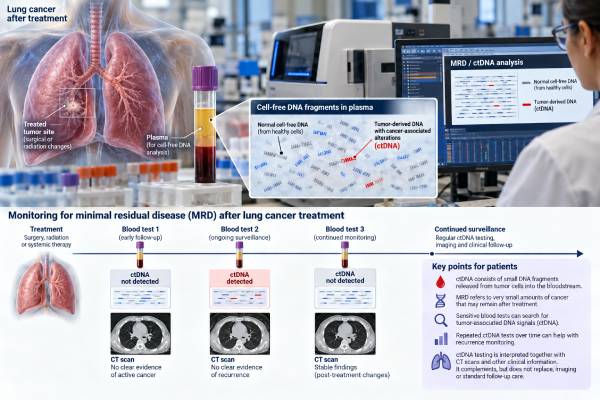
    Learn how liquid biopsy and ctDNA testing find tumor mutations, guide targeted therapy, assess resistance and MRD, and why negative or low-level plasma results need careful interpretation.

    Liquid Biopsy Cancer Test: ctDNA, Tumor Mutations, and Results

    Learn how Lynch syndrome testing for MLH1, MSH2, MSH6, PMS2, and EPCAM works, how tumor screening differs from germline testing, and what positive, negative, and uncertain results mean.

    Lynch Syndrome Genetic Test: MLH1, MSH2, MSH6, PMS2, EPCAM, and Results

    Learn how MEN1 genetic testing confirms multiple endocrine neoplasia type 1, who should be tested, what positive and negative results mean, and how surveillance protects patients and relatives.

    MEN1 Genetic Test: Multiple Endocrine Neoplasia Type 1 and Results

    Learn how MET exon 14 skipping testing finds an actionable lung cancer driver, why DNA and RNA methods differ, and how positive, negative, plasma, treatment, and resistance results are interpreted.

    MET Exon 14 Skipping Test: Lung Cancer, Targeted Therapy, and Results

    1...151617...57Page 16 of 57
    • Disclaimer
    • Privacy Policy
    • About Us
    © 2026 Vita Library. All rights reserved.
    Contact us: contact@vitalibrary.com