• Home
  • Health Topics
  • Human Body
  • Diagnostics
  • Conditions
  • Treatments
  • Foods
  • Herbs
  • Supplements
  • Weight Loss
  • Longevity
Search
VitaLibrary
  • Home
  • Health Topics
  • Human Body
  • Diagnostics
  • Conditions
  • Treatments
  • Foods
  • Herbs
  • Supplements
  • Weight Loss
  • Longevity
  • Blood Tests and Blood Biomarkers
  • Brain, Cognitive, and Mental Health Tests and Diagnostics
  • Genetic and Molecular Biomarkers
  • Hormone Tests
  • Inflammation and Immune Markers
  • Tumor Markers
  • Urine Tests and Kidney Markers
    Latest
    • Latest
    • Featured posts
    • Most popular
    • 7 days popular
    • By review score
    • Random
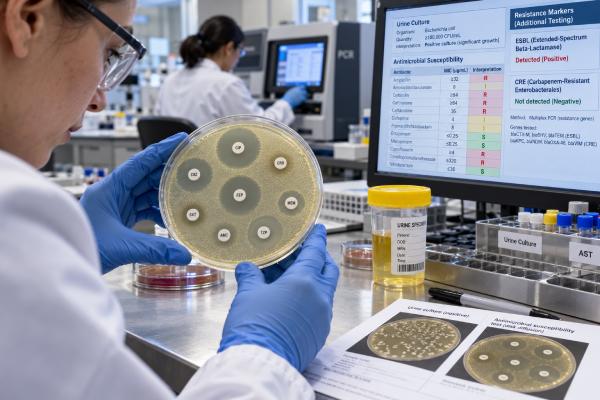
    Learn how antibiotic-resistant UTI testing identifies ESBL, CRE, resistance genes, and antibiotic susceptibility, and how culture results guide treatment and follow-up.

    Antibiotic-Resistant UTI Test: ESBL, CRE, Resistance Markers, and Culture Meaning

    Learn what asymptomatic bacteriuria means, how a positive urine culture without UTI symptoms is interpreted, and when screening, treatment, or follow-up matters.

    Asymptomatic Bacteriuria Test: Positive Culture Without Symptoms and When It Matters

    Learn how bacteria in urine are interpreted using urinalysis, culture, colony count, symptoms, and sample quality, including when contamination or follow-up testing matters.

    Bacteria in Urine Test: UTI, Contamination, Colony Count, and Culture Follow-Up

    Learn how a catheter urine culture helps diagnose catheter-associated UTI, how samples are collected, and what colony counts, pyuria, resistance, and positive results mean.

    Catheter Urine Culture Test: Catheter-Associated UTI and Culture Meaning

    Learn how a chlamydia and gonorrhea urine NAAT works, how to collect first-catch urine, what positive or negative results mean, and when follow-up testing is needed.

    Chlamydia and Gonorrhea Urine NAAT Test: STI Screening, Positive Result, and Meaning

    Learn how to collect a clean-catch urine culture, reduce contamination, handle the sample correctly, and understand mixed flora, colony counts, repeat testing, and accurate results.

    Clean-Catch Urine Culture Test: Sample Collection, Contamination, and Accurate Results

    Diagnostics

    Home Diagnostics Page 20
    Learn what PSA levels mean, why benign prostate conditions can raise PSA, how age and risk affect screening, and when repeat testing, MRI, or biopsy may be considered.

    Prostate-Specific Antigen (PSA) Test: Normal Range, High Levels, Screening, and Benign...

    Learn what a prostatic acid phosphatase (PAP) test measures, why high levels were linked to advanced prostate cancer, why PSA replaced PAP, and how ACP3 is being studied again.

    Prostatic Acid Phosphatase (PAP) Test: Prostate Cancer Marker, High Levels, and...

    PSA density divides PSA by prostate volume to refine prostate cancer risk. Learn how PSAD is calculated, what 0.15 means, and how MRI changes biopsy decisions.

    PSA Density Test: Prostate Size, PSA Level, Cancer Risk, and Result...

    PSA velocity measures PSA change in ng/mL per year, but no velocity cutoff should trigger biopsy alone. Learn how trends are calculated, interpreted, and confirmed.

    PSA Velocity Test: PSA Change Over Time and Prostate Cancer Risk

    PSMA PET uses prostate-specific membrane antigen targeting to stage prostate cancer, detect biochemical recurrence, find metastases, and guide selected PSMA radioligand treatments.

    PSMA Test: Prostate-Specific Membrane Antigen, Imaging Marker, and Metastatic Disease

    SelectMDx measures HOXC6 and DLX1 urine gene markers after a prostate exam to estimate clinically significant prostate cancer risk and help guide MRI and biopsy decisions.

    SelectMDx Test: Urine Gene Markers, Prostate Cancer Risk, and Result Meaning

    Learn how AFP levels help diagnose and monitor ovarian germ cell tumors, what high results can mean, expected decline after treatment, and non-cancer causes.

    AFP Test for Ovarian Germ Cell Tumors: High Levels, Tumor Marker...

    Understand how AMH testing can track ovarian granulosa cell tumor activity, treatment response, and recurrence, plus what high or changing levels may mean.

    AMH Test for Ovarian Granulosa Cell Tumors: Tumor Activity, Monitoring, and...

    Learn what high beta-hCG can mean in ovarian germ cell tumors, which tumor types raise hCG, how levels change with treatment, and causes of false positives.

    Beta-hCG Test for Ovarian Germ Cell Tumors: High Levels, Tumor Marker...

    Learn what BRCA1 and BRCA2 testing means in ovarian cancer, including hereditary risk, germline versus tumor results, VUS findings, DNA repair, and treatment relevance.

    BRCA1 and BRCA2 Test for Ovarian Cancer: Hereditary Risk, DNA Repair,...

    Learn what a BRIP1 genetic test means for ovarian cancer risk, pathogenic variants, VUS results, family testing, screening limits, and risk-reducing surgery decisions.

    BRIP1 Test for Ovarian Cancer: Hereditary Cancer Risk and Variant Meaning

    Learn what high CA-125 levels can mean, common benign causes, how CA-125 tracks ovarian cancer treatment and recurrence, and why one result cannot diagnose cancer.

    CA-125 Test for Ovarian Cancer: High Levels, Monitoring, Recurrence, and Benign...

    Understand cervical cancer biomarkers including high-risk HPV, p16, Ki-67 dual stain, dysplasia risk, biopsy markers, and tumor tests used after diagnosis.

    Cervical Cancer Biomarker Panel: HPV, p16, Ki-67, Dysplasia Risk, and Tumor...

    Understand endometrial cancer MMR, MSI, POLE, and p53 testing, the four molecular subtypes, Lynch syndrome clues, prognosis, and treatment implications.

    Endometrial Cancer Biomarker Panel: MMR, MSI, POLE, p53, and Molecular Subtype

    Learn how hCG is used to monitor gestational trophoblastic disease, interpret falling, plateauing, rising, and low-level hCG, and detect GTN recurrence.

    Gestational Trophoblastic Disease hCG Test: Tumor Monitoring, hCG Levels, and Recurrence

    Understand gynecologic cancer gene panels for BRCA1/2, Lynch syndrome, RAD51C, RAD51D, and BRIP1, including hereditary risk, result meaning, and next steps.

    Gynecologic Cancer Gene Panel: BRCA, Lynch Syndrome, RAD51, BRIP1, and Hereditary...

    1...192021...137Page 20 of 137
    • Disclaimer
    • Privacy Policy
    • About Us
    © 2026 Vita Library. All rights reserved.
    Contact us: contact@vitalibrary.com