• Home
  • Health Topics
  • Human Body
  • Diagnostics
  • Conditions
  • Treatments
  • Foods
  • Herbs
  • Supplements
  • Weight Loss
  • Longevity
Search
VitaLibrary
  • Home
  • Health Topics
  • Human Body
  • Diagnostics
  • Conditions
  • Treatments
  • Foods
  • Herbs
  • Supplements
  • Weight Loss
  • Longevity
  • Blood Tests and Blood Biomarkers
  • Brain, Cognitive, and Mental Health Tests and Diagnostics
  • Genetic and Molecular Biomarkers
  • Hormone Tests
  • Inflammation and Immune Markers
  • Tumor Markers
  • Urine Tests and Kidney Markers
    Latest
    • Latest
    • Featured posts
    • Most popular
    • 7 days popular
    • By review score
    • Random
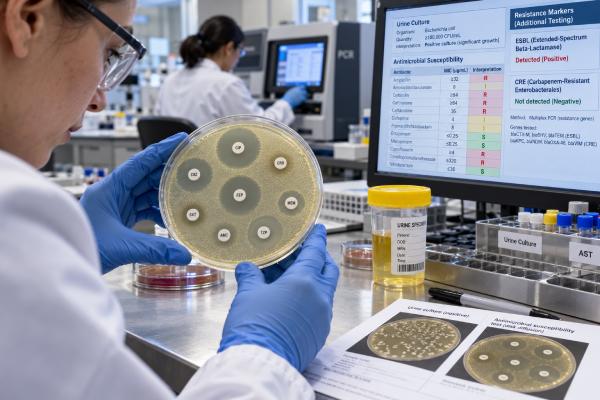
    Learn how antibiotic-resistant UTI testing identifies ESBL, CRE, resistance genes, and antibiotic susceptibility, and how culture results guide treatment and follow-up.

    Antibiotic-Resistant UTI Test: ESBL, CRE, Resistance Markers, and Culture Meaning

    Learn what asymptomatic bacteriuria means, how a positive urine culture without UTI symptoms is interpreted, and when screening, treatment, or follow-up matters.

    Asymptomatic Bacteriuria Test: Positive Culture Without Symptoms and When It Matters

    Learn how bacteria in urine are interpreted using urinalysis, culture, colony count, symptoms, and sample quality, including when contamination or follow-up testing matters.

    Bacteria in Urine Test: UTI, Contamination, Colony Count, and Culture Follow-Up

    Learn how a catheter urine culture helps diagnose catheter-associated UTI, how samples are collected, and what colony counts, pyuria, resistance, and positive results mean.

    Catheter Urine Culture Test: Catheter-Associated UTI and Culture Meaning

    Learn how a chlamydia and gonorrhea urine NAAT works, how to collect first-catch urine, what positive or negative results mean, and when follow-up testing is needed.

    Chlamydia and Gonorrhea Urine NAAT Test: STI Screening, Positive Result, and Meaning

    Learn how to collect a clean-catch urine culture, reduce contamination, handle the sample correctly, and understand mixed flora, colony counts, repeat testing, and accurate results.

    Clean-Catch Urine Culture Test: Sample Collection, Contamination, and Accurate Results

    Diagnostics

    Home Diagnostics Page 21
    Learn what an HE4 test measures, what high HE4 levels can mean, how kidney function affects results, and how HE4 and CA-125 are used in the ROMA ovarian cancer risk score.

    HE4 Test for Ovarian Cancer: High Levels, Risk Assessment, ROMA Score,...

    Learn how HER2 testing in endometrial cancer measures protein expression and ERBB2 amplification, how IHC and FISH results are interpreted, and why HER2 status can affect treatment in uterine serous carcinoma.

    HER2 Test for Endometrial Cancer: HER2 Expression, Amplification, and Tumor Subtype

    Learn what positive and negative HPV 16 and HPV 18 results mean, why these high-risk genotypes raise cervical cancer risk, and when colposcopy or other follow-up is recommended.

    HPV 16 and HPV 18 Test: Cervical Cancer Risk, High-Risk Genotypes,...

    Learn how high-risk HPV testing is used for cervical cancer screening, what positive and negative results mean, which HPV genotypes carry higher risk, and how colposcopy, cytology, and dual stain guide follow-up.

    HPV Test for Cervical Cancer: High-Risk HPV Types, Screening, and Follow-Up

    Learn how HRD testing in ovarian cancer evaluates homologous recombination repair, BRCA mutations, genomic scars and instability scores, and how HRD results can influence PARP inhibitor treatment decisions.

    HRD Test for Ovarian Cancer: Homologous Recombination Deficiency, DNA Repair, and...

    Learn how inhibin A is used as a granulosa cell tumor marker, what high and normal results can mean, why inhibin B is often more sensitive, and how serial inhibin A levels can support long-term ovarian cancer monitoring.

    Inhibin A Test for Ovarian Cancer: Granulosa Cell Tumor Marker and...

    Learn how inhibin B is used to detect and monitor ovarian granulosa cell tumors, what high results can mean, how the marker can signal recurrence, and why serial trends and menopausal status matter.

    Inhibin B Test for Ovarian Cancer: Granulosa Cell Tumor Marker, Recurrence,...

    Learn how Ki-67 staining reflects abnormal cervical cell proliferation, how p16/Ki-67 dual stain helps triage high-risk HPV results, and how Ki-67 relates to CIN1, CIN2, CIN3, colposcopy, and follow-up.

    Ki-67 Test for Cervical Dysplasia: Cell Proliferation Marker and CIN Evaluation

    Learn how LDH is used as a dysgerminoma marker in ovarian germ cell tumors, what high levels can mean, how LDH relates to tumor burden, and why AFP, beta-hCG, imaging, and serial trends are essential for interpretation.

    LDH Test for Ovarian Germ Cell Tumors: Dysgerminoma Marker, High Levels,...

    Learn how MMR IHC testing in endometrial cancer evaluates MLH1, PMS2, MSH2, and MSH6, what protein-loss patterns mean, how Lynch syndrome screening works, and why dMMR status can affect molecular classification and immunotherapy.

    MMR IHC Test for Endometrial Cancer: Lynch Syndrome Screening, Mismatch Repair,...

    Understand what an OVA1 score means, including the five biomarkers, premenopausal and postmenopausal cutoffs, limitations, accuracy, and next steps for an ovarian mass.

    OVA1 Test: Ovarian Cancer Risk, Biomarker Score, and Result Meaning

    Understand how an ovarian cancer biomarker panel uses CA-125, HE4, ROMA, BRCA, HRD, and tumor profiling for risk assessment, treatment, and follow-up.

    Ovarian Cancer Biomarker Panel: CA-125, HE4, ROMA, BRCA, HRD, and Tumor...

    Learn how ovarian cancer ctDNA tests detect tumor DNA, assess MRD, monitor recurrence, identify mutations, and why results need clinical context.

    Ovarian Cancer ctDNA Test: Recurrence Monitoring, MRD, Mutation Detection, and Tumor...

    Learn what the Overa ovarian cancer risk test measures, how its 0-to-10 biomarker score and 5.0 cutoff are interpreted, and what high or low results mean before surgery.

    Overa Test: Ovarian Cancer Risk Assessment and Biomarker Score Meaning

    Learn what p16 IHC means in cervical biopsies, how block-positive staining supports HPV-related HSIL, and how p16 differs from HPV testing and p16/Ki-67 dual stain.

    p16 IHC Test for Cervical Cancer: HPV-Related Tumor Marker, Dysplasia, and...

    Learn how p53 IHC classifies endometrial cancer, what wild-type, overexpression, null, and cytoplasmic patterns mean, and why p53-abnormal tumors carry higher risk on average.

    p53 Test for Endometrial Cancer: Tumor Subtype, Abnormal Staining, and Prognosis

    1...202122...137Page 21 of 137
    • Disclaimer
    • Privacy Policy
    • About Us
    © 2026 Vita Library. All rights reserved.
    Contact us: contact@vitalibrary.com