• Home
  • Health Topics
  • Human Body
  • Diagnostics
  • Conditions
  • Treatments
  • Foods
  • Herbs
  • Supplements
  • Weight Loss
  • Longevity
Search
VitaLibrary
  • Home
  • Health Topics
  • Human Body
  • Diagnostics
  • Conditions
  • Treatments
  • Foods
  • Herbs
  • Supplements
  • Weight Loss
  • Longevity
  • Blood Tests and Blood Biomarkers
  • Brain, Cognitive, and Mental Health Tests and Diagnostics
  • Genetic and Molecular Biomarkers
  • Hormone Tests
  • Inflammation and Immune Markers
  • Tumor Markers
  • Urine Tests and Kidney Markers
    Latest
    • Latest
    • Featured posts
    • Most popular
    • 7 days popular
    • By review score
    • Random
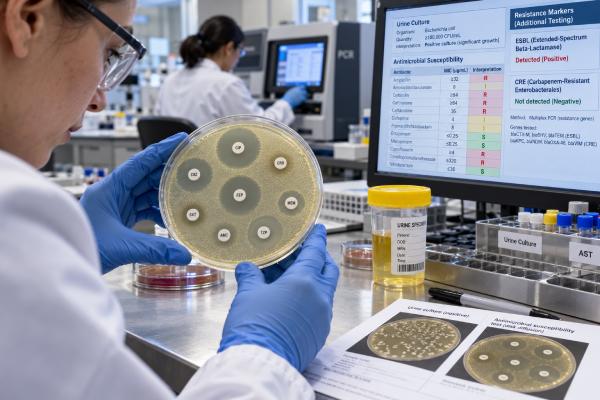
    Learn how antibiotic-resistant UTI testing identifies ESBL, CRE, resistance genes, and antibiotic susceptibility, and how culture results guide treatment and follow-up.

    Antibiotic-Resistant UTI Test: ESBL, CRE, Resistance Markers, and Culture Meaning

    Learn what asymptomatic bacteriuria means, how a positive urine culture without UTI symptoms is interpreted, and when screening, treatment, or follow-up matters.

    Asymptomatic Bacteriuria Test: Positive Culture Without Symptoms and When It Matters

    Learn how bacteria in urine are interpreted using urinalysis, culture, colony count, symptoms, and sample quality, including when contamination or follow-up testing matters.

    Bacteria in Urine Test: UTI, Contamination, Colony Count, and Culture Follow-Up

    Learn how a catheter urine culture helps diagnose catheter-associated UTI, how samples are collected, and what colony counts, pyuria, resistance, and positive results mean.

    Catheter Urine Culture Test: Catheter-Associated UTI and Culture Meaning

    Learn how a chlamydia and gonorrhea urine NAAT works, how to collect first-catch urine, what positive or negative results mean, and when follow-up testing is needed.

    Chlamydia and Gonorrhea Urine NAAT Test: STI Screening, Positive Result, and Meaning

    Learn how to collect a clean-catch urine culture, reduce contamination, handle the sample correctly, and understand mixed flora, colony counts, repeat testing, and accurate results.

    Clean-Catch Urine Culture Test: Sample Collection, Contamination, and Accurate Results

    Diagnostics

    Home Diagnostics Page 36
    Mammostrat was a five-protein breast cancer prognosis test that classified low, moderate, and high recurrence risk; learn how it worked, what old results mean, and why it is no longer used.

    Mammostrat Test: Breast Cancer Prognosis and Risk Classification

    Oncotype DX measures 21 tumor genes to produce a Breast Recurrence Score from 0 to 100; learn how node status, age, menopause, and pathology shape recurrence risk and chemotherapy decisions.

    Oncotype DX Breast Recurrence Score Test: Recurrence Risk, Genomic Score, and...

    PALB2 testing can reveal inherited DNA-repair variants linked to breast and family cancer risk; learn what positive, negative, and uncertain results mean and how they affect screening.

    PALB2 Test for Breast Cancer: Cancer Risk, DNA Repair, Variant Meaning,...

    PD-L1 testing in breast cancer uses tumor-tissue immunohistochemistry and CPS scoring; learn why CPS 10 matters in metastatic TNBC and why early-stage treatment is different.

    PD-L1 Test for Breast Cancer: Immunotherapy Marker, CPS Score, and Expression...

    PIK3CA testing detects PI3K-pathway mutations in breast cancer; learn how tissue and ctDNA results are interpreted and how positive findings can guide targeted therapy.

    PIK3CA Mutation Test for Breast Cancer: Mutation Status, PI3K Pathway, and...

    The progesterone receptor test measures PR nuclear staining in breast cancer; learn the 1% positive threshold, how PR is interpreted with ER, and what low or negative results mean.

    Progesterone Receptor (PR) Test: Breast Cancer Hormone Receptor Status, Positive Score,...

    Prosigna PAM50 measures breast tumor gene expression to report molecular subtype and a 0–100 Risk of Recurrence score; learn how nodal status and menopause shape interpretation.

    Prosigna PAM50 Test: Breast Cancer Subtype, Recurrence Risk, and Molecular Classification

    Understand TNBC biomarker testing for ER, PR, HER2, PD-L1 CPS, BRCA1/2, HER2-low status, and tumor profiling, including what results can mean for treatment.

    Triple-Negative Breast Cancer Biomarker Test: ER, PR, HER2, PD-L1, BRCA, and...

    Learn how the 4Kscore combines four PSA-related kallikrein markers with clinical factors to estimate significant prostate cancer risk and guide MRI or biopsy decisions.

    4Kscore Test: PSA Markers, Prostate Cancer Risk Score, and Result Meaning

    Understand what a 5-HIAA blood test measures, what high levels can mean in carcinoid syndrome and neuroendocrine tumors, and how blood results compare with 24-hour urine testing.

    5-HIAA Blood Test: Carcinoid Syndrome, Serotonin Metabolism, Neuroendocrine Tumors, and Meaning

    Learn what an AFP blood test measures, why AFP rises in liver disease, hepatocellular carcinoma, and germ cell tumors, and how normal ranges and trends guide follow-up.

    Alpha-Fetoprotein (AFP) Blood Test: High Levels, Liver Disease, Liver Cancer, and...

    Learn how AMH is used as a tumor marker for granulosa cell tumors, why levels can rise, how trends are followed after treatment, and how AMH compares with inhibin B.

    Anti-Mullerian Hormone (AMH) Tumor Marker Test: Granulosa Cell Tumors, Tumor Activity,...

    Learn how beta-2 microglobulin is used in myeloma, lymphoma, and leukemia, why kidney function raises B2M, and how staging thresholds and trends are interpreted.

    Beta-2 Microglobulin Blood Test: Myeloma, Lymphoma, Leukemia, Kidney Function, and Prognosis

    Learn how beta-hCG is used in testicular and ovarian germ cell tumors, what high levels can mean, and why pregnancy, false positives, and marker trends matter.

    Beta-hCG Tumor Marker Test: Testicular Cancer, Ovarian Germ Cell Tumors, and...

    Understand what AFP, CEA, CA-125, CA 19-9, and PSA blood tumor markers measure, their common reference limits, cancer uses, benign causes, and key limitations.

    Blood Tumor Marker Test Panel: AFP, CEA, CA-125, CA 19-9, PSA,...

    Learn how the calcitonin blood test is used for medullary thyroid cancer and C-cell disease, what high levels mean, benign causes, and how results guide follow-up.

    Calcitonin Blood Test: Medullary Thyroid Cancer Marker, High Levels, and C-Cell...

    1...353637...137Page 36 of 137
    • Disclaimer
    • Privacy Policy
    • About Us
    © 2026 Vita Library. All rights reserved.
    Contact us: contact@vitalibrary.com