• Home
  • Health Topics
  • Human Body
  • Diagnostics
  • Conditions
  • Treatments
  • Foods
  • Herbs
  • Supplements
  • Weight Loss
  • Longevity
Search
VitaLibrary
  • Home
  • Health Topics
  • Human Body
  • Diagnostics
  • Conditions
  • Treatments
  • Foods
  • Herbs
  • Supplements
  • Weight Loss
  • Longevity
  • Blood Tests and Blood Biomarkers
  • Brain, Cognitive, and Mental Health Tests and Diagnostics
  • Genetic and Molecular Biomarkers
  • Hormone Tests
  • Inflammation and Immune Markers
    Latest
    • Latest
    • Featured posts
    • Most popular
    • 7 days popular
    • By review score
    • Random
    Learn how HLA-DR and CD38 flow cytometry measures activated T cells, what high results may mean, why ranges vary, and how clinicians plan follow-up.

    Activated T-Cell Marker Test: HLA-DR, CD38, Immune Activation, and Inflammation

    Understand how CD19 and CD20 B-cell counts are measured, why results may be high or low, how anti-CD20 therapy affects them, and which follow-up tests assess antibody function.

    B-Cell Count Test: CD19, CD20, Immune Function, and Antibody Production

    Learn what a CD4 count measures, how HIV affects helper T cells, what common ranges and thresholds mean, why results fluctuate, and how the test guides monitoring and infection prevention.

    CD4 Count Test: Helper T Cells, Immune Function, HIV Monitoring, and Meaning

    Learn how the CD4/CD8 ratio is calculated, what low or high results may mean, why an inverted ratio is nonspecific, and how the test adds context in HIV and immune monitoring.

    CD4/CD8 Ratio Test: Immune Balance, High and Low Ratio, and Meaning

    Learn what a CD8 count measures, why cytotoxic T-cell numbers may rise or fall, how viral infections affect results, and why cell quantity does not equal antiviral function.

    CD8 Count Test: Cytotoxic T Cells, Immune Function, and Viral Response

    Understand what a chemokine panel measures, why immune-signaling and cell-migration markers rise or fall, and how specialists interpret patterns and limitations.

    Chemokine Panel Test: Immune Signaling, Inflammation, and Cell Migration Markers

    Diagnostics

    Home Diagnostics Page 32
    Learn what a BCL6 rearrangement test shows, how positive and negative results are interpreted, and how BCL6, MYC, and BCL2 findings affect lymphoma classification and prognosis.

    BCL6 Rearrangement Test: Lymphoma, Prognosis, and Results

    Understand BCR-ABL1 testing for CML and Philadelphia-positive leukemia, including diagnostic methods, International Scale results, molecular response milestones, and resistance testing.

    BCR-ABL1 Test: CML, Leukemia, Philadelphia Chromosome, and Results

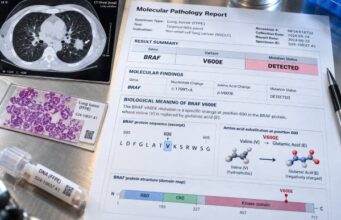
    Understand BRAF mutation testing in melanoma, colorectal, thyroid, and lung cancer, including V600E results, testing methods, targeted therapy, and negative-test limitations.

    BRAF Mutation Test: Melanoma, Colon, Thyroid, Lung Cancer, and Results

    Understand BRCA1 and BRCA2 genetic testing, cancer risks, positive, negative, and VUS results, screening, preventive surgery, treatment options, and family testing.

    BRCA1 and BRCA2 Genetic Test: Cancer Risk, Mutations, and Results

    Understand CALR mutation testing for high platelets, essential thrombocythemia, and primary myelofibrosis, including type 1 and type 2 results, prognosis, and follow-up.

    CALR Mutation Test: Myeloproliferative Neoplasm, Platelets, and Results

    Understand the CCND1/IGH fusion test for mantle cell lymphoma, including t(11;14), FISH results, cyclin D1 and SOX11 findings, prognosis, and diagnostic limits.

    CCND1/IGH Fusion Test: Mantle Cell Lymphoma and Results

    Understand CDH1 genetic testing, diffuse gastric and lobular breast cancer risks, positive and VUS results, expert endoscopy, preventive gastrectomy, and family testing.

    CDH1 Genetic Test: Hereditary Diffuse Gastric Cancer Risk and Results

    Understand CEBPA mutation testing in AML, including in-frame bZIP results, favorable-risk classification, germline familial leukemia, treatment, MRD, and test limitations.

    CEBPA Mutation Test: AML Prognosis, Leukemia Genetics, and Results

    Understand CHEK2 genetic test results, variant-specific breast cancer risk, changing colon guidance, prostate screening, inheritance, family testing, and next steps.

    CHEK2 Genetic Test: Breast, Colon, Prostate Cancer Risk, and Results

    Understand ctDNA test results for liquid biopsy profiling, targeted therapy, treatment response, molecular residual disease, recurrence risk, false negatives, and follow-up.

    Circulating Tumor DNA (ctDNA) Test: Cancer Monitoring, Mutations, and Results

    Understand comprehensive genomic profiling results, tissue and liquid testing, actionable mutations, MSI, TMB, possible germline findings, limitations, and treatment matches.

    Comprehensive Genomic Profiling Test: Cancer Genes, Mutations, and Results

    Understand DICER1 genetic test results, pleuropulmonary blastoma and other tumor risks, mosaicism, childhood and adult surveillance, inheritance, and family testing.

    DICER1 Genetic Test: Tumor Predisposition, Cancer Risk, and Results

    Learn how a DNMT3A mutation test is used in AML and clonal hematopoiesis, what variant allele frequency means, and how positive, negative, and persistent results are interpreted.

    DNMT3A Mutation Test: AML, Clonal Hematopoiesis, and Results

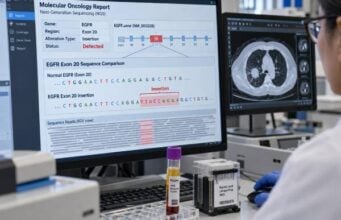
    Understand EGFR mutation testing for lung cancer, including tissue and plasma methods, exon 19, L858R and exon 20 results, targeted therapy meaning, resistance, and next steps.

    EGFR Mutation Test: Lung Cancer, Targeted Therapy, and Results

    Learn how EPCAM deletion testing identifies a cause of Lynch syndrome, why deletion analysis matters, what positive and negative results mean, and how findings affect colon cancer surveillance and family testing.

    EPCAM Deletion Test: Lynch Syndrome, Colon Cancer Risk, and Results

    Learn when ESR1 mutation testing is used in metastatic breast cancer, how plasma and tissue results are interpreted, and how activating variants can guide treatment after hormone therapy resistance.

    ESR1 Mutation Test: Breast Cancer, Hormone Therapy Resistance, and Results

    Learn how FGFR2 and FGFR3 genetic testing detects cancer mutations and fusions, what positive or negative results mean, and how findings may guide targeted therapy.

    FGFR2 and FGFR3 Genetic Test: Cancer Mutations, Fusions, and Results

    Understand FH genetic testing for hereditary leiomyomatosis and renal cell cancer, including who should test, result meanings, kidney surveillance, and family risk.

    FH Genetic Test: Hereditary Leiomyomatosis, Renal Cell Cancer, and Results

    Learn what FLCN genetic testing shows for Birt-Hogg-Dubé syndrome, including kidney cancer surveillance, lung cyst risks, result meanings, and family testing.

    FLCN Genetic Test: Birt-Hogg-Dube Syndrome, Kidney Cancer, and Results

    Learn how the FLT3 mutation test guides AML risk assessment, targeted treatment, transplant planning, relapse testing, and interpretation of ITD and TKD results.

    FLT3 Mutation Test: AML, Leukemia Risk, and Treatment Results

    1...313233...74Page 32 of 74
    • Disclaimer
    • Privacy Policy
    • About Us
    © 2026 Vita Library. All rights reserved.
    Contact us: contact@vitalibrary.com