• Home
  • Health Topics
  • Human Body
  • Diagnostics
  • Conditions
  • Treatments
  • Foods
  • Herbs
  • Supplements
  • Weight Loss
  • Longevity
Search
VitaLibrary
  • Home
  • Health Topics
  • Human Body
  • Diagnostics
  • Conditions
  • Treatments
  • Foods
  • Herbs
  • Supplements
  • Weight Loss
  • Longevity
  • Blood Tests and Blood Biomarkers
  • Brain, Cognitive, and Mental Health Tests and Diagnostics
  • Genetic and Molecular Biomarkers
  • Hormone Tests
  • Inflammation and Immune Markers
  • Tumor Markers
  • Urine Tests and Kidney Markers
    Latest
    • Latest
    • Featured posts
    • Most popular
    • 7 days popular
    • By review score
    • Random
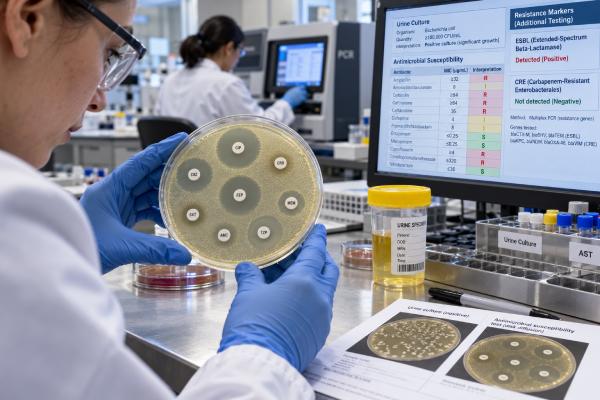
    Learn how antibiotic-resistant UTI testing identifies ESBL, CRE, resistance genes, and antibiotic susceptibility, and how culture results guide treatment and follow-up.

    Antibiotic-Resistant UTI Test: ESBL, CRE, Resistance Markers, and Culture Meaning

    Learn what asymptomatic bacteriuria means, how a positive urine culture without UTI symptoms is interpreted, and when screening, treatment, or follow-up matters.

    Asymptomatic Bacteriuria Test: Positive Culture Without Symptoms and When It Matters

    Learn how bacteria in urine are interpreted using urinalysis, culture, colony count, symptoms, and sample quality, including when contamination or follow-up testing matters.

    Bacteria in Urine Test: UTI, Contamination, Colony Count, and Culture Follow-Up

    Learn how a catheter urine culture helps diagnose catheter-associated UTI, how samples are collected, and what colony counts, pyuria, resistance, and positive results mean.

    Catheter Urine Culture Test: Catheter-Associated UTI and Culture Meaning

    Learn how a chlamydia and gonorrhea urine NAAT works, how to collect first-catch urine, what positive or negative results mean, and when follow-up testing is needed.

    Chlamydia and Gonorrhea Urine NAAT Test: STI Screening, Positive Result, and Meaning

    Learn how to collect a clean-catch urine culture, reduce contamination, handle the sample correctly, and understand mixed flora, colony counts, repeat testing, and accurate results.

    Clean-Catch Urine Culture Test: Sample Collection, Contamination, and Accurate Results

    Diagnostics

    Home Diagnostics Page 23
    Learn how lung cancer resistance mutation panels detect EGFR, ALK, ROS1, MET, and other resistance mechanisms, how blood and tissue testing differ, and what positive or negative results mean.

    Lung Cancer Resistance Mutation Panel: EGFR, ALK, ROS1, MET, and Resistance...

    Learn how MET amplification testing measures lung cancer copy-number gain, how FISH and NGS results differ, why MET can cause EGFR resistance, and what positive or negative results may mean.

    MET Amplification Test for Lung Cancer: Copy Number Gain, Resistance Marker,...

    Learn what MET exon 14 skipping means in lung cancer, how DNA and RNA tests detect it, how positive and negative results are interpreted, and why METex14 can guide targeted NSCLC treatment.

    MET Exon 14 Skipping Test for Lung Cancer: Splice Alteration, Mutation...

    Learn how lung cancer MRD ctDNA testing detects molecular residual disease, what positive and negative results mean, how it can precede recurrence on scans, and why treatment decisions still require clinical context.

    Minimal Residual Disease ctDNA Test for Lung Cancer: Recurrence Monitoring, MRD,...

    Learn what MSI testing means in lung cancer, how MSI-H, MSS, dMMR, and pMMR results differ, how NGS, PCR, and IHC are used, and why this rare biomarker can matter for immunotherapy and hereditary evaluation.

    MSI Test for Lung Cancer: Microsatellite Instability, Mismatch Repair, and Result...

    Learn how Napsin A IHC supports lung adenocarcinoma diagnosis, what positive granular cytoplasmic staining means, why negative results do not exclude lung cancer, and when other tumor origins must be considered.

    Napsin A IHC Test for Lung Cancer: Adenocarcinoma Marker, Tumor Origin,...

    Understand NSCLC biomarker testing for driver mutations, gene fusions, PD-L1 TPS, molecular profiling, liquid biopsy, negative results, resistance testing, and treatment-related next steps.

    Non-Small Cell Lung Cancer Biomarker Test: Driver Mutations, PD-L1, and Molecular...

    Learn what an NSE blood test means in small cell lung cancer, why levels can be high, how hemolysis causes false elevations, and how serial NSE trends may support treatment and recurrence monitoring.

    NSE Test for Lung Cancer: Small Cell Lung Cancer Marker, High...

    Understand NTRK fusion testing in lung cancer, including tumor-agnostic meaning, RNA NGS, pan-TRK IHC, positive results, negative-result limits, and next steps.

    NTRK Fusion Test for Lung Cancer: Gene Fusion, Tumor-Agnostic Marker, and...

    Learn how p40 IHC helps classify lung squamous cell carcinoma, what positive nuclear staining means, how p40 compares with p63 and TTF-1, and its key limitations.

    p40 IHC Test for Lung Cancer: Squamous Cell Marker, Tumor Classification,...

    Understand the PD-L1 test for lung cancer, including TPS score ranges, protein-expression meaning, assay differences, result limits, and how PD-L1 guides NSCLC treatment.

    PD-L1 Test for Lung Cancer: TPS Score, Protein Expression, and Result...

    Understand the ProGRP test for lung cancer, including SCLC marker ranges, kidney effects, tumor-burden trends, treatment monitoring, NSE comparison, and result meaning.

    ProGRP Test for Lung Cancer: Small Cell Lung Cancer Marker, Tumor...

    Understand RET fusion testing in lung cancer, including positive-result meaning, KIF5B and CCDC6 partners, RNA NGS versus FISH, negative-result limits, and next steps.

    RET Fusion Test for Lung Cancer: Gene Fusion, Positive Result, and...

    Understand ROS1 fusion testing in lung cancer, including what a positive result means, RNA NGS versus FISH, negative-result limits, and molecular significance.

    ROS1 Fusion Test for Lung Cancer: Gene Fusion, Positive Result, and...

    Understand the SCC antigen test for lung cancer, including normal-range limits, causes of high results, squamous cell carcinoma relevance, and monitoring use.

    SCC Antigen Test for Lung Cancer: Squamous Cell Carcinoma Marker and...

    Understand how ProGRP, NSE, and DLL3 biomarkers are used in small cell lung cancer, including blood-test trends, DLL3 expression, monitoring limits, and result interpretation.

    Small Cell Lung Cancer Biomarker Panel: ProGRP, NSE, DLL3, and Disease...

    1...222324...137Page 23 of 137
    • Disclaimer
    • Privacy Policy
    • About Us
    © 2026 Vita Library. All rights reserved.
    Contact us: contact@vitalibrary.com