• Home
  • Health Topics
  • Human Body
  • Diagnostics
  • Conditions
  • Treatments
  • Foods
  • Herbs
  • Supplements
  • Weight Loss
  • Longevity
Search
VitaLibrary
  • Home
  • Health Topics
  • Human Body
  • Diagnostics
  • Conditions
  • Treatments
  • Foods
  • Herbs
  • Supplements
  • Weight Loss
  • Longevity
  • Blood Tests and Blood Biomarkers
  • Brain, Cognitive, and Mental Health Tests and Diagnostics
  • Genetic and Molecular Biomarkers
  • Hormone Tests
    Latest
    • Latest
    • Featured posts
    • Most popular
    • 7 days popular
    • By review score
    • Random
    Understand the 1-mg low-dose dexamethasone suppression test, the common cortisol cutoff of 1.8 mcg/dL, causes of nonsuppression, and the follow-up used for Cushing screening.

    Low-Dose Dexamethasone Suppression Test: Cushing Syndrome Screening and Results

    Learn how an 8–9 a.m. cortisol test screens for adrenal insufficiency, what low and intermediate results mean, how ACTH helps identify the cause, and when stimulation testing is needed.

    Morning Cortisol Test: Low Levels, Adrenal Insufficiency, and Results

    Learn how a pheochromocytoma and paraganglioma panel uses plasma or urine metanephrines, normetanephrine, catecholamines, and controlled collection to interpret abnormal results.

    Pheochromocytoma and Paraganglioma Test Panel: Metanephrines, Normetanephrine, Catecholamines, and Results

    Learn what plasma epinephrine, norepinephrine, and dopamine results mean, why collection posture matters, common causes of high values, and when metanephrine testing is preferred.

    Plasma Catecholamines Test: Epinephrine, Norepinephrine, Dopamine, and Results

    Learn how plasma free metanephrine and normetanephrine testing screens for pheochromocytoma and paraganglioma, why supine rest matters, and how high or borderline results are evaluated.

    Plasma Free Metanephrines Test: Pheochromocytoma and Paraganglioma Screening, High Levels, and Results

    Learn what a high plasma normetanephrine result means, why supine rest matters, common false-positive causes, when clonidine testing is used, and how PPGL evaluation proceeds.

    Plasma Normetanephrine Test: High Levels, Pheochromocytoma Screening, and Results

    Diagnostics

    Home Diagnostics Page 7
    Karyotype testing counts chromosomes and detects large structural changes; understand balanced rearrangements, mosaicism, notation, limitations, and next steps.

    Karyotype Test: Chromosome Number, Structure, and Results

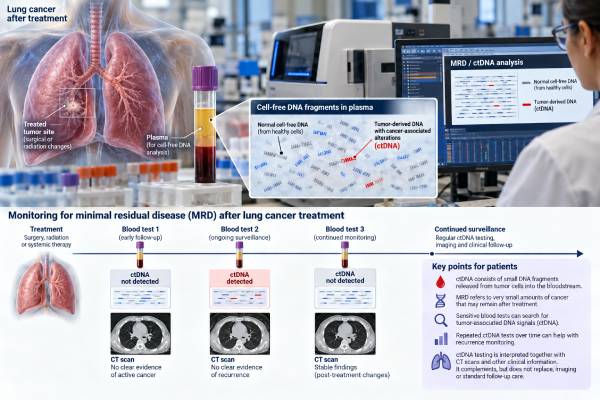
    Liquid biopsy testing analyzes circulating tumor DNA for cancer mutations, treatment targets, resistance, and residual disease; learn how positive and negative results differ.

    Liquid Biopsy Test: Circulating Tumor DNA, Cancer Mutations, and Results

    Loss of heterozygosity testing identifies locus-specific or genome-wide allelic loss in tumors; learn about copy-neutral LOH, HRD scores, limitations, and results.

    Loss of Heterozygosity (LOH) Test: Tumor Genetics and Results

    Methylation genetic testing detects imprinting abnormalities, constitutional episignatures, and cancer profiles; learn how methods, mosaicism, and result types differ.

    Methylation Genetic Test: Imprinting Disorders, Cancer, and Results

    Microsatellite instability testing evaluates mismatch repair in tumors for treatment and Lynch syndrome screening; learn about MSI-high, MSS, IHC, and follow-up.

    Microsatellite Instability (MSI) Test: DNA Repair, Cancer Risk, and Results

    Mitochondrial DNA sequencing detects mtDNA variants and heteroplasmy; learn how tissue choice, maternal inheritance, deletions, VUS findings, and negative results affect interpretation.

    Mitochondrial DNA Sequencing Test: mtDNA Mutations and Results

    Multigene panel testing analyzes inherited disease and cancer genes together; learn how panel selection, coverage, pathogenic variants, VUS findings, and negative results are interpreted.

    Multigene Panel Test: Inherited Disease Genes, Cancer Genes, and Results

    MLPA testing detects targeted gene deletions and duplications; learn how the assay works, how results are interpreted, why findings need confirmation, and what a negative result means.

    Multiplex Ligation-Dependent Probe Amplification (MLPA) Test: Gene Deletions, Duplications, and Results

    Understand how next-generation sequencing tests analyze gene panels, exomes, and genomes, what pathogenic, negative, and VUS results mean, and where NGS can miss variants.

    Next-Generation Sequencing (NGS) Test: Gene Panels, Variants, and Results

    Learn how PCR tests amplify DNA or RNA, what positive, negative, Ct, and invalid results mean, and why sample quality, timing, and assay design affect accuracy.

    Polymerase Chain Reaction (PCR) Test: DNA Amplification, Variants, and Results

    Understand how real-time PCR detects genetic variants and viral DNA, how Ct, Cq, and viral-load values are interpreted, and why assay design and sample quality affect results.

    Real-Time PCR (qPCR) Test: Genetic Variants, Viral DNA, and Results

    Learn how CAG, CGG, CTG, and other repeat expansion tests work, how repeat counts are classified, and what positive, intermediate, premutation, and negative results mean.

    Repeat Expansion Test: CAG, CGG, CTG Repeats, and Results

    Understand how RNA expression panels measure tumor gene activity, create recurrence or risk scores, and guide selected cancer-treatment decisions while accounting for sample quality and limitations.

    RNA Expression Panel Test: Gene Activity, Cancer Risk, and Results

    Sanger sequencing reads targeted gene regions to find or confirm small DNA variants. Understand chromatograms, result categories, limitations, and follow-up testing.

    Sanger Sequencing Test: Single-Gene Variants and Results

    Single-gene sequencing searches one selected gene for DNA variants. Learn when focused testing is useful, what results mean, what may be missed, and next steps.

    Single-Gene Sequencing Test: DNA Variants, Diagnosis, and Results

    SNP genotyping tests selected DNA markers for traits, medication response, and disease risk. Learn how genotypes and polygenic scores work, their limits, and follow-up.

    SNP Genotyping Test: DNA Variants, Risk Markers, and Results

    Structural variant tests detect inversions, translocations, and complex chromosome changes. Learn which methods find balanced and unbalanced events and what results mean.

    Structural Variant Genetic Test: Inversions, Translocations, and Results

    Targeted variant testing checks relatives for a known family mutation. Learn who should test, what positive and true-negative results mean, and how to follow up.

    Targeted Variant Test: Known Mutation, Family Testing, and Results

    Genetic variant classification labels findings as pathogenic, likely pathogenic, VUS, likely benign, or benign. Learn the evidence behind each category and reclassification.

    Variant Classification in Genetic Testing: Pathogenic, Benign, VUS, and Results

    Whole-exome sequencing examines most coding DNA for rare disease variants. Learn how WES works, what trio results mean, what it can miss, and when reanalysis helps.

    Whole-Exome Sequencing (WES) Method: Coding DNA, Variants, and Results

    1...678...57Page 7 of 57
    • Disclaimer
    • Privacy Policy
    • About Us
    © 2026 Vita Library. All rights reserved.
    Contact us: contact@vitalibrary.com